Soledad O’Brien
Soledad O'Brien addresses University of Delaware's class of 2012 with humor about graduates returning home and persistent alumni associations before turning to her family history. She recounts how her interracial parents married when such unions were illegal and ignored advice that they couldn't succeed, framing her career as a reporter who tells the stories of ordinary people to reveal a shared humanity. She urges graduates to listen to others, reject discouraging advice, and refuse neutrality in times of moral crisis.
Key moments
- 01 Joking about the boomerang generation and the relentless Alumni Association
- 02 Telling the story of her interracial parents marrying when it was illegal
- 03 Describing her documentary work giving voice to overlooked communities
- 04 Sharing the starfish story from a missionary in Haiti and urging graduates not to remain neutral
Save the visual map
Download or open the generated poster as a standalone PNG.
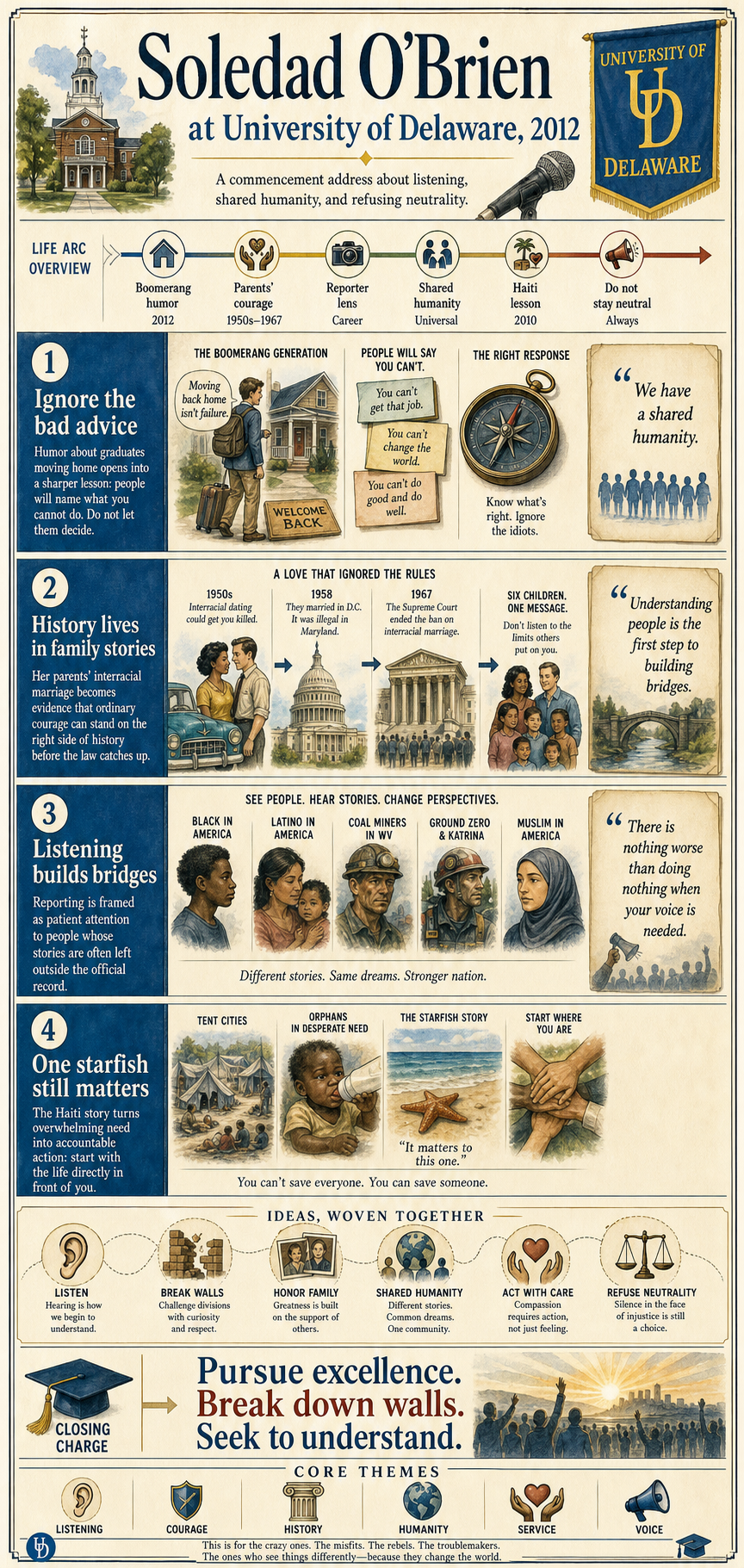
Soledad O'Brien at University of Delaware, 2012
A University of Delaware address about story, identity, shared humanity, curiosity, accountability, and refusing neutrality when a voice is needed.
Speech arc
- 01University of Delaware
Opening move
- 02Class of 2012
Speech beat
- 03Immigrant family story
Speech beat
- 04Ignore bad advice
Speech beat
- 05Tell unheard stories
Speech beat
- 06Break down walls
Speech beat
- 07Pick up the starfish
Speech beat
- 08Do not stay neutral
Final charge
Belonging: Graduation stretches family, school, and identity
O'Brien opens with humor about parents, alumni, and the boomerang generation before turning toward the deeper question of what graduates owe one another.
Family
Parents, siblings, grandparents, and fans are treated as part of the achievement on stage.
Alma mater
The university remains part of graduates' lives rather than a place they simply leave behind.
Frame
The speech resists tidy advice and instead builds around stories that reveal obligations.
O'Brien opens with humor about parents, alumni, and the boomerang generation before turning toward the deeper question of what graduates owe one another.
Story: Unheard lives can widen the national imagination
Her journalism becomes a model for graduates: ask hard questions, listen past labels, and give attention to people who may never appear in history books.
Origin
O'Brien connects her work to her parents' experience and her mother's belief that America is greater than exclusion.
Subjects
Documentaries about Black, Latino, Muslim, coal mining, rescue, Katrina, and Haiti stories become examples of public listening.
Purpose
The point is not fame but helping people understand lives, choices, dreams, fears, and hopes.
Her journalism becomes a model for graduates: ask hard questions, listen past labels, and give attention to people who may never appear in history books.
Bridge: Difference should become a bridge, not a wall
O'Brien argues that identity and heritage matter because honest stories can reveal common dreams and reduce the distance between communities.
Common ground
Political labels, race, gender, class, and religion do not erase shared humanity.
Curiosity
Graduates are urged to seek to know people they do not understand and people they think they already understand.
Nation
The address links American strength to what binds people in spite of difference.
O'Brien argues that identity and heritage matter because honest stories can reveal common dreams and reduce the distance between communities.
• Key takeaways •
Stories can dismantle walls
Connects to journalism.
Curiosity is a civic practice
Connects to storytelling.
Identity can build bridges
Connects to identity.
Small acts still matter
Connects to shared humanity.
Neutrality fails when a voice is needed
Connects to moral courage.
Closing charge
The starfish story gives the speech its practical method: the whole beach may be too large, but one act can matter and can invite others into motion.
Progress starts with the person in front of you
Scale
O'Brien does not deny large problems; she rejects paralysis in the face of them.
Voice
Dante's warning becomes a charge against neutrality when moral stakes are high.
Result
Life satisfaction is tied to curiosity, accountability, and improving the world for others.
The starfish story gives the speech its practical method: the whole beach may be too large, but one act can matter and can invite others into motion.
Visual speech maps
Browse more visual maps from University of Delaware or continue with related mapped speeches below.
Transcript
The full transcript is hosted by the original publisher. Commencement Archive links to the source rather than republishing copyrighted text.
Read the full transcript at source →Provenance
Imported from Open Commencement DB
Open Commencement DB transcript; not independently verified against the original recording
Explore this speech
Find the next thread through the archive
Themes in this address
Speeches like this one
Search all speeches ->