Dennis Lehane
Field: letters
Dennis Lehane, a college dropout who returned to receive an honorary degree, reflects on his own unconventional path and rejects clichéd graduation advice. He argues that honor is a daily practice of treating all living things with dignity, and distinguishes empathy from sympathy, crediting his working-class parents and public education for his success. He criticizes those who dismiss mercy and the helping hand as weakness, and urges graduates to carry compassion and empathy into the world.
Key moments
- 01 Recounts his own experience dropping out of UMass and humble origins
- 02 Defines honor as a day-to-day question of behaving with dignity toward all living things
- 03 Distinguishes empathy from sympathy, illustrated by a story about his father in traffic
- 04 Argues public education is a form of welfare and rejects the self-made man myth
- 05 Calls lack of empathy 'unamerican' and urges graduates to keep their compassion
Save the visual map
Download or open the generated poster as a standalone PNG.
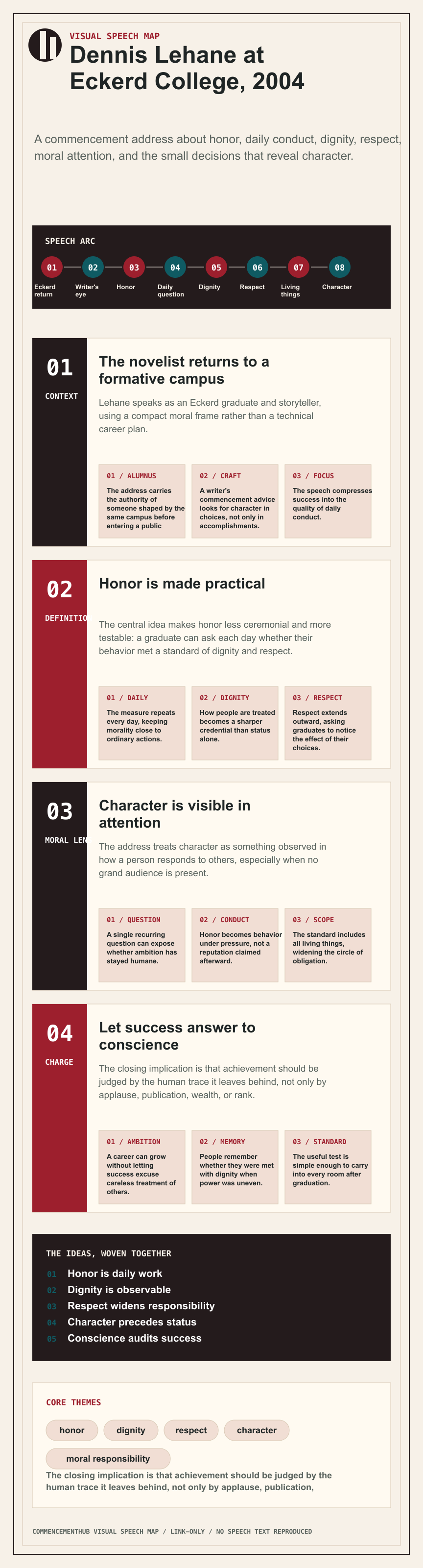
Dennis Lehane at Eckerd College, 2004
A commencement address about honor, daily conduct, dignity, respect, moral attention, and the small decisions that reveal character.
Speech arc
- 01Eckerd return
Opening move
- 02Writer's eye
Speech beat
- 03Honor
Speech beat
- 04Daily question
Speech beat
- 05Dignity
Speech beat
- 06Respect
Speech beat
- 07Living things
Speech beat
- 08Character
Final charge
Context: The novelist returns to a formative campus
Lehane speaks as an Eckerd graduate and storyteller, using a compact moral frame rather than a technical career plan.
Alumnus
The address carries the authority of someone shaped by the same campus before entering a public creative life.
Craft
A writer's commencement advice looks for character in choices, not only in accomplishments.
Focus
The speech compresses success into the quality of daily conduct.
Lehane speaks as an Eckerd graduate and storyteller, using a compact moral frame rather than a technical career plan.
Definition: Honor is made practical
The central idea makes honor less ceremonial and more testable: a graduate can ask each day whether their behavior met a standard of dignity and respect.
Daily
The measure repeats every day, keeping morality close to ordinary actions.
Dignity
How people are treated becomes a sharper credential than status alone.
Respect
Respect extends outward, asking graduates to notice the effect of their choices.
The central idea makes honor less ceremonial and more testable: a graduate can ask each day whether their behavior met a standard of dignity and respect.
Moral lens: Character is visible in attention
The address treats character as something observed in how a person responds to others, especially when no grand audience is present.
Question
A single recurring question can expose whether ambition has stayed humane.
Conduct
Honor becomes behavior under pressure, not a reputation claimed afterward.
Scope
The standard includes all living things, widening the circle of obligation.
The address treats character as something observed in how a person responds to others, especially when no grand audience is present.
• Key takeaways •
Honor is daily work
Connects to honor.
Dignity is observable
Connects to dignity.
Respect widens responsibility
Connects to respect.
Character precedes status
Connects to character.
Conscience audits success
Connects to moral responsibility.
Closing charge
The closing implication is that achievement should be judged by the human trace it leaves behind, not only by applause, publication, wealth, or rank.
Let success answer to conscience
Ambition
A career can grow without letting success excuse careless treatment of others.
Memory
People remember whether they were met with dignity when power was uneven.
Standard
The useful test is simple enough to carry into every room after graduation.
The closing implication is that achievement should be judged by the human trace it leaves behind, not only by applause, publication, wealth, or rank.
Visual speech maps
Browse more visual maps from Eckerd College or continue with related mapped speeches below.
Transcript
The previously catalogued transcript link is no longer live and is queued for re-sourcing. A video of the address is available above.
Machine transcript available for archive analysis; it is unverified and may contain transcription errors. Machine transcript source ->
Provenance
BROKEN transcript link (checked 2026-06-26): returns 404 Not Found. Provenance: Imported from NPR commencement archive
NPR archive last updated in 2015; destination availability has not been exhaustively rechecked | Transcript URL dead (returns 404 Not Found); video fallback present
Explore this speech
Find the next thread through the archive
Themes in this address
Speeches like this one
Search all speeches ->