John McCain
Field: politics
McCain congratulates graduates and their parents, then reflects on his own youthful arrogance and the value of debate in a free society. He defends his support for the Iraq War while affirming the right and duty of Americans to argue over such issues, and argues that human rights are God-given and universal, citing genocide in Darfur and Rwanda. He closes by recounting his friendship with David Ifshin, a former Vietnam War critic, to illustrate that political opponents are countrymen, not enemies.
Key moments
- 01 Reflection on his youthful self-assurance and the humility gained with age
- 02 Defense of his support for the Iraq War alongside respect for dissent
- 03 Argument that human rights are universal and God-given, citing Darfur and Rwanda
- 04 Story of reconciliation with antiwar activist David Ifshin
Save the visual map
Download or open the generated poster as a standalone PNG.
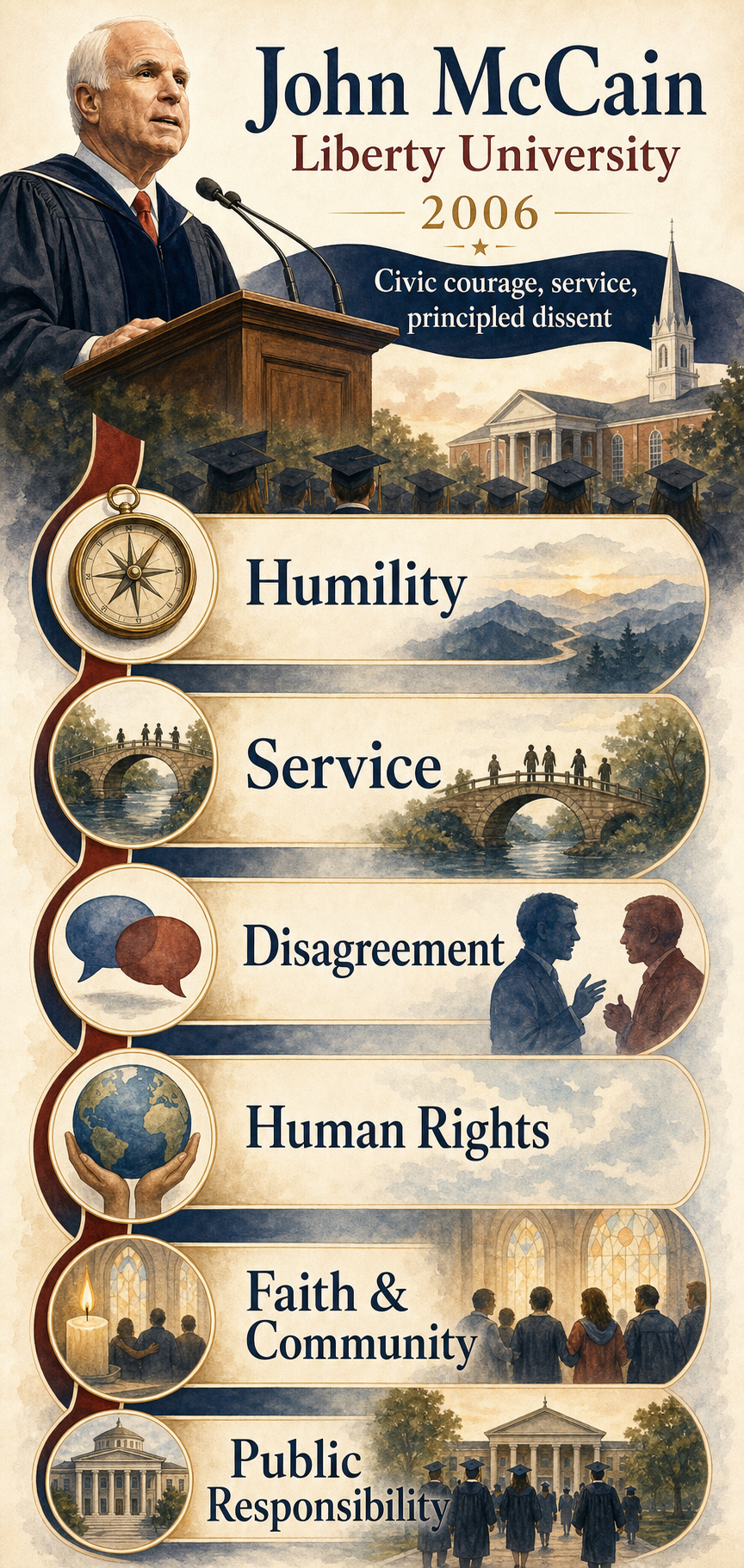
John McCain at Liberty University, 2006
A Liberty University address about humility, principled disagreement, patriotic service, universal human rights, and reconciliation across bitter divides.
Speech arc
- 01Liberty University
Opening move
- 02Public service
Speech beat
- 03Humility with age
Speech beat
- 04Iraq debate
Speech beat
- 05Civil disagreement
Speech beat
- 06Human rights
Speech beat
- 07Darfur and Rwanda
Speech beat
- 08David Ifshin story
Final charge
Humility: Age complicates certainty
McCain begins with congratulations, then looks back at youthful arrogance to make humility a condition of credible public judgment.
Self-critique
The speech admits that confidence can outrun wisdom.
Experience
Service teaches limits, debts, and second thoughts.
Respect
Parents and graduates are placed inside a larger civic story.
McCain begins with congratulations, then looks back at youthful arrogance to make humility a condition of credible public judgment.
Dispute: Argument belongs inside a free society
He defends his support for the Iraq War while insisting that dissent is not betrayal and that citizens owe one another serious disagreement.
War
The address does not evade the divisive issue in the room.
Dissent
Opposition is framed as a right and sometimes a duty.
Countrymen
Political opponents remain members of the same republic.
He defends his support for the Iraq War while insisting that dissent is not betrayal and that citizens owe one another serious disagreement.
Rights: Human dignity is not a local privilege
The speech widens from American argument to universal human rights, invoking atrocities in Darfur and Rwanda as tests of moral seriousness.
Universal
Rights are treated as God-given, not granted by governments.
Memory
Genocide becomes a warning against comfortable indifference.
Duty
Power carries obligations beyond national self-interest.
The speech widens from American argument to universal human rights, invoking atrocities in Darfur and Rwanda as tests of moral seriousness.
• Key takeaways •
Humility strengthens public judgment
Connects to public service.
Dissent can be patriotic
Connects to civil discourse.
Human rights are universal claims
Connects to human rights.
Service enlarges identity
Connects to patriotism.
Reconciliation is civic work
Connects to reconciliation.
Closing charge
The David Ifshin story gives the address its human proof: a Vietnam-era adversary apologizes, McCain accepts, and shared country outlasts bitterness.
An old enemy can become a friend
Ifshin
The personal story turns civility into a lived discipline.
Forgiveness
Reconciliation does not require pretending harm never happened.
Service
Public life is measured by loyalty to something larger than pride.
The David Ifshin story gives the address its human proof: a Vietnam-era adversary apologizes, McCain accepts, and shared country outlasts bitterness.
Visual speech maps
Browse more visual maps from Liberty University or continue with related mapped speeches below.
Transcript
The full transcript is hosted by the original publisher. Commencement Archive links to the source rather than republishing copyrighted text.
Read the full transcript at source →Provenance
Imported from NPR commencement archive; cross-referenced with Open Commencement DB
NPR archive last updated in 2015; destination availability has not been exhaustively rechecked | Open Commencement DB transcript; not independently verified against the original recording
Explore this speech
Find the next thread through the archive
Themes in this address
Speeches like this one
Search all speeches ->