Chuck Norris
Field: arts
Chuck Norris recounts his personal life story, describing his impoverished childhood in Oklahoma, his shy and non-athletic youth, and how his mother's Christian faith shaped him. He traces his journey through the Air Force, his discovery of martial arts in Korea, his rise as a tournament champion, and his eventual transition toward acting after his martial arts schools went bankrupt. Throughout, he credits God and faith as instrumental in guiding his path and overcoming personal insecurity.
Key moments
- 01 Growing up poor in Oklahoma with a devout Christian mother and an alcoholic father
- 02 Overcoming lifelong shyness during his first martial arts demonstration speech
- 03 Rising from tournament losses to winning local, state, national, and world championships
- 04 Meeting Bruce Lee and later transitioning to acting after his schools went bankrupt
Save the visual map
Download or open the generated poster as a standalone PNG.
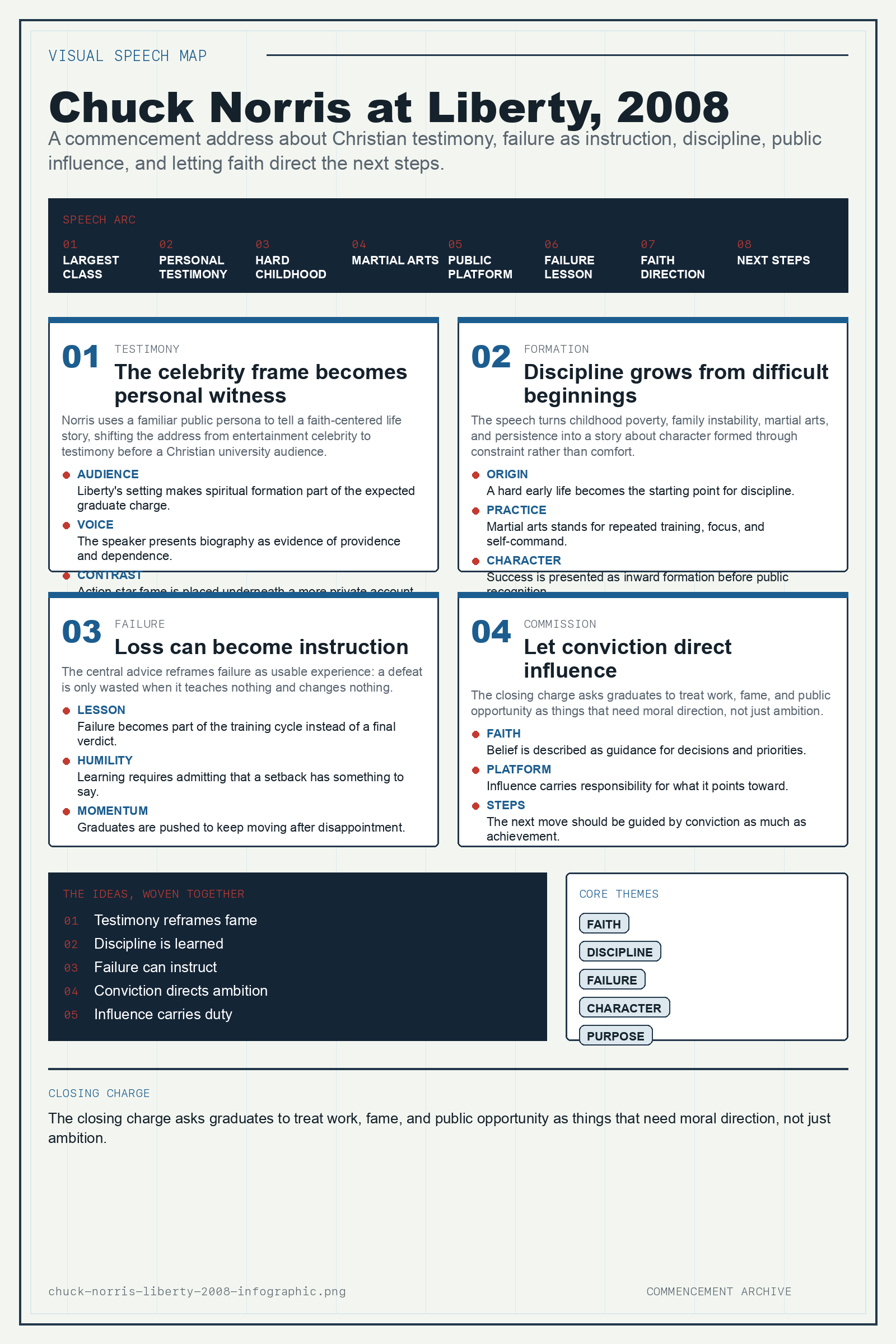
Chuck Norris at Liberty, 2008
A commencement address about Christian testimony, failure as instruction, discipline, public influence, and letting faith direct the next steps.
Speech arc
- 01Largest class
Opening move
- 02Personal testimony
Speech beat
- 03Hard childhood
Speech beat
- 04Martial arts
Speech beat
- 05Public platform
Speech beat
- 06Failure lesson
Speech beat
- 07Faith direction
Speech beat
- 08Next steps
Final charge
Testimony: The celebrity frame becomes personal witness
Norris uses a familiar public persona to tell a faith-centered life story, shifting the address from entertainment celebrity to testimony before a Christian university audience.
Audience
Liberty's setting makes spiritual formation part of the expected graduate charge.
Voice
The speaker presents biography as evidence of providence and dependence.
Contrast
Action-star fame is placed underneath a more private account of belief.
Norris uses a familiar public persona to tell a faith-centered life story, shifting the address from entertainment celebrity to testimony before a Christian university audience.
Formation: Discipline grows from difficult beginnings
The speech turns childhood poverty, family instability, martial arts, and persistence into a story about character formed through constraint rather than comfort.
Origin
A hard early life becomes the starting point for discipline.
Practice
Martial arts stands for repeated training, focus, and self-command.
Character
Success is presented as inward formation before public recognition.
The speech turns childhood poverty, family instability, martial arts, and persistence into a story about character formed through constraint rather than comfort.
Failure: Loss can become instruction
The central advice reframes failure as usable experience: a defeat is only wasted when it teaches nothing and changes nothing.
Lesson
Failure becomes part of the training cycle instead of a final verdict.
Humility
Learning requires admitting that a setback has something to say.
Momentum
Graduates are pushed to keep moving after disappointment.
The central advice reframes failure as usable experience: a defeat is only wasted when it teaches nothing and changes nothing.
• Key takeaways •
Testimony reframes fame
Connects to faith.
Discipline is learned
Connects to discipline.
Failure can instruct
Connects to failure.
Conviction directs ambition
Connects to character.
Influence carries duty
Connects to purpose.
Closing charge
The closing charge asks graduates to treat work, fame, and public opportunity as things that need moral direction, not just ambition.
Let conviction direct influence
Faith
Belief is described as guidance for decisions and priorities.
Platform
Influence carries responsibility for what it points toward.
Steps
The next move should be guided by conviction as much as achievement.
The closing charge asks graduates to treat work, fame, and public opportunity as things that need moral direction, not just ambition.
Visual speech maps
Browse more visual maps from Liberty University or continue with related mapped speeches below.
Transcript
The previously catalogued transcript link is no longer live and is queued for re-sourcing. A video of the address is available above.
Machine transcript available for archive analysis; it is unverified and may contain transcription errors.
Provenance
BROKEN transcript link (checked 2026-06-26): gradspeeches.com is a parked/redirecting domain serving no real content. Provenance: Imported from NPR commencement archive; cross-referenced with Open Commencement DB
NPR archive last updated in 2015; destination availability has not been exhaustively rechecked | Open Commencement DB transcript; not independently verified against the original recording | Transcript URL dead (gradspeeches.com is a parked/redirecting domain serving no real content); video fallback present
Explore this speech
Find the next thread through the archive
Themes in this address
Speeches like this one
Search all speeches ->