John McEnroe
Tennis champion
John McEnroe addresses Stanford's Class of 2023, using tennis analogies and personal stories from his career and time as a Stanford student to reflect on success, failure, and well-being. He encourages graduates to pursue work/life balance, take care of their mental health, stand up for themselves, and not define themselves solely by professional accomplishments. He emphasizes that handling pressure, learning from failure, and measuring success by personal growth matter more than winning.
“Everyone wants a great career, but don't miss your life on the way to work.”
Key moments
- 01 Recalls his year at Stanford winning a singles title and the 1978 NCAA team championship under coach Dick Gould
- 02 Urges graduates to value work/life balance and not be defined by their careers
- 03 Discusses mental health, therapy, and the danger of trying to eliminate all stress and pain
- 04 Reflects on his 1980 Wimbledon loss to Björn Borg and Nelson Mandela hearing it from prison
- 05 Closes with the Kipling quote about meeting triumph and disaster as impostors
Save the visual map
Download or open the generated poster as a standalone PNG.
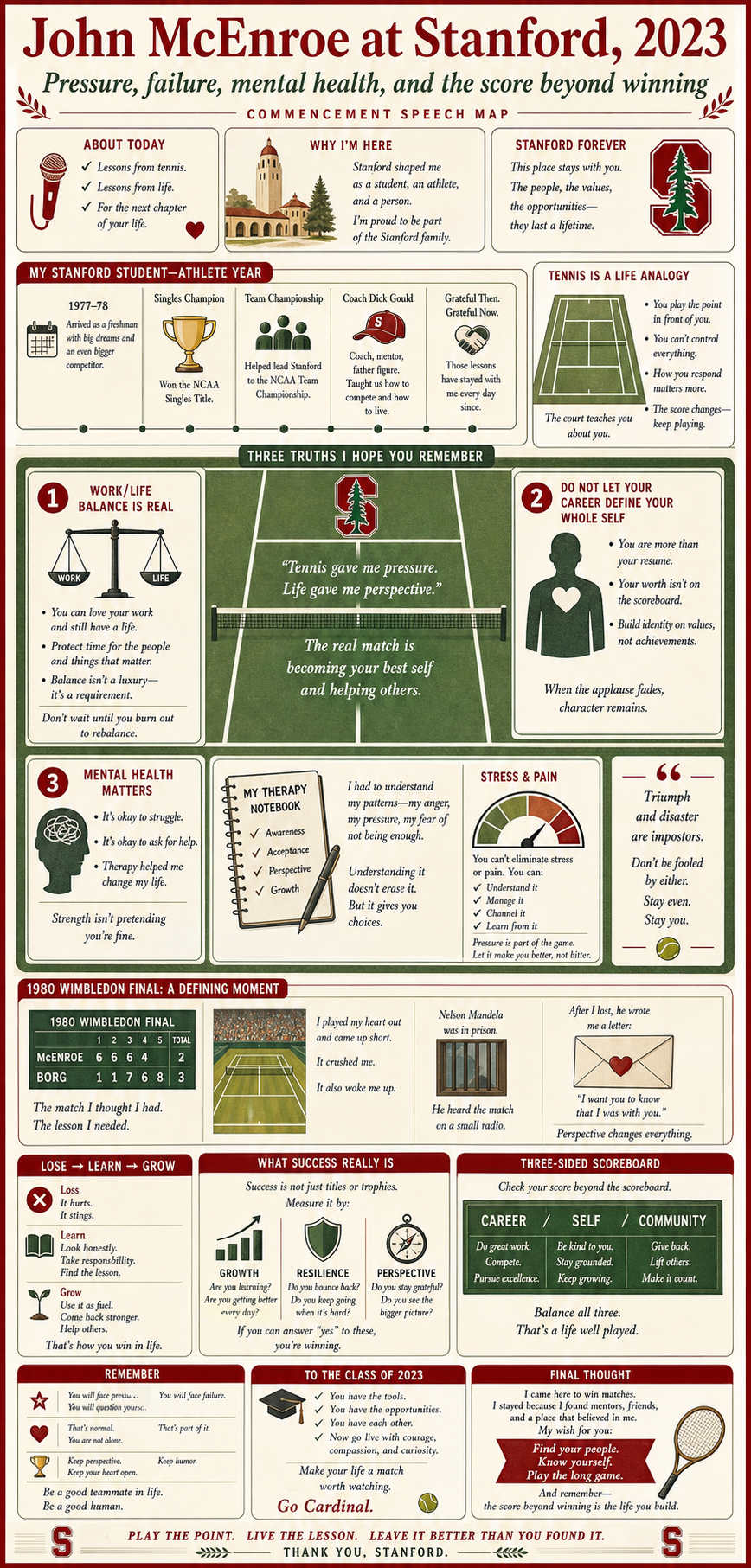
John McEnroe at Stanford, 2023
A commencement address about pressure, failure, mental health, and success beyond winning.
Speech arc
- 01Stanford tennis
Opening move
- 02NCAA title
Speech beat
- 03Pressure
Speech beat
- 04Balance
Speech beat
- 05Mental health
Speech beat
- 061980 loss
Speech beat
- 07Mandela story
Speech beat
- 08Growth over winning
Final charge
Court memory: Stanford as proving ground
McEnroe returns to his Stanford year as a place of achievement, teamwork, coaching, and identity formation.
Team
The NCAA championship becomes a memory of shared effort.
Coach
Dick Gould represents discipline and belief.
Start
The court becomes a map for choices beyond sport.
McEnroe returns to his Stanford year as a place of achievement, teamwork, coaching, and identity formation.
Pressure: Do not become only the score
The speech pushes back against defining a whole life by professional accomplishment or the scoreboard of winning.
Balance
Work matters, but it cannot be the entire self.
Mental health
Stress and pain need attention, not denial.
Perspective
The person is larger than the result.
The speech pushes back against defining a whole life by professional accomplishment or the scoreboard of winning.
Loss: Failure can teach
The famous Wimbledon loss becomes a story about perspective, humility, and how defeat can remain meaningful years later.
Wimbledon
A painful loss becomes a lasting lesson.
Mandela
A prison listener changes the scale of the story.
Resilience
Failure is not the opposite of growth; it is one route into it.
The famous Wimbledon loss becomes a story about perspective, humility, and how defeat can remain meaningful years later.
• Key takeaways •
The score is not the self
Connects to resilience.
Pressure needs care
Connects to mental health.
Failure keeps teaching
Connects to balance.
Balance is achievement
Connects to failure.
Growth is the deeper win
Connects to growth.
Closing charge
Graduates are encouraged to meet triumph and disaster with perspective and to define success by maturity, courage, and well-being.
Success as growth
Impostors
Victory and defeat can both distort the self.
Growth
The better measure is who pressure helps you become.
Charge
Stand up for yourself while staying whole.
Graduates are encouraged to meet triumph and disaster with perspective and to define success by maturity, courage, and well-being.
Visual speech maps
Browse more visual maps from Stanford University or continue with related mapped speeches below.
Transcript
The full transcript is hosted by the original publisher. Commencement Archive links to the source rather than republishing copyrighted text.
Read the full transcript at source →Provenance
Verified from official archive
Explore this speech
Find the next thread through the archive
Themes in this address
Speeches like this one
Search all speeches ->