Njabulo S. Ndebele
Save the visual map
Download or open the generated poster as a standalone PNG.
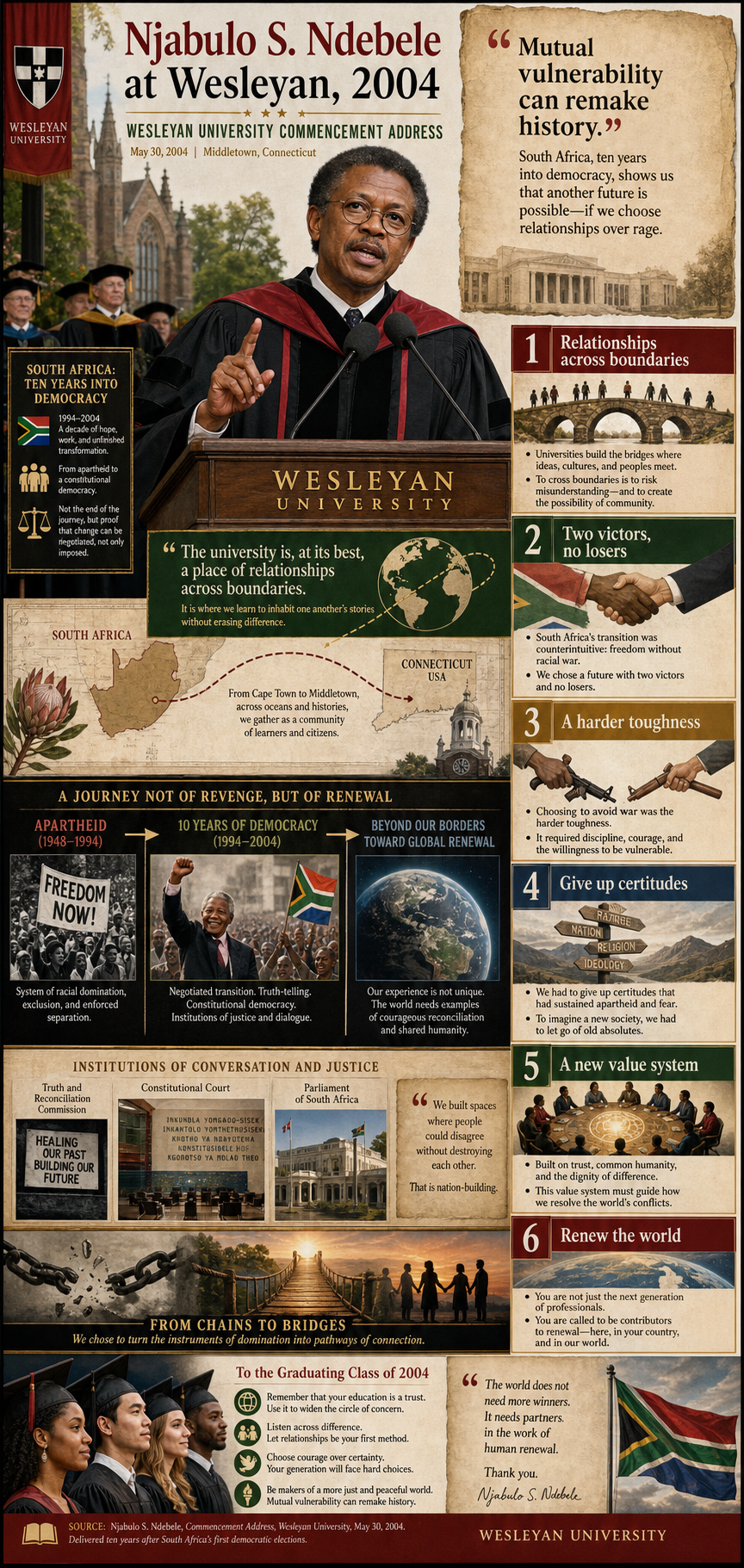
Njabulo S. Ndebele at Wesleyan, 2004
A Wesleyan address connecting South Africa’s first decade of democracy to mutual vulnerability, negotiated freedom, and a renewed global value system.
Speech arc
- 01Wesleyan honor
Opening move
- 02South Africa at ten
Speech beat
- 03Counterintuitive liberty
Speech beat
- 04Two victors, no losers
Speech beat
- 05Mutual vulnerability
Speech beat
- 06Harder toughness
Speech beat
- 07Give up certitudes
Speech beat
- 08Renew the world
Final charge
Relationship: Universities cross boundaries
Ndebele begins with gratitude for an honor that links Wesleyan, Cape Town, South Africa, scholarship, art, and the graduating class.
Occasion
The address joins Wesleyan’s ceremony to the University of Cape Town’s long history and South Africa’s ten years of democracy.
Value
The invitation itself affirms relationships that cut across national, racial, academic, and personal boundaries.
Question
He asks what a ten-year democracy and a two-hundred-year democracy might still have to teach each other.
Ndebele begins with gratitude for an honor that links Wesleyan, Cape Town, South Africa, scholarship, art, and the graduating class.
Freedom: The road to liberty was counterintuitive
South Africa’s transition matters because it refused the familiar pattern of final battle, racial war, victors, and vanquished.
Choice
The contending sides negotiated a future with two victors and no losers.
Need
Both sides recognized, at the last moment, how much they needed one another.
Institutions
Parliament, courts, schooling, housing, water, and electricity become visible signs of democratic change.
South Africa’s transition matters because it refused the familiar pattern of final battle, racial war, victors, and vanquished.
Vulnerability: A harder toughness is choosing not to fight
The speech reframes courage as the willingness to risk credibility, abandon habit, and expose mutual vulnerability rather than go to war.
Leaders
Both white and black leaders had to tell followers that old certainties about power and violence could no longer hold.
Risk
Each camp risked betrayal, weakness, and loss of identity in order to negotiate.
Revolution
The deeper revolution was a transformation of attitudes, beliefs, bias, stereotype, and preconception.
The speech reframes courage as the willingness to risk credibility, abandon habit, and expose mutual vulnerability rather than go to war.
• Key takeaways •
Freedom can reject final battle
Connects to democracy.
Need can become common ground
Connects to reconciliation.
Vulnerability is civic courage
Connects to courage.
Certitudes can be surrendered
Connects to trust.
Renewal requires new values
Connects to global citizenship.
Closing charge
Ndebele turns South Africa’s experience outward, asking whether nations can develop a new value system for resolving global conflict.
Give up certitudes to find common humanity
Trust
Mutual vulnerability creates the fragile possibility of trust when adversaries need each other.
Identity
Peace requires reconstituting meaning and credibility after the old value system becomes unsustainable.
Charge
Graduates are invited to imagine another birth and help renew a divided world.
Ndebele turns South Africa’s experience outward, asking whether nations can develop a new value system for resolving global conflict.
Visual speech maps
Browse more visual maps from Wesleyan University or continue with related mapped speeches below.
Transcript
The full transcript is hosted by the original publisher. Commencement Archive links to the source rather than republishing copyrighted text.
Read the full transcript at source →Provenance
Imported from NPR commencement archive; cross-referenced with Open Commencement DB
NPR archive last updated in 2015; destination availability has not been exhaustively rechecked | Open Commencement DB transcript; not independently verified against the original recording
Explore this speech
Find the next thread through the archive
Themes in this address
No canonical themes have been assigned yet.