Joss Whedon
Field: arts
Joss Whedon opens by joking about a past Wesleyan address by Bill Cosby before declaring that the graduates are going to die, using mortality and the body's biological drive as a starting point. He argues that the central gift of human existence is the contradiction and tension between body and mind, and within the mind itself, urging graduates to listen to internal dissent in order to earn their identity. He contends that peace comes from accepting the part of oneself that can never be at peace, that understanding opposing views strengthens one's own, and that everyone is unavoidably connected to others and thus already changing the world.
Key moments
- 01 References Bill Cosby's brief, dismissive address at his own graduation
- 02 Frames mortality and the body's biological urge as the opening provocation
- 03 Argues that accepting internal contradiction is how one earns identity
- 04 Claims understanding and even losing a debate fosters real growth
- 05 Asserts everyone is connected and inevitably changes the world simply by living
Save the visual map
Download or open the generated poster as a standalone PNG.
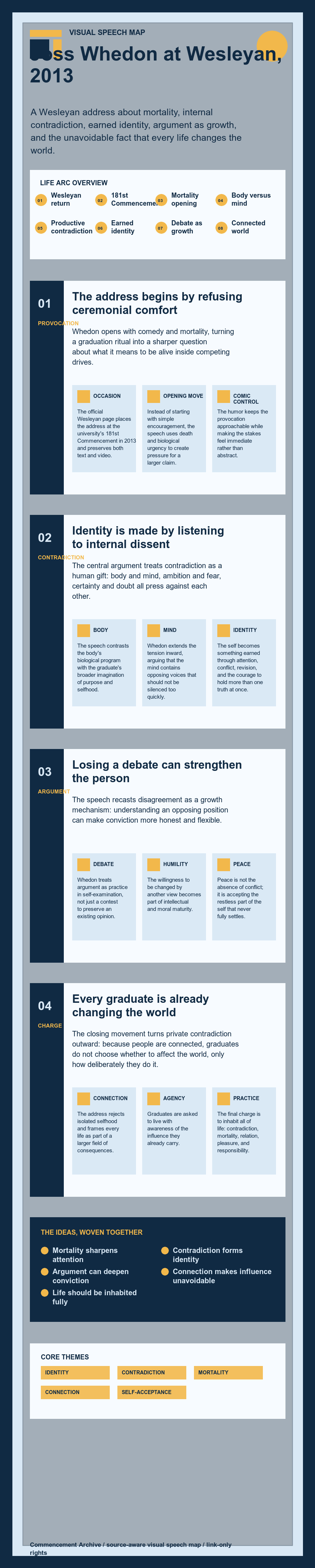
Joss Whedon at Wesleyan, 2013
A Wesleyan address about mortality, internal contradiction, earned identity, argument as growth, and the unavoidable fact that every life changes the world.
Speech arc
- 01Wesleyan return
Opening move
- 02181st Commencement
Speech beat
- 03Mortality opening
Speech beat
- 04Body versus mind
Speech beat
- 05Productive contradiction
Speech beat
- 06Earned identity
Speech beat
- 07Debate as growth
Speech beat
- 08Connected world
Final charge
Provocation: The address begins by refusing ceremonial comfort
Whedon opens with comedy and mortality, turning a graduation ritual into a sharper question about what it means to be alive inside competing drives.
Occasion
The official Wesleyan page places the address at the university's 181st Commencement in 2013 and preserves both text and video.
Opening move
Instead of starting with simple encouragement, the speech uses death and biological urgency to create pressure for a larger claim.
Comic control
The humor keeps the provocation approachable while making the stakes feel immediate rather than abstract.
Whedon opens with comedy and mortality, turning a graduation ritual into a sharper question about what it means to be alive inside competing drives.
Contradiction: Identity is made by listening to internal dissent
The central argument treats contradiction as a human gift: body and mind, ambition and fear, certainty and doubt all press against each other.
Body
The speech contrasts the body's biological program with the graduate's broader imagination of purpose and selfhood.
Mind
Whedon extends the tension inward, arguing that the mind contains opposing voices that should not be silenced too quickly.
Identity
The self becomes something earned through attention, conflict, revision, and the courage to hold more than one truth at once.
The central argument treats contradiction as a human gift: body and mind, ambition and fear, certainty and doubt all press against each other.
Argument: Losing a debate can strengthen the person
The speech recasts disagreement as a growth mechanism: understanding an opposing position can make conviction more honest and flexible.
Debate
Whedon treats argument as practice in self-examination, not just a contest to preserve an existing opinion.
Humility
The willingness to be changed by another view becomes part of intellectual and moral maturity.
Peace
Peace is not the absence of conflict; it is accepting the restless part of the self that never fully settles.
The speech recasts disagreement as a growth mechanism: understanding an opposing position can make conviction more honest and flexible.
• Key takeaways •
Mortality sharpens attention
Connects to identity.
Contradiction forms identity
Connects to contradiction.
Argument can deepen conviction
Connects to mortality.
Connection makes influence unavoidable
Connects to connection.
Life should be inhabited fully
Connects to self-acceptance.
Closing charge
The closing movement turns private contradiction outward: because people are connected, graduates do not choose whether to affect the world, only how deliberately they do it.
Every graduate is already changing the world
Connection
The address rejects isolated selfhood and frames every life as part of a larger field of consequences.
Agency
Graduates are asked to live with awareness of the influence they already carry.
Practice
The final charge is to inhabit all of life: contradiction, mortality, relation, pleasure, and responsibility.
The closing movement turns private contradiction outward: because people are connected, graduates do not choose whether to affect the world, only how deliberately they do it.
Visual speech maps
Browse more visual maps from Wesleyan University or continue with related mapped speeches below.
Transcript
The full transcript is hosted by the original publisher. Commencement Archive links to the source rather than republishing copyrighted text.
Read the full transcript at source →Provenance
Imported from NPR commencement archive; cross-referenced with Open Commencement DB
NPR archive last updated in 2015; destination availability has not been exhaustively rechecked | Open Commencement DB transcript; not independently verified against the original recording
Explore this speech
Find the next thread through the archive
Themes in this address
Speeches like this one
Search all speeches ->