William Jefferson Clinton
42nd president of the United States
Clinton congratulates the Yale graduates and reflects on his own ties to the university before arguing that despite humanity's genetic near-identity, people fixate on their differences rather than their common humanity. He contends the modern world is too unstable, too unequal, and too unsustainable, and urges graduates to devote their lives to reducing the negative and building the positive forces of interdependence. He calls for reforming energy production, embracing 'non-zero sum' solutions, focusing on the 'how' of policy, and participating in NGO and public-good work as private citizens.
“our common humanity matters more.”
Key moments
- 01 Reflecting on his Yale years, meeting Hillary, and current health work in Ethiopia and Liberia
- 02 Citing genome research to argue common humanity outweighs genetic differences
- 03 Framing the world's three core problems as instability, inequality, and unsustainability
- 04 Advocating energy change, 'non-zero sum' approaches, and NGO citizen service, with Haiti as an example
Save the visual map
Download or open the generated poster as a standalone PNG.
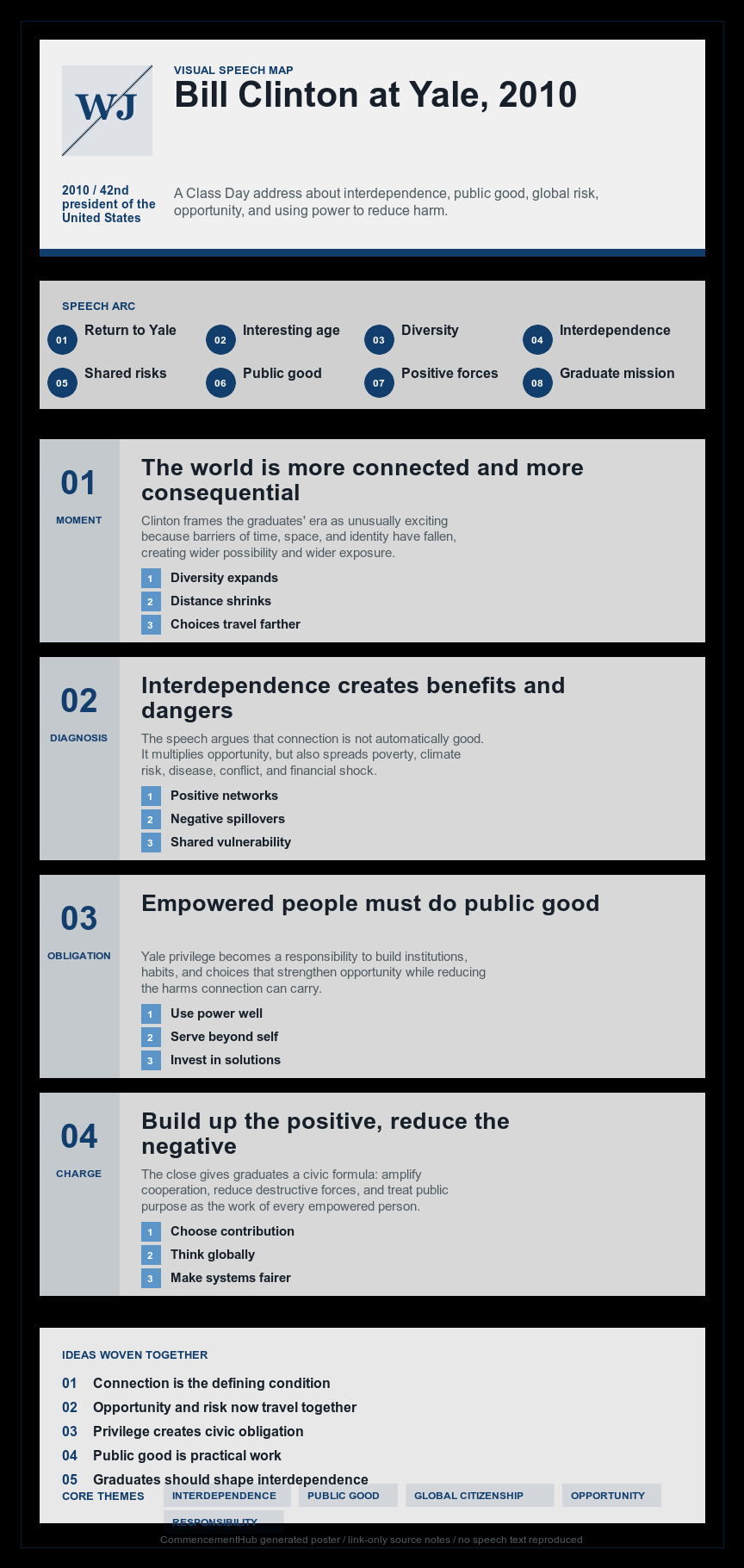
Bill Clinton at Yale, 2010
A Class Day address about interdependence, public good, global risk, opportunity, and using power to reduce harm.
Speech arc
- 01Return to Yale
Opening move
- 02Interesting age
Speech beat
- 03Diversity
Speech beat
- 04Interdependence
Speech beat
- 05Shared risks
Speech beat
- 06Public good
Speech beat
- 07Positive forces
Speech beat
- 08Graduate mission
Final charge
Moment: The world is more connected and more consequential
Clinton frames the graduates' era as unusually exciting because barriers of time, space, and identity have fallen, creating wider possibility and wider exposure.
Diversity
America and the world are described as more open, mobile, and mixed than earlier generations could expect.
Scale
Graduates inherit choices that travel farther because institutions, markets, and communities are tightly linked.
Possibility
The address begins with optimism about what empowered people can now build.
Clinton frames the graduates' era as unusually exciting because barriers of time, space, and identity have fallen, creating wider possibility and wider exposure.
Diagnosis: Interdependence creates benefits and dangers
The speech argues that connection is not automatically good. It multiplies opportunity, but also spreads poverty, climate risk, disease, conflict, and financial shock.
Positive
Networks can spread knowledge, cooperation, growth, and civic capacity across old boundaries.
Negative
The same connected world can carry instability and suffering quickly from one place to another.
Reality
The class is asked to see interdependence as a condition to shape, not a slogan to admire.
The speech argues that connection is not automatically good.
It multiplies opportunity, but also spreads poverty, climate risk, disease, conflict, and financial shock.
Obligation: Empowered people must do public good
Yale privilege becomes a responsibility to build institutions, habits, and choices that strengthen opportunity while reducing the harms connection can carry.
Power
Education and access are treated as tools for enlarging public benefit rather than private insulation.
Service
The speech asks graduates to put capacity to work on problems beyond personal advancement.
Systems
Public good requires practical structures that make cooperation easier and damage less likely.
Yale privilege becomes a responsibility to build institutions, habits, and choices that strengthen opportunity while reducing the harms connection can carry.
• Key takeaways •
Connection is the defining condition
Connects to interdependence.
Opportunity and risk now travel together
Connects to public good.
Privilege creates civic obligation
Connects to global citizenship.
Public good is practical work
Connects to opportunity.
Graduates should shape interdependence
Connects to responsibility.
Closing charge
The close gives graduates a civic formula: amplify cooperation, reduce destructive forces, and treat public purpose as the work of every empowered person.
Build up the positive, reduce the negative
Formula
The mission is simple enough to remember and broad enough to guide many careers.
Global
Graduates are pushed to think across borders because consequences already do.
Fairness
The final measure is whether connection becomes more humane, more stable, and more just.
The close gives graduates a civic formula: amplify cooperation, reduce destructive forces, and treat public purpose as the work of every empowered person.
Visual speech maps
Browse more visual maps from Yale University or continue with related mapped speeches below.
Transcript
The previously catalogued transcript link is no longer live and is queued for re-sourcing. A video of the address is available above.
Machine transcript available for archive analysis; it is unverified and may contain transcription errors.
Provenance
BROKEN transcript link (checked 2026-06-26): gradspeeches.com is a parked/redirecting domain serving no real content. Provenance: Verified from official archive; cross-referenced with NPR commencement archive; cross-referenced with Open Commencement DB
Category: Politics | NPR archive last updated in 2015; destination availability has not been exhaustively rechecked | Open Commencement DB transcript; not independently verified against the original recording | Transcript URL dead (gradspeeches.com is a parked/redirecting domain serving no real content); video fallback present
Explore this speech
Find the next thread through the archive
Themes in this address
Speeches like this one
Search all speeches ->