Kofi Annan
U.N. secretary-general
UN Secretary-General Kofi Annan urges the Stanford Class of 2000 to take the lead in safeguarding the global environment. Drawing on his report 'We the Peoples,' he warns of grave environmental challenges—water stress, food insecurity, and accelerating climate change—and criticizes the low political priority given to sustainable development. He calls on graduates in various fields to become activists, entrepreneurs, and citizens who build an ethic of global stewardship.
“We thrive and survive on planet earth as a single human family.”
Key moments
- 01 Compares the Stanford community to an interdependent ecosystem and human family
- 02 Cites findings from his UN report on environmental threats and inaction
- 03 Points to water stress, food insecurity, and rising climate-related disaster losses
- 04 Advocates Kyoto Protocol ratification, green accounting, and the polluter pays principle
- 05 Challenges graduates in each field to engage in environmental leadership and activism
Save the visual map
Download or open the generated poster as a standalone PNG.
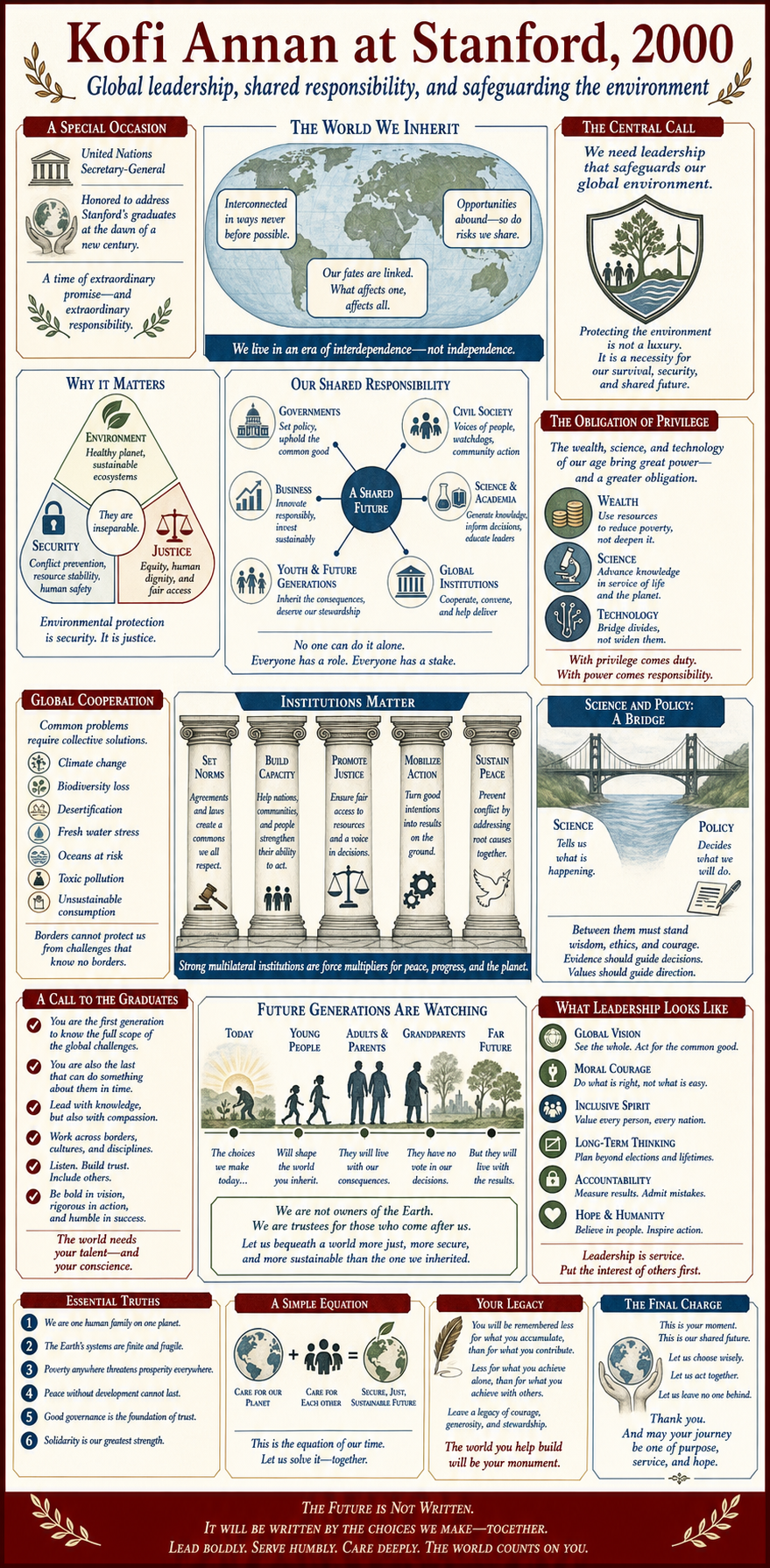
Kofi Annan at Stanford, 2000
A commencement address about global leadership, shared responsibility, environmental stewardship, and future generations.
Speech arc
- 01UN leadership
Opening move
- 02Global environment
Speech beat
- 03Interdependence
Speech beat
- 04Security
Speech beat
- 05Justice
Speech beat
- 06Science and wealth
Speech beat
- 07Cooperation
Speech beat
- 08Future generations
Final charge
World stage: Leadership for one planet
Annan frames graduates as entering a deeply interdependent world that needs leadership to safeguard the global environment.
Interdependence
No nation stands outside shared ecological systems.
Leadership
Privilege and knowledge create obligation.
Planet
The environment becomes common inheritance.
Annan frames graduates as entering a deeply interdependent world that needs leadership to safeguard the global environment.
Stakes: Environment, security, justice
Environmental protection is linked to human security, equity, and the stability of communities.
Security
Ecological harm becomes political risk.
Justice
The vulnerable often bear the costs first.
Responsibility
Development must include stewardship.
Environmental protection is linked to human security, equity, and the stability of communities.
Tools: Science and cooperation
Wealth, science, technology, and institutions are presented as tools that matter only when used cooperatively.
Science
Knowledge gives capacity to act.
Institutions
Global problems need durable collaboration.
Policy
Shared rules turn concern into action.
Wealth, science, technology, and institutions are presented as tools that matter only when used cooperatively.
• Key takeaways •
Interdependence defines the era
Connects to environment.
Environment is security and justice
Connects to global leadership.
Science creates obligation
Connects to responsibility.
Institutions enable cooperation
Connects to cooperation.
Future generations are stakeholders
Connects to future generations.
Closing charge
Graduates are asked to lead across borders because future generations depend on present choices.
Safeguard the future
Future
The unborn inherit today's decisions.
Borders
Leadership must cross national limits.
Stewardship
Protecting the planet is shared work.
Graduates are asked to lead across borders because future generations depend on present choices.
Visual speech maps
Browse more visual maps from Stanford University or continue with related mapped speeches below.
Transcript
The full transcript is hosted by the original publisher. Commencement Archive links to the source rather than republishing copyrighted text.
Read the full transcript at source →Provenance
Verified from official archive; targeted event-level link verified
Explore this speech
Find the next thread through the archive
Themes in this address
Speeches like this one
Search all speeches ->