Ngozi Okonjo-Iweala
Director-General of the World Trade Organization
WTO Director-General and MIT alumna Ngozi Okonjo-Iweala reflects on her time at MIT and the lessons it taught her, framing the present era as a 'polycrisis' requiring the integration of science, social science, and policy. She argues that scientific innovation alone is insufficient without access, diffusion, and international cooperation, drawing on the COVID-19 vaccine response and climate change as examples of where science succeeded but policy failed. She shares examples from her own career bridging science and policy in international development, urging graduates to take risks, connect disconnected approaches, and use their education to serve others.
“education is a privilege – and with that privilege comes responsibility, the responsibility to use it for others, not just for yourself.”
Key moments
- 01 Tribute to departing President Rafael Reif and personal recollections of her MIT graduate studies
- 02 Lessons from her education interrupted by the Biafran civil war and the responsibility privilege entails
- 03 COVID-19 as a case of good science but poor policy, citing MIT's role in mRNA vaccine development and global vaccine inequity
- 04 Climate change requiring both innovation and diffusion, and the failure of rich nations to meet financing pledges
- 05 Examples from her career connecting science and policy in development, finance, and vaccines
Save the visual map
Download or open the generated poster as a standalone PNG.
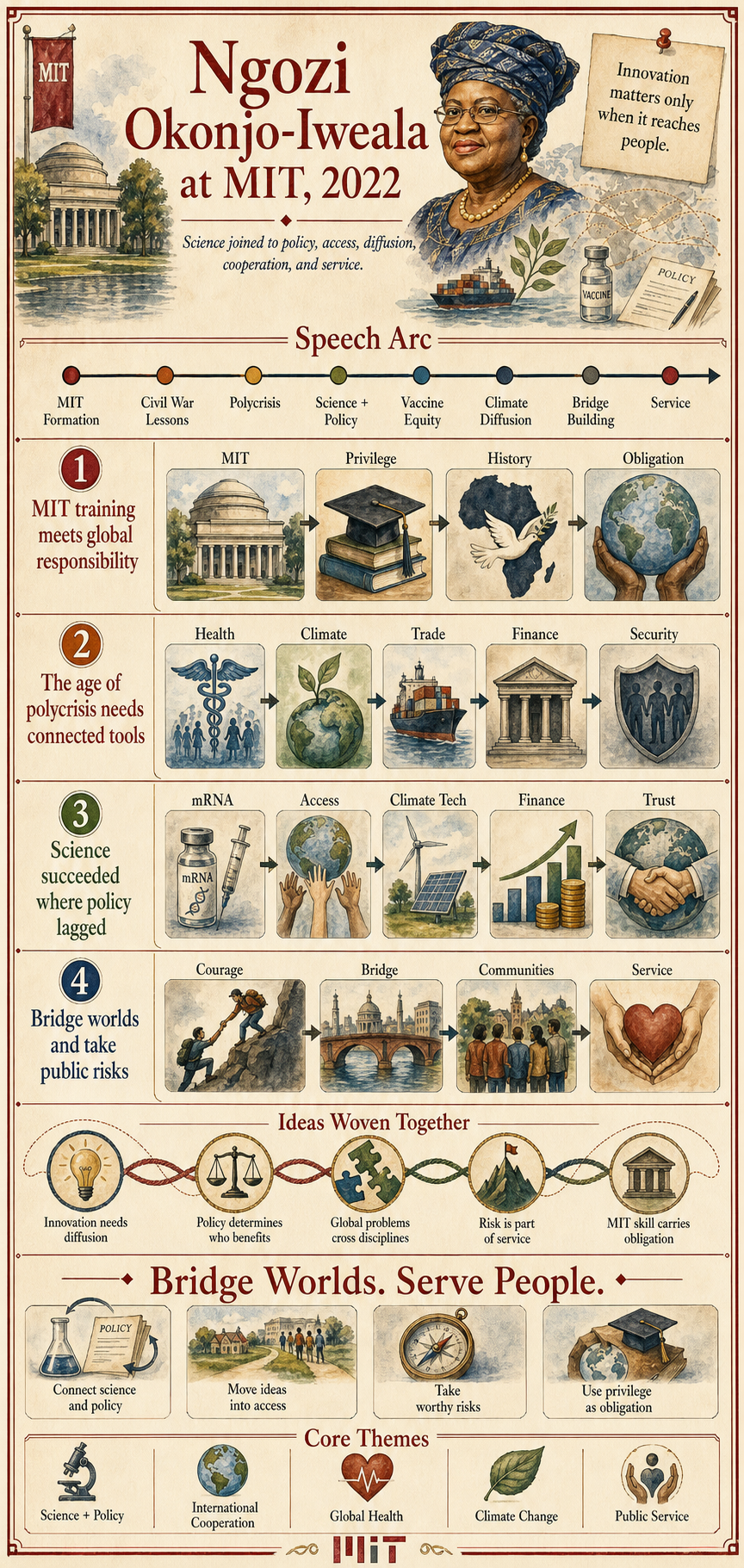
Ngozi Okonjo-Iweala at MIT, 2022
A commencement address about the polycrisis, science joined to policy, vaccine equity, climate finance, global cooperation, and service through risk.
Speech arc
- 01MIT formation
Opening move
- 02Civil war lessons
Speech beat
- 03Polycrisis
Speech beat
- 04Science plus policy
Speech beat
- 05Vaccine equity
Speech beat
- 06Climate diffusion
Speech beat
- 07Bridge building
Speech beat
- 08Service
Final charge
Formation: MIT training meets global responsibility
Okonjo-Iweala links her graduate education to a wider duty: privilege and scientific skill matter only when they reach people.
MIT
Technical training joins economics, policy, and systems thinking.
Privilege
Education creates obligation, not distance.
History
Personal disruption gives urgency to public service.
Okonjo-Iweala links her graduate education to a wider duty: privilege and scientific skill matter only when they reach people.
Diagnosis: The age of polycrisis needs connected tools
She names overlapping shocks that cannot be solved by one discipline, one nation, or one institution acting alone.
Systems
Health, climate, trade, finance, and security reinforce one another.
Integration
Science must travel with social science and policy.
Scale
Good ideas fail when access and diffusion fail.
She names overlapping shocks that cannot be solved by one discipline, one nation, or one institution acting alone.
Case Studies: Science succeeded where policy lagged
COVID-19 vaccines and climate technology show the same pattern: innovation is necessary, but distribution decides impact.
Vaccines
mRNA breakthroughs saved lives; inequity left many exposed.
Climate
New tools must move from labs into adoption and finance.
Trust
International cooperation is infrastructure for resilience.
COVID-19 vaccines and climate technology show the same pattern: innovation is necessary, but distribution decides impact.
• Key takeaways •
Innovation needs diffusion
Connects to science and policy.
Policy determines who benefits
Connects to international cooperation.
Global problems cross disciplines
Connects to global health.
Risk is part of service
Connects to climate change.
MIT skill carries obligation
Connects to public service.
Closing charge
Her advice asks graduates to cross boundaries, accept hard assignments, and use MIT skill in service of people beyond MIT.
Bridge worlds and take public risks
Courage
Take risks before the outcome is neatly secured.
Bridge
Connect science, policy, capital, and communities.
Service
Let usefulness, not status, define the career arc.
Her advice asks graduates to cross boundaries, accept hard assignments, and use MIT skill in service of people beyond MIT.
Visual speech maps
Browse more visual maps from Massachusetts Institute of Technology or continue with related mapped speeches below.
Transcript
No official full transcript has been located yet. If you know of one, suggestions are welcome.
Provenance
Verified from official archive
Explore this speech
Find the next thread through the archive
Themes in this address
Speeches like this one
Search all speeches ->