Bryan Stevenson
Founder and Executive Director, Equal Justice Initiative
“Each of us is more than the worst thing we've ever done.”
Save the visual map
Download or open the generated poster as a standalone PNG.
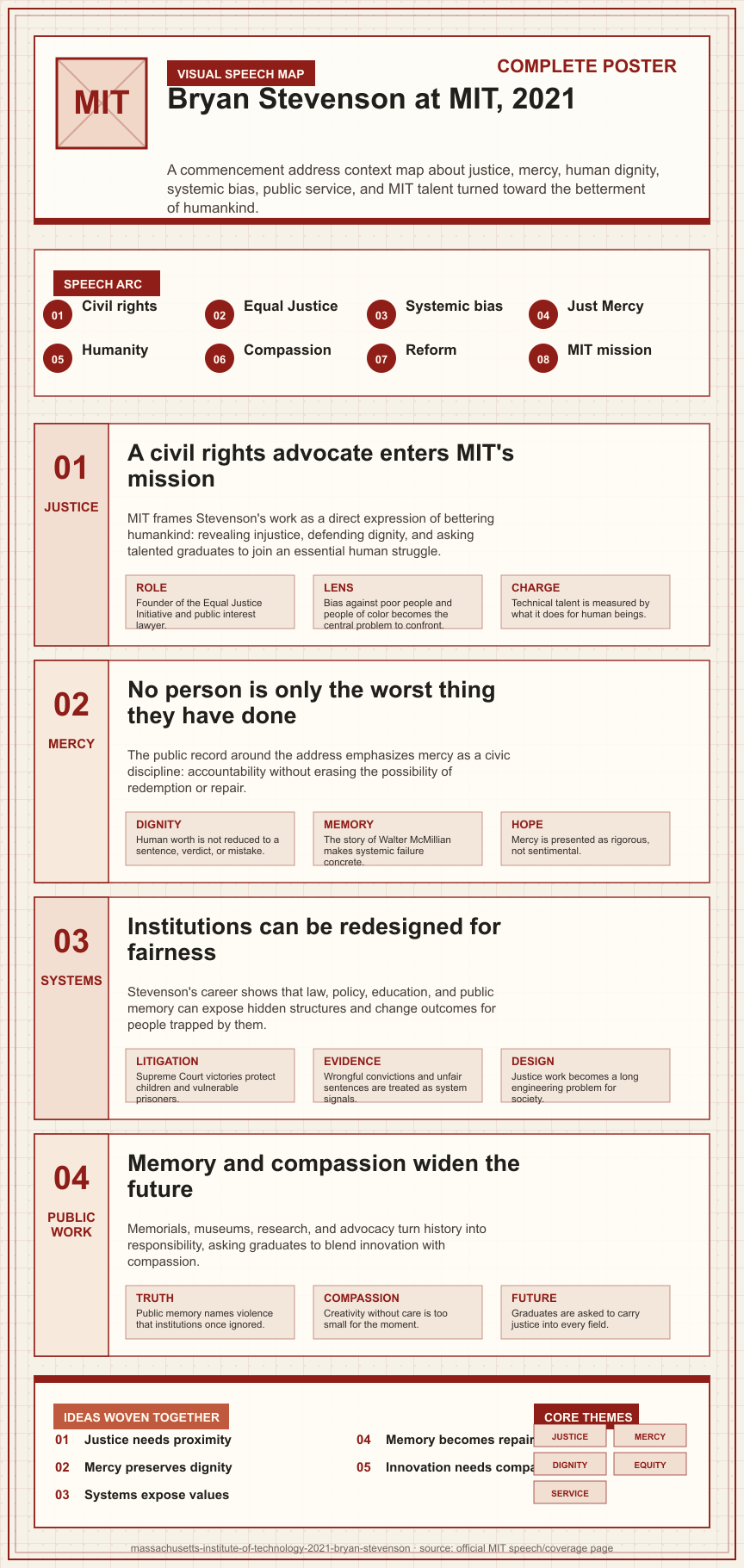
Bryan Stevenson at MIT, 2021
A commencement address context map about justice, mercy, human dignity, systemic bias, public service, and MIT talent turned toward the betterment of humankind.
Speech arc
- 01Civil rights
Opening move
- 02Equal Justice
Speech beat
- 03Systemic bias
Speech beat
- 04Just Mercy
Speech beat
- 05Humanity
Speech beat
- 06Compassion
Speech beat
- 07Reform
Speech beat
- 08MIT mission
Final charge
Justice: A civil rights advocate enters MIT's mission
MIT frames Stevenson's work as a direct expression of bettering humankind: revealing injustice, defending dignity, and asking talented graduates to join an essential human struggle.
Role
Founder of the Equal Justice Initiative and public interest lawyer.
Lens
Bias against poor people and people of color becomes the central problem to confront.
Charge
Technical talent is measured by what it does for human beings.
MIT frames Stevenson's work as a direct expression of bettering humankind: revealing injustice, defending dignity, and asking talented graduates to join an essential human struggle.
Mercy: No person is only the worst thing they have done
The public record around the address emphasizes mercy as a civic discipline: accountability without erasing the possibility of redemption or repair.
Dignity
Human worth is not reduced to a sentence, verdict, or mistake.
Memory
The story of Walter McMillian makes systemic failure concrete.
Hope
Mercy is presented as rigorous, not sentimental.
The public record around the address emphasizes mercy as a civic discipline: accountability without erasing the possibility of redemption or repair.
Systems: Institutions can be redesigned for fairness
Stevenson's career shows that law, policy, education, and public memory can expose hidden structures and change outcomes for people trapped by them.
Litigation
Supreme Court victories protect children and vulnerable prisoners.
Evidence
Wrongful convictions and unfair sentences are treated as system signals.
Design
Justice work becomes a long engineering problem for society.
Stevenson's career shows that law, policy, education, and public memory can expose hidden structures and change outcomes for people trapped by them.
• Key takeaways •
Justice needs proximity
Connects to justice.
Mercy preserves dignity
Connects to mercy.
Systems expose values
Connects to dignity.
Memory becomes repair
Connects to equity.
Innovation needs compassion
Connects to service.
Closing charge
Memorials, museums, research, and advocacy turn history into responsibility, asking graduates to blend innovation with compassion.
Memory and compassion widen the future
Truth
Public memory names violence that institutions once ignored.
Compassion
Creativity without care is too small for the moment.
Future
Graduates are asked to carry justice into every field.
Memorials, museums, research, and advocacy turn history into responsibility, asking graduates to blend innovation with compassion.
Visual speech maps
Browse more visual maps from Massachusetts Institute of Technology or continue with related mapped speeches below.
Transcript
No official full transcript has been located yet. If you know of one, suggestions are welcome.
Provenance
Verified from official archive
Explore this speech
Find the next thread through the archive
Themes in this address
No canonical themes have been assigned yet.
Speeches like this one
Search all speeches ->