Kofi Annan
Field: politics
Kofi Annan congratulates Penn State's class of 2005 and urges graduates to put their ideas into practice, framing both the United States and the United Nations as ideas grounded in human equality and freedom. He explains his concept of 'larger freedom'—the interdependence of human rights, security, and development—and describes the UN's work in conflict zones and humanitarian crises worldwide. He calls for reform of the UN and encourages graduates to make the cause of larger freedom their own.
Key moments
- 01 Framing the US and the UN as ideas rooted in human equality and freedom
- 02 Historical lesson from grandparents' generation, Pearl Harbor, and the Holocaust
- 03 Defining 'larger freedom' as combining rights, security, and development
- 04 Describing UN personnel serving in war zones and disaster areas worldwide
- 05 Presenting his blueprint for UN reform and charging graduates to lead
Save the visual map
Download or open the generated poster as a standalone PNG.
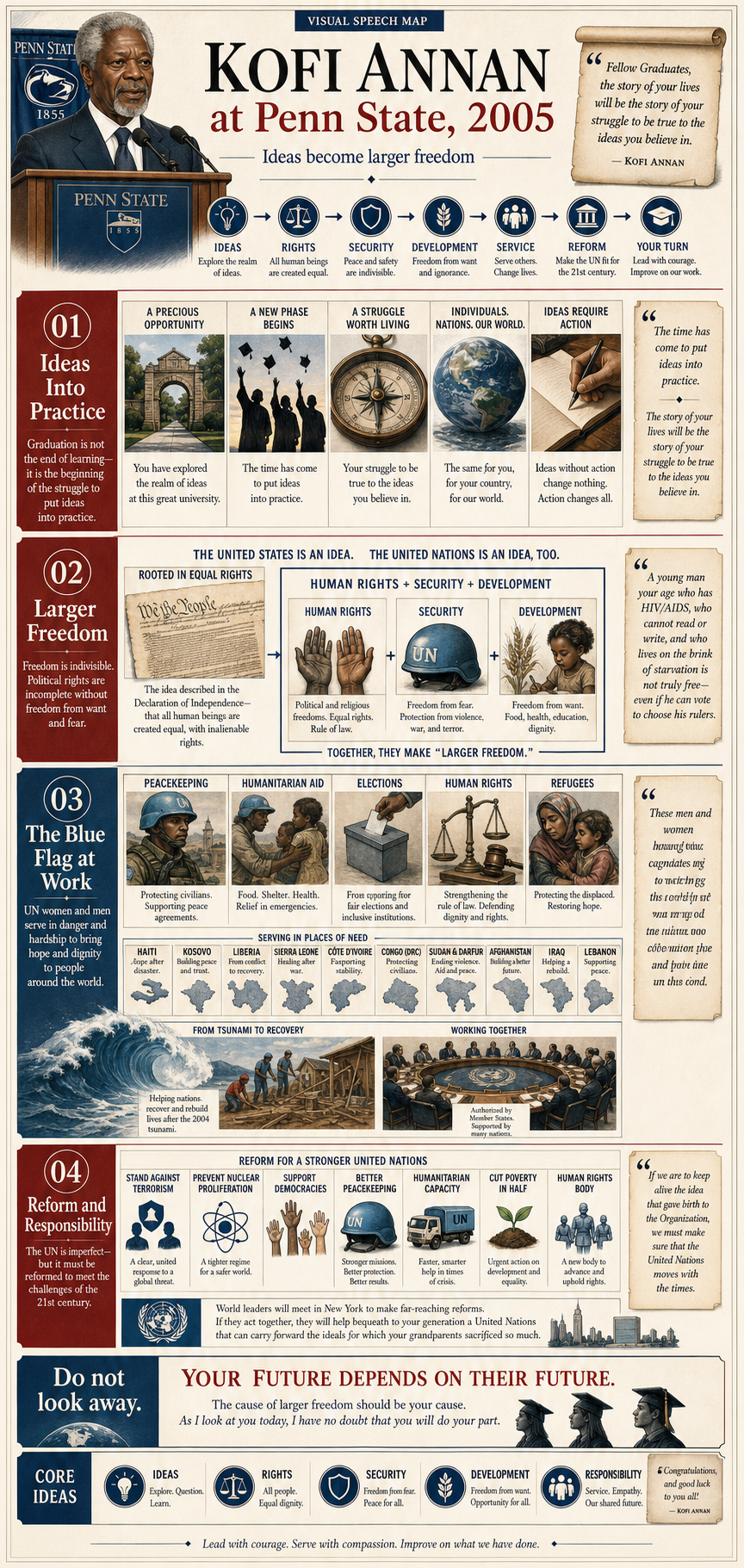
Kofi Annan at Penn State, 2005
A commencement address about turning ideas into practice, joining rights with security and development, and refusing to look away from global responsibility.
Speech arc
- 01Full transcript mirror
Opening move
- 02Realm of ideas
Speech beat
- 03Ideas into practice
Speech beat
- 04United States as idea
Speech beat
- 05United Nations as idea
Speech beat
- 06Larger freedom
Speech beat
- 07Blue flag service
Speech beat
- 08Do not look away
Final charge
Practice: Ideas become real only when tested
Annan tells graduates that university has given them ideas, but the next phase asks them to live by those ideas in public choices.
Graduation
The address begins by turning ceremony into a threshold: the story of graduates lives will be their struggle to be true to what they believe.
Nation
He reads the United States as an idea rooted in equal creation and inalienable rights rather than only a country or institution.
World
The same logic expands outward: ideas about freedom become obligations when other people are not secure or free.
Annan tells graduates that university has given them ideas, but the next phase asks them to live by those ideas in public choices.
Freedom: Rights, security, and development belong together
The speech defines larger freedom as a practical union of political liberty, freedom from fear, and freedom from want.
Rights
Voting and legal rights matter, but Annan argues they are incomplete when people face starvation, disease, war, or illiteracy.
Security
Pearl Harbor, the Holocaust, terrorism, Afghanistan, and war become evidence that distant suffering can become shared danger.
Development
Food, health, education, and dignity are treated as freedom questions, not secondary humanitarian extras.
The speech defines larger freedom as a practical union of political liberty, freedom from fear, and freedom from want.
Service: The blue flag works where one nation cannot
Annan inventories the daily work of UN personnel in emergencies, elections, refugee protection, peacekeeping, and recovery.
Mandate
Diplomats, soldiers, police, aid workers, rights experts, economists, and agronomists carry mandates from member states.
Places
The transcript names Haiti, Kosovo, Liberia, Sierra Leone, Congo, Sudan, Iraq, Afghanistan, Lebanon, Darfur, and tsunami recovery.
Invitation
He hopes some graduates will join that work and all will recognize why it matters.
Annan inventories the daily work of UN personnel in emergencies, elections, refugee protection, peacekeeping, and recovery.
• Key takeaways •
Ideas require practice
Connects to global citizenship.
Freedom is indivisible
Connects to human rights.
Security includes dignity
Connects to service.
Institutions need reform
Connects to security.
Do not look away
Connects to responsibility.
Closing charge
The closing argument is not institutional complacency; it is a call to reform global machinery so it can serve larger freedom better.
An imperfect institution still carries the charge
Reform
He names terrorism, proliferation, democracy, peacekeeping, humanitarian capacity, poverty, and human rights machinery as reform tests.
Inheritance
World leaders are asked to bequeath graduates a United Nations able to carry forward hard-won ideals.
Charge
The final claim is direct: graduates cannot look away because their future depends on others future.
The closing argument is not institutional complacency; it is a call to reform global machinery so it can serve larger freedom better.
Visual speech maps
Browse more visual maps from Penn State or continue with related mapped speeches below.
Transcript
The previously catalogued transcript link is no longer live and is queued for re-sourcing. A video of the address is available above.
Machine transcript available for archive analysis; it is unverified and may contain transcription errors. Machine transcript source ->
Provenance
BROKEN transcript link (checked 2026-06-26): gradspeeches.com is a parked/redirecting domain serving no real content. Provenance: Imported from NPR commencement archive; cross-referenced with Open Commencement DB
NPR archive last updated in 2015; destination availability has not been exhaustively rechecked | Open Commencement DB transcript; not independently verified against the original recording | Transcript URL dead (gradspeeches.com is a parked/redirecting domain serving no real content); no video fallback — needs re-sourcing
Explore this speech
Find the next thread through the archive
Themes in this address
Speeches like this one
Search all speeches ->