Bill and Melinda Gates
Philanthropists
Bill and Melinda Gates reflect on how their early optimism about technology evolved through encounters with extreme poverty and disease in places like Soweto, a multi-drug-resistant TB hospital in South Africa, and communities in India. They argue that optimism alone is insufficient and must be paired with empathy to address inequities, sharing personal stories of suffering they witnessed. They urge graduates to combine their genius and optimism with empathy, to see those most in need, and to turn toward suffering as the moment when change begins.
“Technology should benefit everybody.”
Key moments
- 01 Bill's 1997 visit to Soweto revealing the limits of donating computers amid extreme poverty
- 02 Visit to a multi-drug-resistant TB hospital and progress on a more affordable, faster TB cure
- 03 Melinda carrying a dying AIDS patient to the roof to watch the sunset in India
- 04 Sex worker support groups in India helping curb HIV and empowering marginalized women
- 05 Argument that optimism needs empathy and recognition of the role of luck and privilege
Save the visual map
Download or open the generated poster as a standalone PNG.
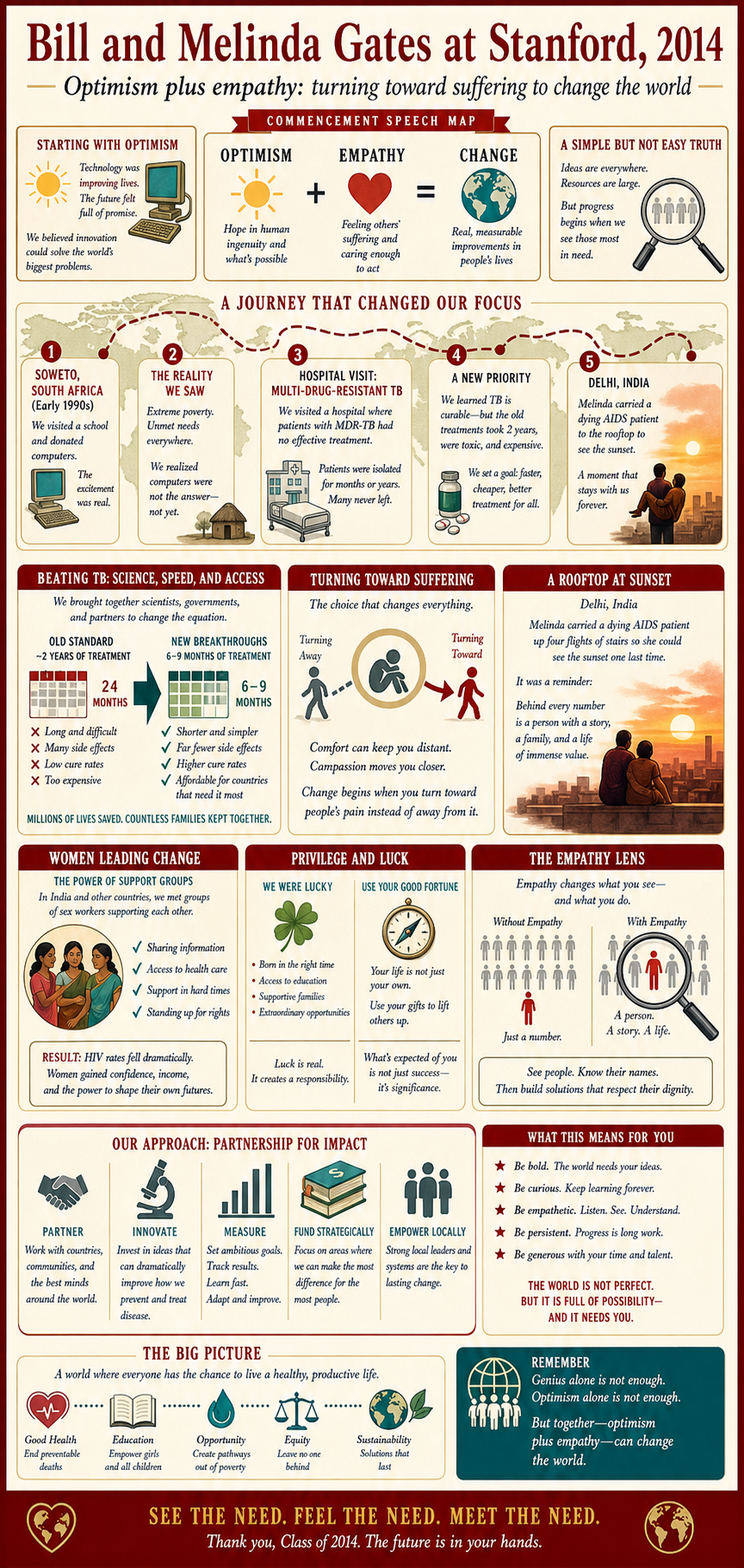
Bill and Melinda Gates at Stanford, 2014
A commencement address about optimism, empathy, global health, poverty, privilege, and turning toward suffering.
Speech arc
- 01Tech optimism
Opening move
- 02Soweto
Speech beat
- 03TB hospital
Speech beat
- 04India rooftop
Speech beat
- 05Support groups
Speech beat
- 06Privilege
Speech beat
- 07Empathy
Speech beat
- 08Genius plus service
Final charge
Optimism: Technology is not enough
Bill Gates's early faith in technology is complicated by encounters with poverty where computers alone cannot answer human need.
Soweto
Extreme poverty reveals the limits of simple tech optimism.
Humility
Good tools do not replace seeing people clearly.
Shift
Optimism needs moral depth.
Bill Gates's early faith in technology is complicated by encounters with poverty where computers alone cannot answer human need.
Health: Suffering must be faced
Stories from TB care and AIDS work show that progress begins when people refuse to turn away from suffering.
TB
Disease exposes inequality and urgency.
Treatment
Innovation matters when it becomes affordable and accessible.
India
The rooftop story centers dignity at the edge of death.
Stories from TB care and AIDS work show that progress begins when people refuse to turn away from suffering.
Empathy: See people as agents
Sex worker support groups become evidence that marginalized communities can organize, protect, and empower themselves.
Community
People closest to harm often build the strongest response.
HIV
Health work includes trust and social power.
Agency
Empathy sees capability, not only need.
Sex worker support groups become evidence that marginalized communities can organize, protect, and empower themselves.
• Key takeaways •
Optimism needs empathy
Connects to empathy.
Technology must meet real need
Connects to optimism.
Health equity requires access
Connects to global health.
Privilege creates duty
Connects to poverty.
Turn toward suffering
Connects to innovation.
Closing charge
Graduates are asked to bring talent, optimism, and privilege into direct contact with the people most in need.
Pair genius with empathy
Privilege
Luck creates responsibility.
Genius
Ability should widen opportunity.
Empathy
Change begins by turning toward suffering.
Graduates are asked to bring talent, optimism, and privilege into direct contact with the people most in need.
Visual speech maps
Browse more visual maps from Stanford University or continue with related mapped speeches below.
Transcript
The full transcript is hosted by the original publisher. Commencement Archive links to the source rather than republishing copyrighted text.
Read the full transcript at source →Provenance
Verified from official archive; targeted event-level link verified
Explore this speech
Find the next thread through the archive
Themes in this address
Speeches like this one
Search all speeches ->