Lisa T. Su
Advanced Micro Devices CEO
AMD chair and CEO Lisa Su, an MIT alumna, reflects on her undergraduate and graduate years at MIT, including her UROP research experiences and the development of what she calls an 'engineer's instinct' to break down hard problems. She discusses her career path through IBM and AMD, the promise of AI to accelerate discovery in fields like medicine, and argues that people, not technology, determine the future. She urges graduates to choose ambitious problems, run toward the hardest ones, and make their own luck.
“Technology itself does not decide what the future looks like. People do.”
Key moments
- 01 Recounting her arrival at MIT and early UROP research in semiconductor clean rooms
- 02 The mentor advice to 'run toward the hardest problems'
- 03 Becoming CEO of AMD and betting on high-performance computing
- 04 Framing AI as a tool that makes people more capable, especially in medicine
- 05 Closing advice to be ambitious, take risks, and make your own luck
Save the visual map
Download or open the generated poster as a standalone PNG.
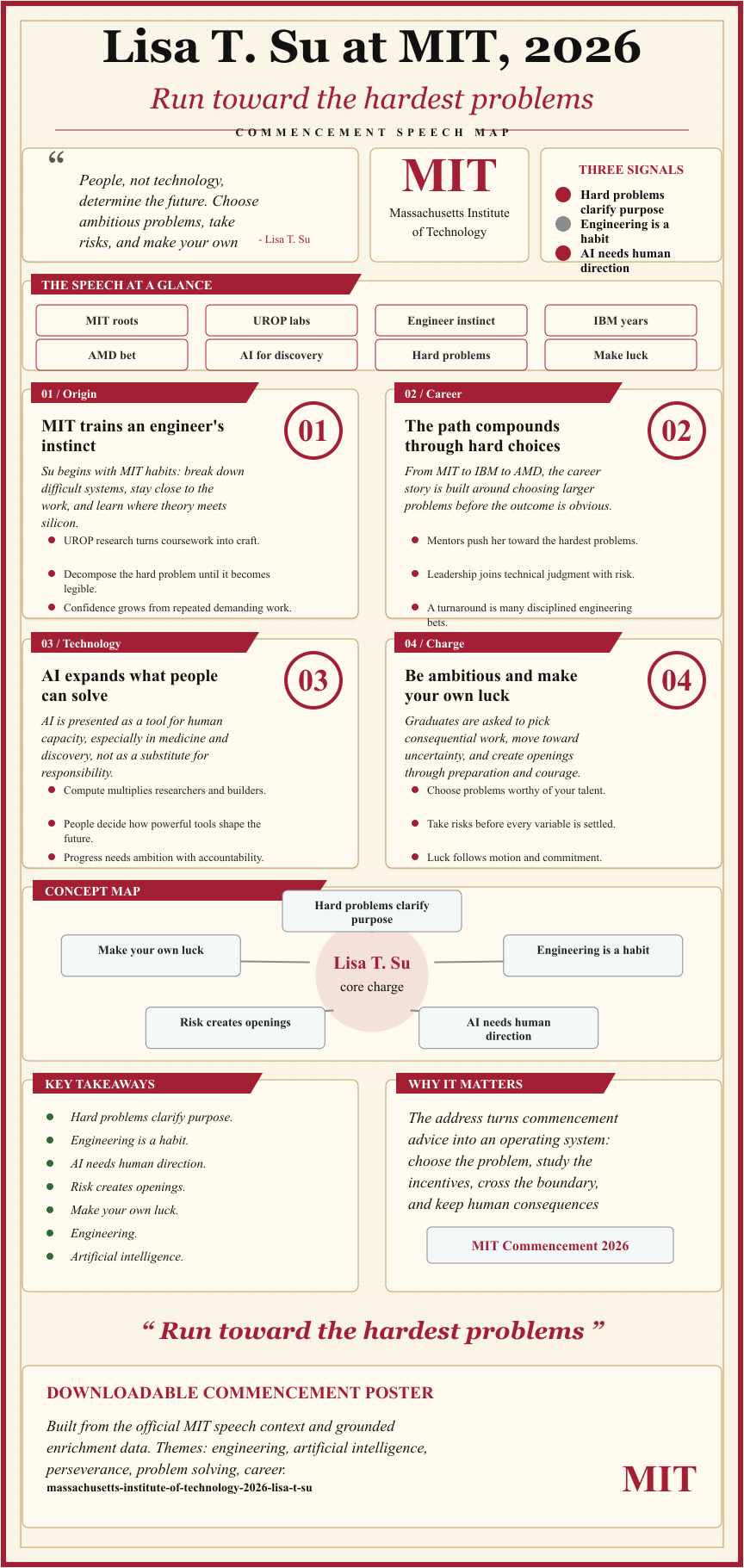
Lisa T. Su at MIT, 2026
A commencement address about engineering instinct, hard problems, AI as a human multiplier, and making your own luck.
Speech arc
- 01MIT roots
Opening move
- 02UROP labs
Speech beat
- 03Engineer instinct
Speech beat
- 04IBM years
Speech beat
- 05AMD bet
Speech beat
- 06AI for discovery
Speech beat
- 07Hard problems
Speech beat
- 08Make luck
Final charge
Origin: MIT trains an engineer's instinct
Su begins with the habits shaped by MIT: breaking down difficult systems, staying close to the work, and learning in research settings where theory meets silicon.
UROP
Clean-room research turns coursework into craft and gives technical judgment a physical setting.
Method
The useful habit is decomposition: make a hard problem legible enough to attack.
Confidence
Repeated contact with demanding work becomes the instinct to keep going.
Su begins with the habits shaped by MIT: breaking down difficult systems, staying close to the work, and learning in research settings where theory meets silicon.
Career: The path compounds through hard choices
From MIT to IBM to AMD, the career story is built around choosing larger problems before the outcome is obvious.
Advice
Mentors push her to run toward the hardest problems instead of optimizing for comfort.
Leadership
The CEO role joins technical judgment, long time horizons, and appetite for risk.
Turnaround
A company-scale comeback is made from many disciplined engineering bets.
From MIT to IBM to AMD, the career story is built around choosing larger problems before the outcome is obvious.
Technology: AI expands what people can solve
Su frames artificial intelligence as a tool for human capacity, especially in medicine and discovery, rather than a substitute for human responsibility.
Multiplier
High-performance computing and AI increase what researchers and builders can attempt.
Agency
People, not technology alone, decide how powerful tools shape the future.
Standard
Progress needs ambition paired with accountability.
Su frames artificial intelligence as a tool for human capacity, especially in medicine and discovery, rather than a substitute for human responsibility.
• Key takeaways •
Hard problems clarify purpose
Connects to engineering.
Engineering is a habit
Connects to artificial intelligence.
AI needs human direction
Connects to perseverance.
Risk creates openings
Connects to problem solving.
Make your own luck
Connects to career.
Closing charge
Her closing advice asks graduates to pick consequential work, move toward uncertainty, and create openings through preparation and courage.
Be ambitious and make your own luck
Ambition
Choose problems worthy of your talent and training.
Risk
Move before every variable is settled.
Luck
Luck follows motion, preparation, and hard commitments.
Her closing advice asks graduates to pick consequential work, move toward uncertainty, and create openings through preparation and courage.
Visual speech maps
Browse more visual maps from Massachusetts Institute of Technology or continue with related mapped speeches below.
Transcript
No official full transcript has been located yet. If you know of one, suggestions are welcome.
Provenance
Verified from official archive
Explore this speech
Find the next thread through the archive
Themes in this address
Speeches like this one
Search all speeches ->