Sandra Soto
Sandra Soto urges the 2010 University of Arizona graduates to apply their critical thinking and knowledge of history, cultures, and ethics to civic debates, particularly around immigration. She criticizes Arizona's SB1070 as inviting racial profiling and HB 2281 as eliminating ethnic studies, recounting her participation in a student protest. She argues that education has public value beyond personal gain and calls on graduates to defend public education and keep opportunities open for others.
Key moments
- 01 Calls for educated, non-hysterical debate on immigration respectful of human and civil rights
- 02 Criticizes SB1070 as anti-immigrant legislation inviting racial profiling
- 03 Describes joining a student protest against HB 2281's ban on ethnic studies
- 04 Argues education has public value and urges graduates to fight for public education
Save the visual map
Download or open the generated poster as a standalone PNG.
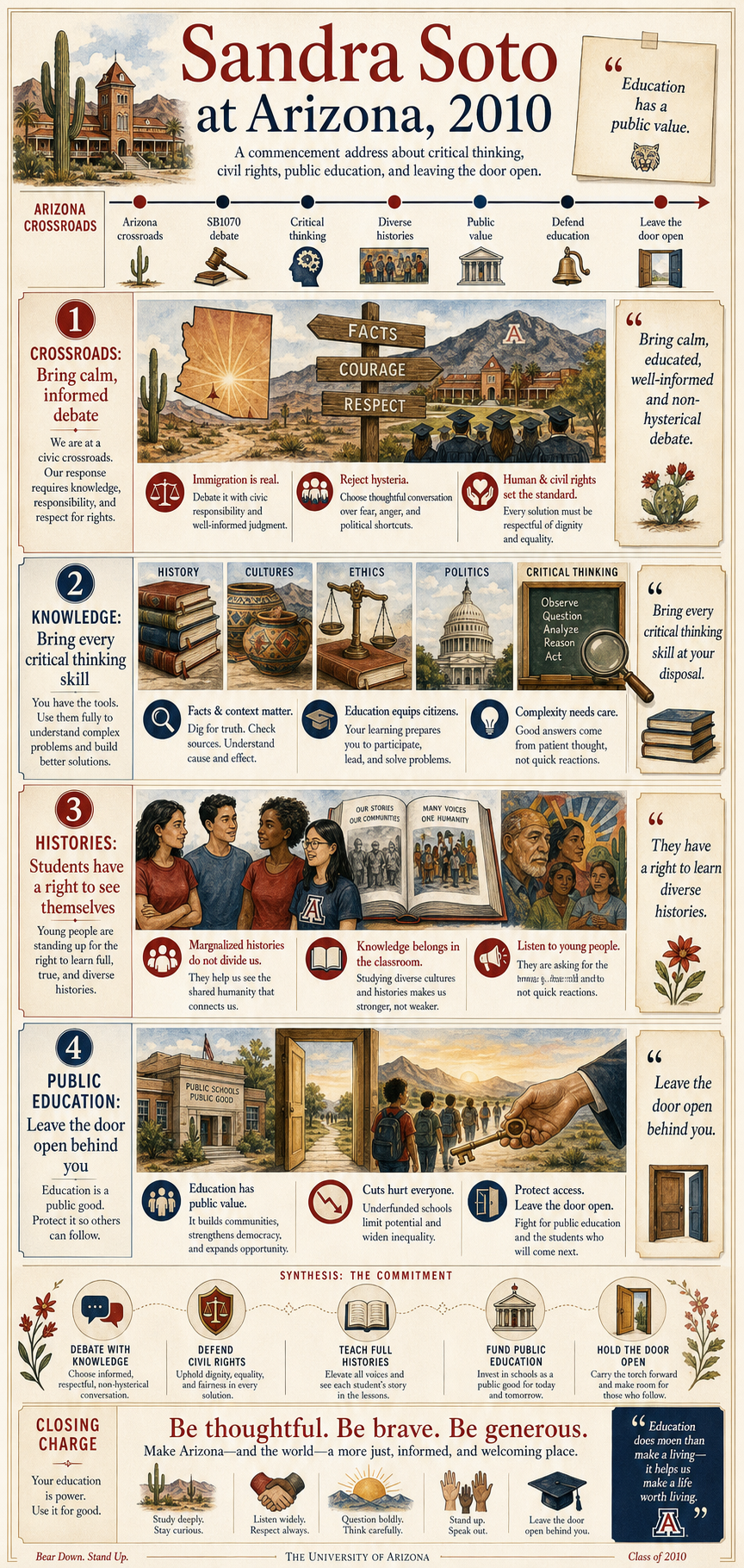
Sandra Soto at Arizona, 2010
A commencement address about critical thinking, civil rights, diverse histories, public education, and leaving the door open.
Speech arc
- 01University of Arizona
Opening move
- 02Class of 2010
Speech beat
- 03Civic crossroads
Speech beat
- 04SB1070 debate
Speech beat
- 05Critical thinking
Speech beat
- 06Diverse histories
Speech beat
- 07Public value
Speech beat
- 08Leave the door open
Final charge
Crossroads: Public problems require informed debate
Soto places graduates inside Arizona’s immigration fight and calls for debate that is educated, calm, and grounded in human and civil rights.
Responsibility
Citizenship requires more than reaction; it requires informed, non-hysterical argument.
Rights
Human and civil rights set the moral boundary for policy fights.
Moment
The class enters public life at a particular civic crossroads.
Soto places graduates inside Arizona’s immigration fight and calls for debate that is educated, calm, and grounded in human and civil rights.
Knowledge: Bring every critical thinking skill
The address asks graduates to bring history, cultures, ethics, politics, and rigorous thought to problems older generations have not solved.
Context
Facts need history and culture before they become responsible judgment.
Education
A university education equips graduates for public participation, not only employment.
Complexity
Hard problems demand more knowledge, not slogans.
The address asks graduates to bring history, cultures, ethics, politics, and rigorous thought to problems older generations have not solved.
Histories: Students deserve to see themselves in learning
Soto defends marginalized histories and cultural expression against the claim that fuller knowledge divides people.
Representation
Students ask to see their lives reflected in lessons, lectures, and books.
Messenger
Attacking a field of study avoids the deeper questions that field reveals.
Right
Diverse histories belong in the classroom because they enlarge public understanding.
Soto defends marginalized histories and cultural expression against the claim that fuller knowledge divides people.
• Key takeaways •
Debate with knowledge
Connects to education.
Defend civil rights
Connects to civil-rights.
Teach full histories
Connects to critical-thinking.
Protect public education
Connects to public-service.
Hold the door open
Connects to inclusion.
Closing charge
The final charge makes education a public good: protect schools, resist cuts that narrow access, and help future students enter.
Leave the door open behind you
Public value
Education helps graduates become better fellow citizens and problem solvers.
Funding
Cuts to public education harm both the quantity and quality of opportunity.
Door
Completion creates an obligation to keep the path open for those who follow.
The final charge makes education a public good: protect schools, resist cuts that narrow access, and help future students enter.
Visual speech maps
Browse more visual maps from University of Arizona or continue with related mapped speeches below.
Transcript
The previously catalogued transcript link is no longer live and is queued for re-sourcing. A video of the address is available above.
Machine transcript available for archive analysis; it is unverified and may contain transcription errors. Machine transcript source ->
Provenance
BROKEN transcript link (checked 2026-06-26): gradspeeches.com is a parked/redirecting domain serving no real content. Provenance: Imported from NPR commencement archive; cross-referenced with Open Commencement DB
NPR archive last updated in 2015; destination availability has not been exhaustively rechecked | Open Commencement DB transcript; not independently verified against the original recording | Transcript URL dead (gradspeeches.com is a parked/redirecting domain serving no real content); video fallback present
Explore this speech
Find the next thread through the archive
Themes in this address
Speeches like this one
Search all speeches ->