Ira Glass
Field: arts
Ira Glass opens by declaring his opposition to the very form of the commencement speech, then shares personal connections to Goucher, including his grandmother Frieda Freelander (Class of '31). He reassures graduates that feeling lost, floundering, and questioning their choices in their twenties is normal, recounting his own years of struggling as a writer and performer in public radio and clashing with his parents. He advises that ideas and creative work require deliberate effort, and closes with a story about his grandmother encountering Hitler in 1932, urging graduates to keep building themselves so they will recognize their chance to change the world when it comes.
Key moments
- 01 Glass critiques the commencement speech as a doomed, cloying form even as he delivers one
- 02 He shares his floundering twenties as a poor writer and stiff performer paying NPR reporters to critique his scripts
- 03 He reflects on conflicts with his worried parents and advises graduates not to be a dick as parents adjust
- 04 He recounts his grandmother Frieda's hardships and her 1932 encounter with Hitler as a lesson about uncertainty
Save the visual map
Download or open the generated poster as a standalone PNG.
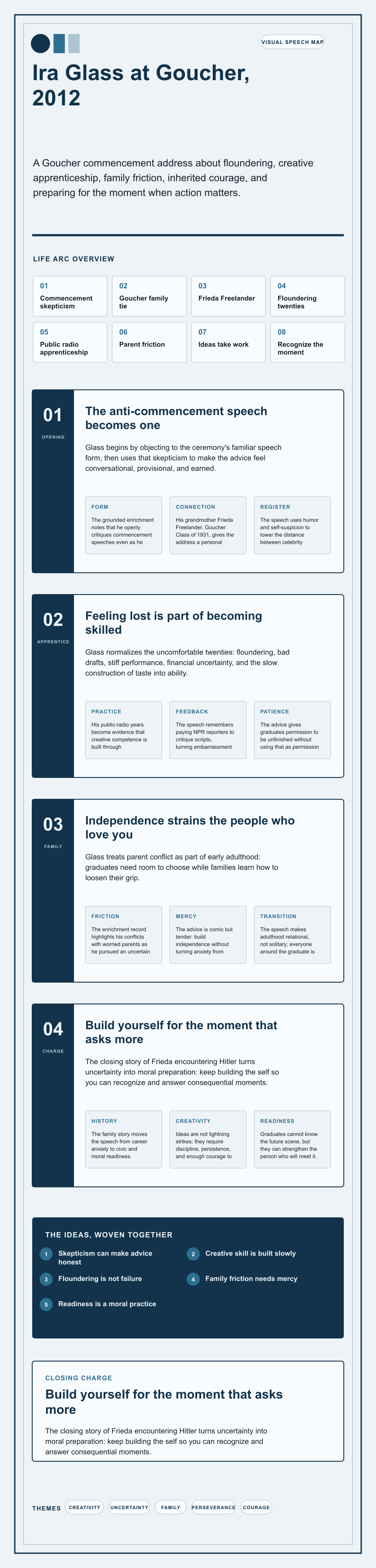
Ira Glass at Goucher, 2012
A Goucher commencement address about floundering, creative apprenticeship, family friction, inherited courage, and preparing for the moment when action matters.
Speech arc
- 01Commencement skepticism
Opening move
- 02Goucher family tie
Speech beat
- 03Frieda Freelander
Speech beat
- 04Floundering twenties
Speech beat
- 05Public radio apprenticeship
Speech beat
- 06Parent friction
Speech beat
- 07Ideas take work
Speech beat
- 08Recognize the moment
Final charge
Opening: The anti-commencement speech becomes one
Glass begins by objecting to the ceremony's familiar speech form, then uses that skepticism to make the advice feel conversational, provisional, and earned.
Form
The grounded enrichment notes that he openly critiques commencement speeches even as he delivers one.
Connection
His grandmother Frieda Freelander, Goucher Class of 1931, gives the address a personal institutional tie.
Register
The speech uses humor and self-suspicion to lower the distance between celebrity speaker and anxious graduates.
Glass begins by objecting to the ceremony's familiar speech form, then uses that skepticism to make the advice feel conversational, provisional, and earned.
Apprenticeship: Feeling lost is part of becoming skilled
Glass normalizes the uncomfortable twenties: floundering, bad drafts, stiff performance, financial uncertainty, and the slow construction of taste into ability.
Practice
His public-radio years become evidence that creative competence is built through repetition, critique, and awkward effort.
Feedback
The speech remembers paying NPR reporters to critique scripts, turning embarrassment into a working method.
Patience
The advice gives graduates permission to be unfinished without using that as permission to stop improving.
Glass normalizes the uncomfortable twenties: floundering, bad drafts, stiff performance, financial uncertainty, and the slow construction of taste into ability.
Family: Independence strains the people who love you
Glass treats parent conflict as part of early adulthood: graduates need room to choose while families learn how to loosen their grip.
Friction
The enrichment record highlights his conflicts with worried parents as he pursued an uncertain radio path.
Mercy
The advice is comic but tender: build independence without turning anxiety from others into cruelty.
Transition
The speech makes adulthood relational, not solitary; everyone around the graduate is adjusting.
Glass treats parent conflict as part of early adulthood: graduates need room to choose while families learn how to loosen their grip.
• Key takeaways •
Skepticism can make advice honest
Connects to creativity.
Creative skill is built slowly
Connects to uncertainty.
Floundering is not failure
Connects to family.
Family friction needs mercy
Connects to perseverance.
Readiness is a moral practice
Connects to courage.
Closing charge
The closing story of Frieda encountering Hitler turns uncertainty into moral preparation: keep building the self so you can recognize and answer consequential moments.
Build yourself for the moment that asks more
History
The family story moves the speech from career anxiety to civic and moral readiness.
Creativity
Ideas are not lightning strikes; they require discipline, persistence, and enough courage to keep making them.
Readiness
Graduates cannot know the future scene, but they can strengthen the person who will meet it.
The closing story of Frieda encountering Hitler turns uncertainty into moral preparation: keep building the self so you can recognize and answer consequential moments.
Visual speech maps
Browse more visual maps from Goucher College or continue with related mapped speeches below.
Transcript
The full transcript is hosted by the original publisher. Commencement Archive links to the source rather than republishing copyrighted text.
Read the full transcript at source →Provenance
Imported from NPR commencement archive; cross-referenced with Open Commencement DB
NPR archive last updated in 2015; destination availability has not been exhaustively rechecked | Open Commencement DB transcript; not independently verified against the original recording
Explore this speech
Find the next thread through the archive
Themes in this address
Speeches like this one
Search all speeches ->