David Carr
Field: letters
David Carr addresses the graduating journalism class with self-deprecating humor about his own unconventional past, including addiction and taking seven years to finish college, while celebrating the students' achievements. He argues that despite a troubled business model, the ability to do meaningful journalism and reach audiences has never been better, and encourages graduates to aim high. Throughout, he repeatedly points to overlooked stories—homelessness, tech-driven erosion of privacy, wealth disparity, and surveillance—urging that 'somebody should do a story about that.'
Key moments
- 01 Opens with self-mocking references to his addiction history and unlikely path to The New York Times
- 02 Praises the graduates' ambition and range of storytelling skills
- 03 Recounts his first story on police brutality in Minneapolis, sparked by his father's challenge
- 04 Cites the Snowden/Greenwald reporting as evidence of journalism's continuing power
- 05 Lists overlooked stories—homelessness, tech privacy trade-offs, wealth, and surveillance in Oakland
Save the visual map
Download or open the generated poster as a standalone PNG.
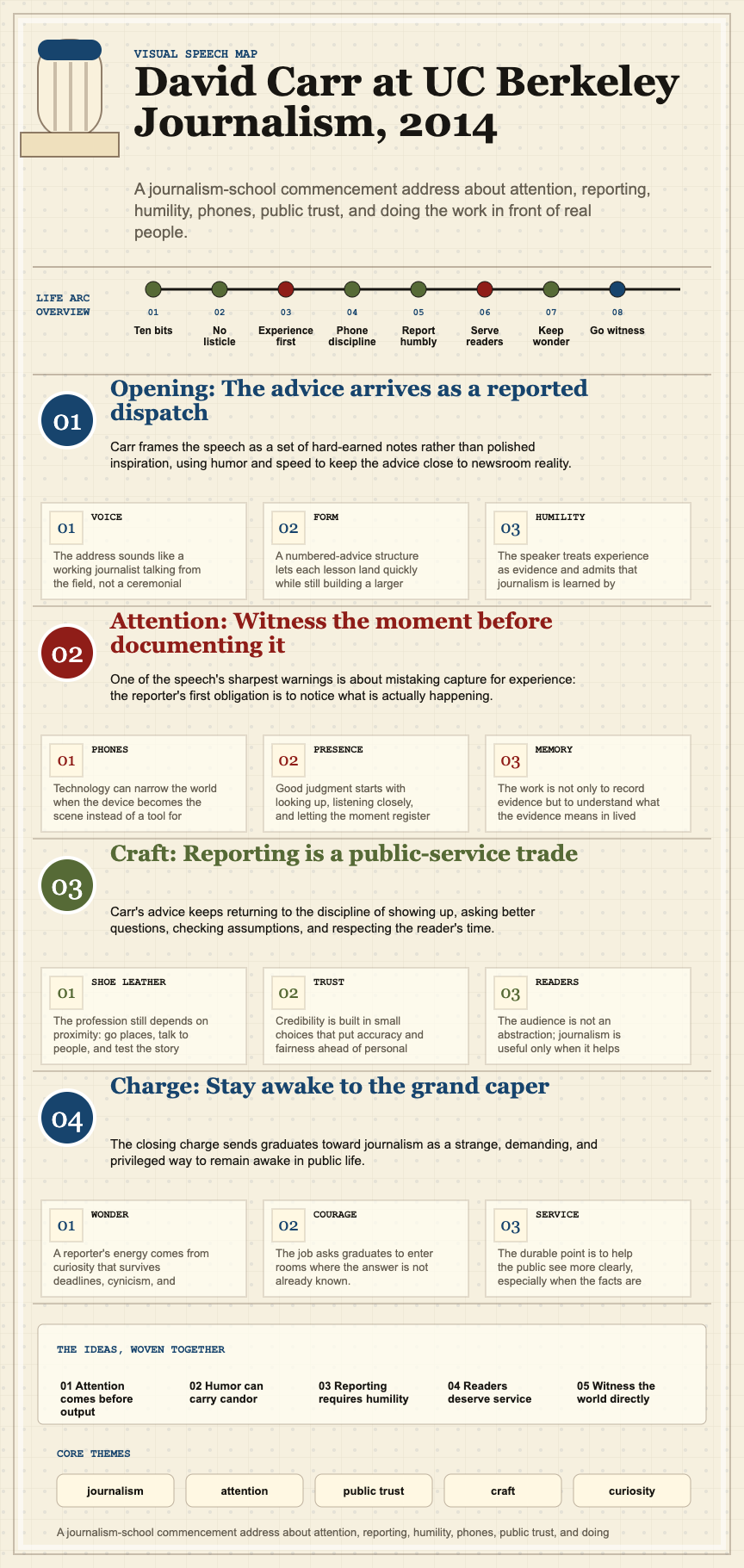
David Carr at UC Berkeley Journalism, 2014
A journalism-school commencement address about attention, reporting, humility, phones, public trust, and doing the work in front of real people.
Speech arc
- 01Ten bits
Opening move
- 02No listicle
Speech beat
- 03Experience first
Speech beat
- 04Phone discipline
Speech beat
- 05Report humbly
Speech beat
- 06Serve readers
Speech beat
- 07Keep wonder
Speech beat
- 08Go witness
Final charge
Opening: The advice arrives as a reported dispatch
Carr frames the speech as a set of hard-earned notes rather than polished inspiration, using humor and speed to keep the advice close to newsroom reality.
Voice
The address sounds like a working journalist talking from the field, not a ceremonial authority floating above it.
Form
A numbered-advice structure lets each lesson land quickly while still building a larger ethic of attention.
Humility
The speaker treats experience as evidence and admits that journalism is learned by repeated contact with uncertainty.
Carr frames the speech as a set of hard-earned notes rather than polished inspiration, using humor and speed to keep the advice close to newsroom reality.
Attention: Witness the moment before documenting it
One of the speech's sharpest warnings is about mistaking capture for experience: the reporter's first obligation is to notice what is actually happening.
Phones
Technology can narrow the world when the device becomes the scene instead of a tool for seeing.
Presence
Good judgment starts with looking up, listening closely, and letting the moment register before turning it into output.
Memory
The work is not only to record evidence but to understand what the evidence means in lived context.
One of the speech's sharpest warnings is about mistaking capture for experience: the reporter's first obligation is to notice what is actually happening.
Craft: Reporting is a public-service trade
Carr's advice keeps returning to the discipline of showing up, asking better questions, checking assumptions, and respecting the reader's time.
Shoe leather
The profession still depends on proximity: go places, talk to people, and test the story against the world.
Trust
Credibility is built in small choices that put accuracy and fairness ahead of personal performance.
Readers
The audience is not an abstraction; journalism is useful only when it helps people understand what they cannot see alone.
Carr's advice keeps returning to the discipline of showing up, asking better questions, checking assumptions, and respecting the reader's time.
• Key takeaways •
Attention comes before output
Connects to journalism.
Humor can carry candor
Connects to attention.
Reporting requires humility
Connects to public trust.
Readers deserve service
Connects to craft.
Witness the world directly
Connects to curiosity.
Closing charge
The closing charge sends graduates toward journalism as a strange, demanding, and privileged way to remain awake in public life.
Stay awake to the grand caper
Wonder
A reporter's energy comes from curiosity that survives deadlines, cynicism, and institutional churn.
Courage
The job asks graduates to enter rooms where the answer is not already known.
Service
The durable point is to help the public see more clearly, especially when the facts are contested.
The closing charge sends graduates toward journalism as a strange, demanding, and privileged way to remain awake in public life.
Visual speech maps
Browse more visual maps from University of California, Berkeley, Graduate School of Journalism or continue with related mapped speeches below.
Transcript
The previously catalogued transcript link is no longer live and is queued for re-sourcing. A video of the address is available above.
Machine transcript available for archive analysis; it is unverified and may contain transcription errors. Machine transcript source ->
Provenance
BROKEN transcript link (checked 2026-06-26): graduationwisdom.com repurposed into lifestyle blog; speech pages gone. Provenance: Imported from NPR commencement archive; cross-referenced with Open Commencement DB
NPR archive last updated in 2015; destination availability has not been exhaustively rechecked | Open Commencement DB transcript; not independently verified against the original recording | Transcript URL dead (graduationwisdom.com repurposed into lifestyle blog; speech pages gone); video fallback present
Explore this speech
Find the next thread through the archive
Themes in this address
Speeches like this one
Search all speeches ->