Anthony Kennedy
U.S. Supreme Court justice
Justice Anthony Kennedy urges Stanford graduates to see themselves as trustees of freedom under law, arguing that American freedom carries a duty to help secure it for others around the world. Drawing on examples from his teaching in China, the absence of the rule of law in struggling nations, and the costs of corruption and lack of property rights, he contends that law is an instrument of progress rather than a threat. He calls on graduates to know and revere their constitutional heritage and to use their interconnected, empowered generation to advance law and freedom globally.
“With our own freedom comes the duty to secure it for others.”
Key moments
- 01 Freedom carries the duty to secure it for others, and freedom requires law
- 02 Examples from teaching in China and the 'Legally Blonde' anecdote about taking risks
- 03 Illustrations of life without rule of law: fines, human trafficking, business licensing, water crisis
- 04 Contrast with Solzhenitsyn's view of law, and the call to revere and defend the Constitution
Save the visual map
Download or open the generated poster as a standalone PNG.
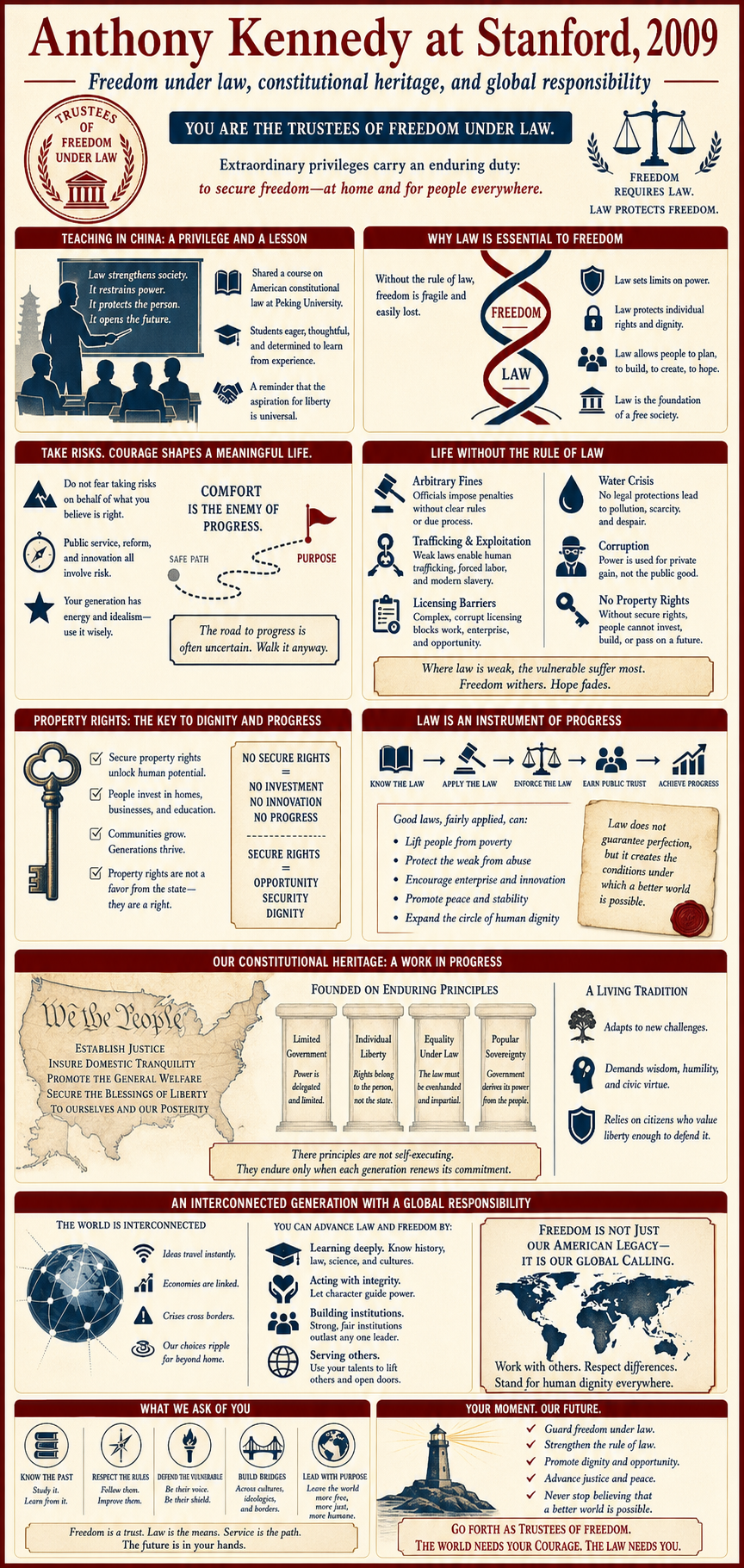
Anthony Kennedy at Stanford, 2009
A commencement address about freedom under law, constitutional heritage, civic duty, and global responsibility.
Speech arc
- 01Trustees of freedom
Opening move
- 02Law enables liberty
Speech beat
- 03China teaching
Speech beat
- 04Risk
Speech beat
- 05No rule of law
Speech beat
- 06Corruption
Speech beat
- 07Constitution
Speech beat
- 08Global duty
Final charge
Trusteeship: Freedom carries duty
Kennedy asks graduates to see themselves as trustees of freedom under law, responsible for more than private liberty.
Trust
Freedom is inherited and held for others.
Duty
American liberty carries global obligation.
Law
Freedom needs structure to endure.
Kennedy asks graduates to see themselves as trustees of freedom under law, responsible for more than private liberty.
Teaching: Law as progress
Examples from teaching and global encounters show law as a practical instrument for human dignity and development.
China
Classroom stories make legal ideals concrete.
Risk
Professional courage includes entering unfamiliar places.
Progress
Law can enable commerce, safety, and civic trust.
Examples from teaching and global encounters show law as a practical instrument for human dignity and development.
Absence: What happens without law
Arbitrary fines, trafficking, licensing barriers, water crises, corruption, and insecure property rights reveal the cost of legal failure.
Arbitrary power
Without law, power becomes unpredictable.
Rights
People need enforceable protections.
Property
Security lets communities build.
Arbitrary fines, trafficking, licensing barriers, water crises, corruption, and insecure property rights reveal the cost of legal failure.
• Key takeaways •
Freedom requires law
Connects to rule of law.
Liberty creates duty
Connects to freedom.
Legal failure has human cost
Connects to constitution.
Constitutional heritage needs stewards
Connects to civic duty.
Global responsibility follows power
Connects to global responsibility.
Closing charge
The speech closes by linking constitutional reverence to an interconnected generation's responsibility to advance freedom globally.
Know and defend the Constitution
Constitution
Heritage must be known to be defended.
Generation
Interconnection gives graduates new reach.
Charge
Use law to widen freedom.
The speech closes by linking constitutional reverence to an interconnected generation's responsibility to advance freedom globally.
Visual speech maps
Browse more visual maps from Stanford University or continue with related mapped speeches below.
Transcript
The full transcript is hosted by the original publisher. Commencement Archive links to the source rather than republishing copyrighted text.
Read the full transcript at source →Provenance
Verified from official archive; targeted event-level link verified
Explore this speech
Find the next thread through the archive
Themes in this address
Speeches like this one
Search all speeches ->