Atul Gawande
Field: science
Gawande opens with research showing that children with cancer often report equal or better quality of life than healthy children, attributing this to environments of care, connection, and shared purpose that strengthened them through adversity. He argues that true flourishing comes not from pursuing personal passions or defeating rivals, but from finding a place in the world where one contributes to something larger than oneself. He encourages graduates to seek purpose through community and service, drawing on his own experience in medicine.
Key moments
- 01 Story of a pediatrician's puzzling quality-of-life study on children with cancer
- 02 St. Jude's research showing cancer survivors developed empathy and resilience
- 03 College as a place to experiment, connect, and find direction
- 04 Warning against defining purpose through enemies or narrow self-interest
- 05 Purpose as finding a place where you help others reach their potential
Save the visual map
Download or open the generated poster as a standalone PNG.
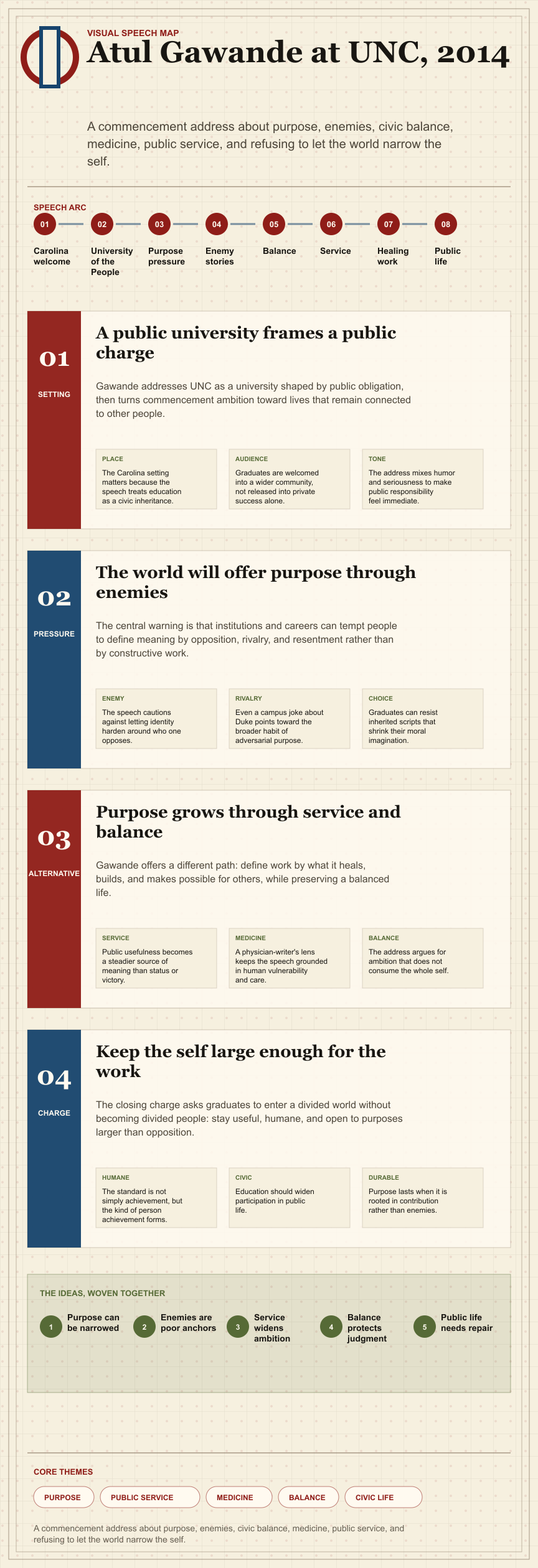
Atul Gawande at UNC, 2014
A commencement address about purpose, enemies, civic balance, medicine, public service, and refusing to let the world narrow the self.
Speech arc
- 01Carolina welcome
Opening move
- 02University of the People
Speech beat
- 03Purpose pressure
Speech beat
- 04Enemy stories
Speech beat
- 05Balance
Speech beat
- 06Service
Speech beat
- 07Healing work
Speech beat
- 08Public life
Final charge
Setting: A public university frames a public charge
Gawande addresses UNC as a university shaped by public obligation, then turns commencement ambition toward lives that remain connected to other people.
Place
The Carolina setting matters because the speech treats education as a civic inheritance.
Audience
Graduates are welcomed into a wider community, not released into private success alone.
Tone
The address mixes humor and seriousness to make public responsibility feel immediate.
Gawande addresses UNC as a university shaped by public obligation, then turns commencement ambition toward lives that remain connected to other people.
Pressure: The world will offer purpose through enemies
The central warning is that institutions and careers can tempt people to define meaning by opposition, rivalry, and resentment rather than by constructive work.
Enemy
The speech cautions against letting identity harden around who one opposes.
Rivalry
Even a campus joke about Duke points toward the broader habit of adversarial purpose.
Choice
Graduates can resist inherited scripts that shrink their moral imagination.
The central warning is that institutions and careers can tempt people to define meaning by opposition, rivalry, and resentment rather than by constructive work.
Alternative: Purpose grows through service and balance
Gawande offers a different path: define work by what it heals, builds, and makes possible for others, while preserving a balanced life.
Service
Public usefulness becomes a steadier source of meaning than status or victory.
Medicine
A physician-writer's lens keeps the speech grounded in human vulnerability and care.
Balance
The address argues for ambition that does not consume the whole self.
Gawande offers a different path: define work by what it heals, builds, and makes possible for others, while preserving a balanced life.
• Key takeaways •
Purpose can be narrowed
Connects to purpose.
Enemies are poor anchors
Connects to public service.
Service widens ambition
Connects to medicine.
Balance protects judgment
Connects to balance.
Public life needs repair
Connects to civic life.
Closing charge
The closing charge asks graduates to enter a divided world without becoming divided people: stay useful, humane, and open to purposes larger than opposition.
Keep the self large enough for the work
Humane
The standard is not simply achievement, but the kind of person achievement forms.
Civic
Education should widen participation in public life.
Durable
Purpose lasts when it is rooted in contribution rather than enemies.
The closing charge asks graduates to enter a divided world without becoming divided people: stay useful, humane, and open to purposes larger than opposition.
Visual speech maps
Browse more visual maps from University of North Carolina at Chapel Hill or continue with related mapped speeches below.
Transcript
The previously catalogued transcript link is no longer live and is queued for re-sourcing. A video of the address is available above.
Machine transcript available for archive analysis; it is unverified and may contain transcription errors. Machine transcript source ->
Provenance
BROKEN transcript link (checked 2026-06-26): returns 404 Not Found. Provenance: Imported from NPR commencement archive; cross-referenced with Open Commencement DB
NPR archive last updated in 2015; destination availability has not been exhaustively rechecked | Open Commencement DB transcript; not independently verified against the original recording | Transcript URL dead (returns 404 Not Found); video fallback present
Explore this speech
Find the next thread through the archive
Themes in this address
Speeches like this one
Search all speeches ->