Jason Kilar
Field: business
Save the visual map
Download or open the generated poster as a standalone PNG.
Jason Kilar at UNC-Chapel Hill, 2015
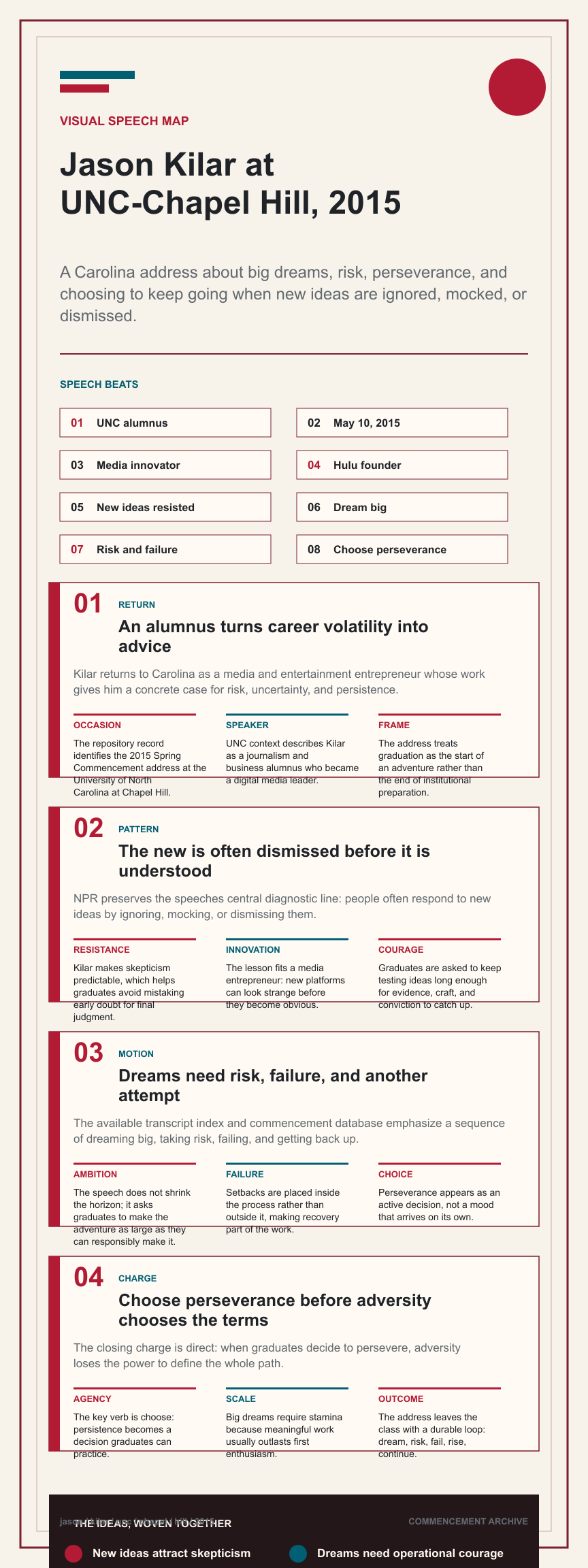
A Carolina address about big dreams, risk, perseverance, and choosing to keep going when new ideas are ignored, mocked, or dismissed.
Speech arc
- 01UNC alumnus
Opening move
- 02May 10, 2015
Speech beat
- 03Media innovator
Speech beat
- 04Hulu founder
Speech beat
- 05New ideas resisted
Speech beat
- 06Dream big
Speech beat
- 07Risk and failure
Speech beat
- 08Choose perseverance
Final charge
Return: An alumnus turns career volatility into advice
Kilar returns to Carolina as a media and entertainment entrepreneur whose work gives him a concrete case for risk, uncertainty, and persistence.
Occasion
The repository record identifies the 2015 Spring Commencement address at the University of North Carolina at Chapel Hill.
Speaker
UNC context describes Kilar as a journalism and business alumnus who became a digital media leader.
Frame
The address treats graduation as the start of an adventure rather than the end of institutional preparation.
Kilar returns to Carolina as a media and entertainment entrepreneur whose work gives him a concrete case for risk, uncertainty, and persistence.
Pattern: The new is often dismissed before it is understood
NPR preserves the speech's central diagnostic line: people often respond to new ideas by ignoring, mocking, or dismissing them.
Resistance
Kilar makes skepticism predictable, which helps graduates avoid mistaking early doubt for final judgment.
Innovation
The lesson fits a media entrepreneur: new platforms can look strange before they become obvious.
Courage
Graduates are asked to keep testing ideas long enough for evidence, craft, and conviction to catch up.
NPR preserves the speech's central diagnostic line: people often respond to new ideas by ignoring, mocking, or dismissing them.
Motion: Dreams need risk, failure, and another attempt
The available transcript index and commencement database emphasize a sequence of dreaming big, taking risk, failing, and getting back up.
Ambition
The speech does not shrink the horizon; it asks graduates to make the adventure as large as they can responsibly make it.
Failure
Setbacks are placed inside the process rather than outside it, making recovery part of the work.
Choice
Perseverance appears as an active decision, not a mood that arrives on its own.
The available transcript index and commencement database emphasize a sequence of dreaming big, taking risk, failing, and getting back up.
• Key takeaways •
New ideas attract skepticism
Connects to perseverance.
Dreams need operational courage
Connects to innovation.
Failure belongs inside the process
Connects to risk.
Perseverance is a choice
Connects to failure.
Adventure rewards the persistent
Connects to purpose.
Closing charge
The closing charge is direct: when graduates decide to persevere, adversity loses the power to define the whole path.
Choose perseverance before adversity chooses the terms
Agency
The key verb is choose: persistence becomes a decision graduates can practice.
Scale
Big dreams require stamina because meaningful work usually outlasts first enthusiasm.
Outcome
The address leaves the class with a durable loop: dream, risk, fail, rise, continue.
The closing charge is direct: when graduates decide to persevere, adversity loses the power to define the whole path.
Visual speech maps
Browse more visual maps from University of North Carolina at Chapel Hill or continue with related mapped speeches below.
Transcript
The full transcript is hosted by the original publisher. Commencement Archive links to the source rather than republishing copyrighted text.
Read the full transcript at source →Provenance
Imported from NPR commencement archive; cross-referenced with Open Commencement DB
NPR archive last updated in 2015; destination availability has not been exhaustively rechecked | Open Commencement DB transcript; not independently verified against the original recording
Explore this speech
Find the next thread through the archive
Themes in this address
No canonical themes have been assigned yet.