Ursula M. Burns
Chairman and CEO, Xerox
At MIT's 145th Commencement, Xerox chairwoman and CEO Ursula M. Burns urged graduates to set their sights on changing the world and leaving the planet better than they found it. She emphasized that making a difference need not be grandiose, citing examples like working for organizations that create decent jobs, raising a family with good values, or mentoring a child. Burns, who is also a parent of a graduating student, praised the Class of 2011 as among the best and brightest.
“Believe in something larger than yourself. Make a difference.”
Key moments
- 01 Calling on graduates to leave behind more than they took away
- 02 Defining meaningful impact through everyday acts like mentoring or raising a family
- 03 Urging graduates to believe in something larger than themselves
- 04 Expressing pride as both speaker and parent of a graduate
Save the visual map
Download or open the generated poster as a standalone PNG.
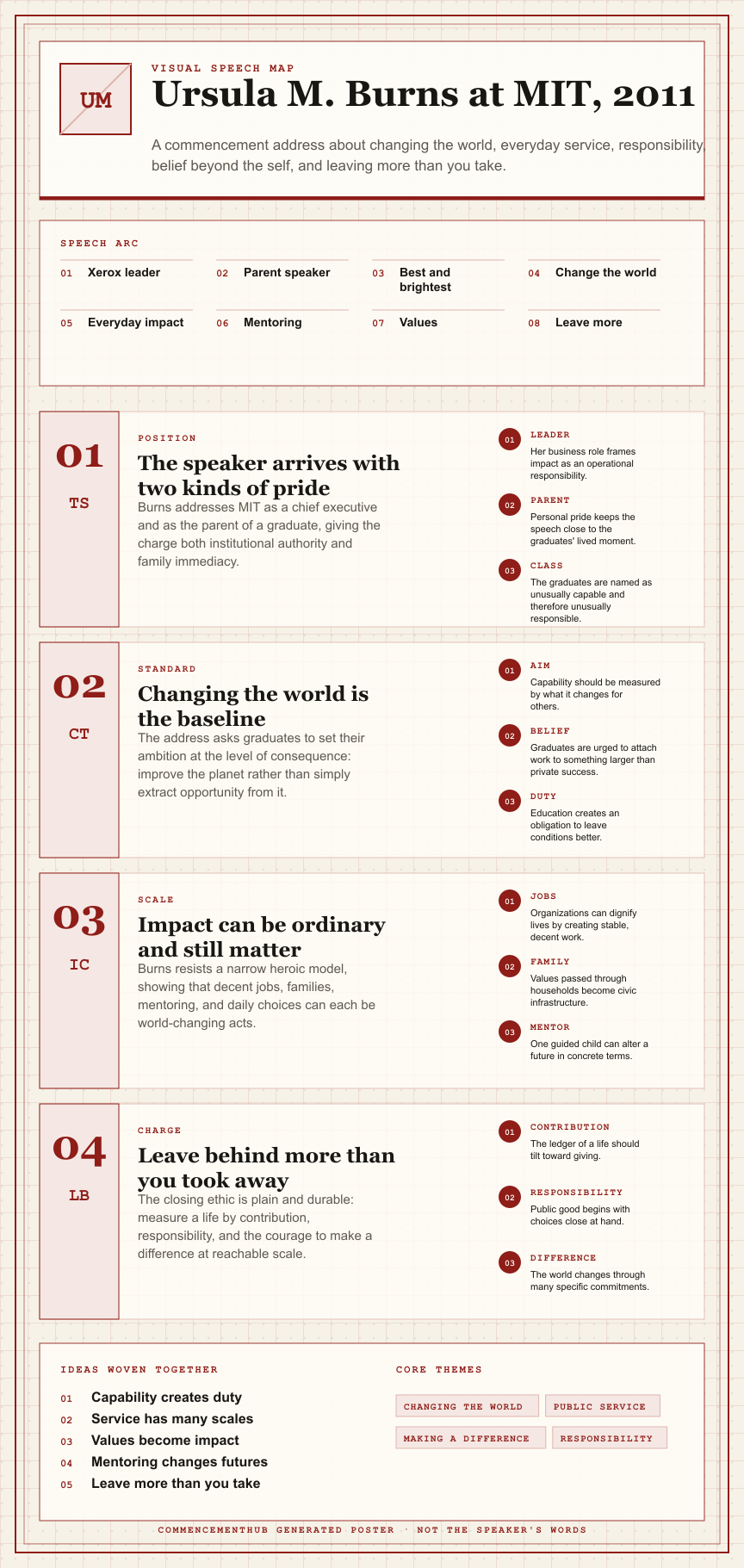
Ursula M. Burns at MIT, 2011
A commencement address about changing the world, everyday service, responsibility, belief beyond the self, and leaving more than you take.
Speech arc
- 01Xerox leader
Opening move
- 02Parent speaker
Speech beat
- 03Best and brightest
Speech beat
- 04Change the world
Speech beat
- 05Everyday impact
Speech beat
- 06Mentoring
Speech beat
- 07Values
Speech beat
- 08Leave more
Final charge
Position: The speaker arrives with two kinds of pride
Burns addresses MIT as a chief executive and as the parent of a graduate, giving the charge both institutional authority and family immediacy.
Leader
Her business role frames impact as an operational responsibility.
Parent
Personal pride keeps the speech close to the graduates' lived moment.
Class
The graduates are named as unusually capable and therefore unusually responsible.
Burns addresses MIT as a chief executive and as the parent of a graduate, giving the charge both institutional authority and family immediacy.
Standard: Changing the world is the baseline
The address asks graduates to set their ambition at the level of consequence: improve the planet rather than simply extract opportunity from it.
Aim
Capability should be measured by what it changes for others.
Belief
Graduates are urged to attach work to something larger than private success.
Duty
Education creates an obligation to leave conditions better.
The address asks graduates to set their ambition at the level of consequence: improve the planet rather than simply extract opportunity from it.
Scale: Impact can be ordinary and still matter
Burns resists a narrow heroic model, showing that decent jobs, families, mentoring, and daily choices can each be world-changing acts.
Jobs
Organizations can dignify lives by creating stable, decent work.
Family
Values passed through households become civic infrastructure.
Mentor
One guided child can alter a future in concrete terms.
Burns resists a narrow heroic model, showing that decent jobs, families, mentoring, and daily choices can each be world-changing acts.
• Key takeaways •
Capability creates duty
Connects to changing the world.
Service has many scales
Connects to public service.
Values become impact
Connects to making a difference.
Mentoring changes futures
Connects to responsibility.
Leave more than you take
A core idea carried through the address.
Closing charge
The closing ethic is plain and durable: measure a life by contribution, responsibility, and the courage to make a difference at reachable scale.
Leave behind more than you took away
Contribution
The ledger of a life should tilt toward giving.
Responsibility
Public good begins with choices close at hand.
Difference
The world changes through many specific commitments.
The closing ethic is plain and durable: measure a life by contribution, responsibility, and the courage to make a difference at reachable scale.
Visual speech maps
Browse more visual maps from Massachusetts Institute of Technology or continue with related mapped speeches below.
Transcript
No official full transcript has been located yet. If you know of one, suggestions are welcome.
Provenance
Verified from official archive
Explore this speech
Find the next thread through the archive
Themes in this address
Speeches like this one
Search all speeches ->