Salman Khan
Founder and Executive Director, Khan Academy
Khan Academy founder and MIT alumnus Salman Khan praises MIT for prioritizing principle over profit through initiatives like OpenCourseWare and edX, crediting the Institute as an inspiration for his own work. He celebrates the intensity and bonds of the MIT experience with humor, comparing the school to Hogwarts. He then offers graduates personal advice on happiness, relationships, empathy, and pursuing passions, urging them to use their gifts to better the world.
“The best way to make people feel that you are listening to them, is to listen to them.”
Key moments
- 01 Praise for MIT OpenCourseWare and edX as putting principle over profit
- 02 Humorous comparison of MIT to Hogwarts and its intense, bonding experience
- 03 Practical tips for happiness, empathy, and listening
- 04 Advice to pursue passions, not waste inspiration, and value relationships over status
- 05 A 'genie' thought experiment about regrets and a second chance
Save the visual map
Download or open the generated poster as a standalone PNG.
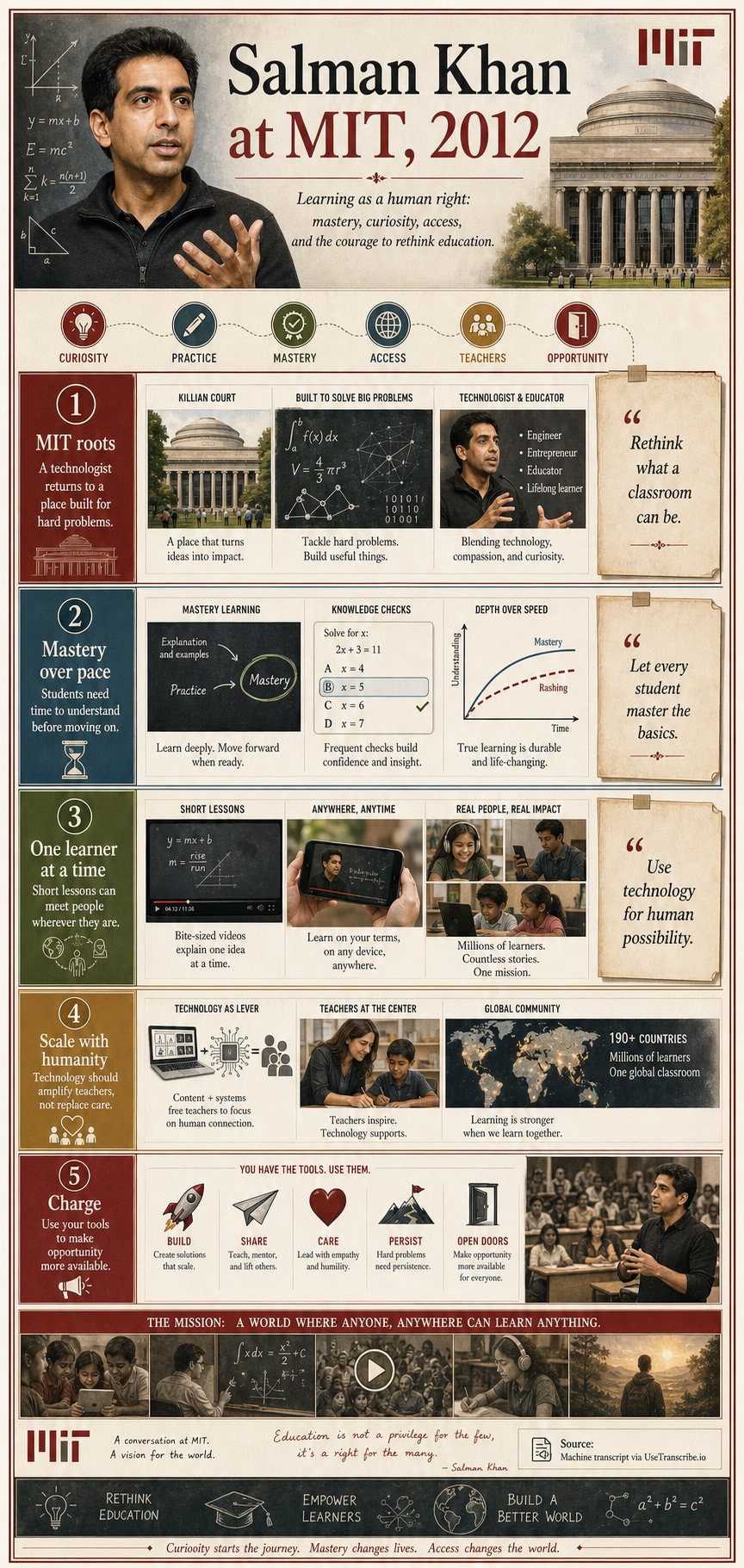
Salman Khan at MIT, 2012
A commencement address about open education, MIT intensity, happiness, empathy, relationships, and using inspiration to serve the world.
Speech arc
- 01OpenCourseWare
Opening move
- 02edX
Speech beat
- 03MIT as Hogwarts
Speech beat
- 04Shared intensity
Speech beat
- 05Happiness habits
Speech beat
- 06Empathy
Speech beat
- 07Passion
Speech beat
- 08Second chance
Final charge
Institution: MIT makes access part of its identity
Khan praises the Institute for choosing principle over profit through OpenCourseWare and edX, framing MIT as a model for making knowledge more widely usable.
Access
Open courses turn elite teaching into a public resource.
Principle
The Institute's example validates education work aimed beyond campus walls.
Influence
Khan Academy's mission is placed in conversation with MIT's own public-minded experiments.
Khan praises the Institute for choosing principle over profit through OpenCourseWare and edX, framing MIT as a model for making knowledge more widely usable.
Community: The pressure becomes a shared language
Humor about MIT as Hogwarts and the intensity of student life turns difficulty into a bond that graduates carry forward.
Myth
The campus is treated as a place where demanding work feels almost magical.
Intensity
The workload is remembered as proof of capacity, not merely stress.
Belonging
Shared strain creates durable trust among classmates.
Humor about MIT as Hogwarts and the intensity of student life turns difficulty into a bond that graduates carry forward.
Practice: Happiness depends on attention to people
The advice narrows from global education to daily conduct: listen well, choose empathy, and treat relationships as central rather than incidental.
Listen
Attention to another person becomes a practical form of respect.
Empathy
Understanding other lives is part of intelligent action.
Status
External markers matter less than the quality of human connection.
The advice narrows from global education to daily conduct: listen well, choose empathy, and treat relationships as central rather than incidental.
• Key takeaways •
Knowledge should travel
Connects to education access.
Intensity can build kinship
Connects to happiness.
Happiness is relational
Connects to empathy.
Empathy is a discipline
Connects to passion.
Use gifts before regret
Connects to relationships.
Closing charge
The closing thought experiment asks graduates to imagine returning with the chance to avoid regret, then spend their gifts on passionate and useful work.
Treat inspiration as a second chance
Passion
Do not postpone the work that feels alive and consequential.
Service
Talent is most meaningful when it improves lives beyond the self.
Regret
A simulated second chance makes today's choices feel urgent.
The closing thought experiment asks graduates to imagine returning with the chance to avoid regret, then spend their gifts on passionate and useful work.
Visual speech maps
Browse more visual maps from Massachusetts Institute of Technology or continue with related mapped speeches below.
Transcript
No official full transcript has been located yet. A video of the address is available above.
Machine transcript available for archive analysis; it is unverified and may contain transcription errors.
Provenance
Verified from official archive; cross-referenced with NPR commencement archive; cross-referenced with Open Commencement DB
NPR archive last updated in 2015; destination availability has not been exhaustively rechecked | Open Commencement DB transcript; not independently verified against the original recording
Explore this speech
Find the next thread through the archive
Themes in this address
Speeches like this one
Search all speeches ->