Jonathan Safran Foer
Field: letters
Foer recounts seeing a teenage girl crying on her phone in public and his hesitation over whether to intervene, using the moment to explore how communication technologies make it easier to retreat from genuine human connection. He argues that we have come to prefer diminished substitutes for face-to-face interaction, and that this habit gradually erodes our capacity for attention and empathy. He concludes that attending to the needs of others, though difficult, is the essential work of a finite life.
Key moments
- 01 Witnessing a crying stranger and weighing whether to intervene
- 02 Argument that technology celebrates connectedness but encourages retreat
- 03 Communication tools as diminished substitutes we come to prefer
- 04 Attentiveness and empathy as the essential work of a mortal life
Save the visual map
Download or open the generated poster as a standalone PNG.
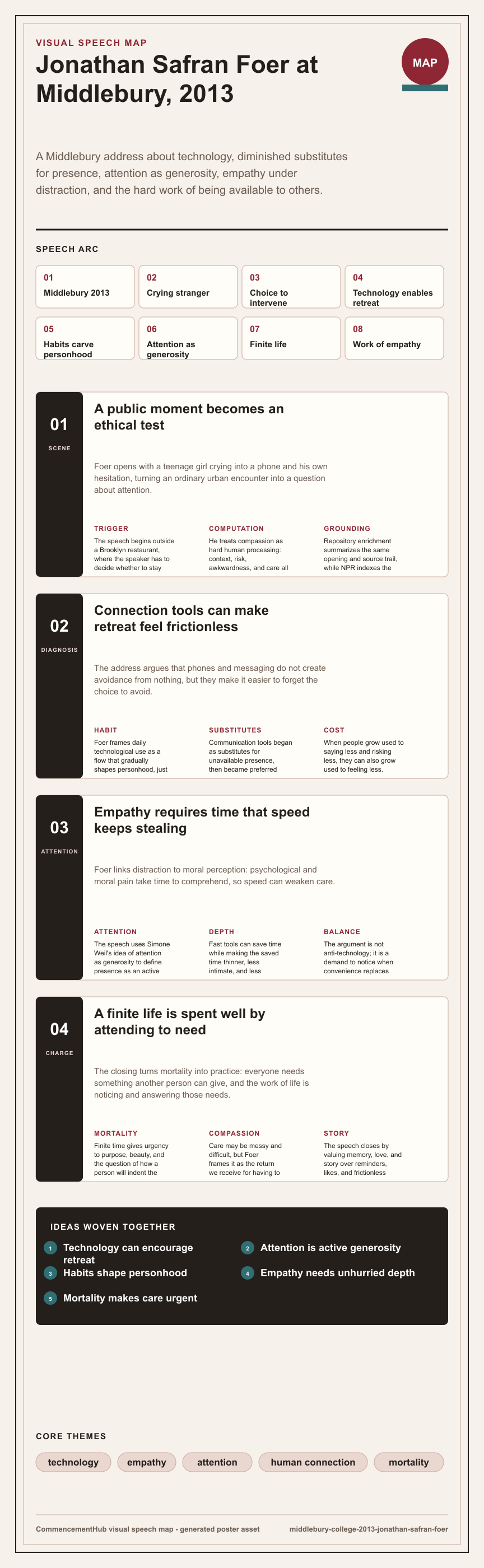
Jonathan Safran Foer at Middlebury, 2013
A Middlebury address about technology, diminished substitutes for presence, attention as generosity, empathy under distraction, and the hard work of being available to others.
Speech arc
- 01Middlebury 2013
Opening move
- 02Crying stranger
Speech beat
- 03Choice to intervene
Speech beat
- 04Technology enables retreat
Speech beat
- 05Habits carve personhood
Speech beat
- 06Attention as generosity
Speech beat
- 07Finite life
Speech beat
- 08Work of empathy
Final charge
Scene: A public moment becomes an ethical test
Foer opens with a teenage girl crying into a phone and his own hesitation, turning an ordinary urban encounter into a question about attention.
Trigger
The speech begins outside a Brooklyn restaurant, where the speaker has to decide whether to stay inside his phone or respond to another person.
Computation
He treats compassion as hard human processing: context, risk, awkwardness, and care all have to be weighed at once.
Grounding
Repository enrichment summarizes the same opening and source trail, while NPR indexes the speech under unplugging and changing the world.
Foer opens with a teenage girl crying into a phone and his own hesitation, turning an ordinary urban encounter into a question about attention.
Diagnosis: Connection tools can make retreat feel frictionless
The address argues that phones and messaging do not create avoidance from nothing, but they make it easier to forget the choice to avoid.
Habit
Foer frames daily technological use as a flow that gradually shapes personhood, just as water carves rock over time.
Substitutes
Communication tools began as substitutes for unavailable presence, then became preferred because each reduced emotional demand.
Cost
When people grow used to saying less and risking less, they can also grow used to feeling less.
The address argues that phones and messaging do not create avoidance from nothing, but they make it easier to forget the choice to avoid.
Attention: Empathy requires time that speed keeps stealing
Foer links distraction to moral perception: psychological and moral pain take time to comprehend, so speed can weaken care.
Attention
The speech uses Simone Weil's idea of attention as generosity to define presence as an active gift rather than a passive mood.
Depth
Fast tools can save time while making the saved time thinner, less intimate, and less available for others.
Balance
The argument is not anti-technology; it is a demand to notice when convenience replaces humanity.
Foer links distraction to moral perception: psychological and moral pain take time to comprehend, so speed can weaken care.
• Key takeaways •
Technology can encourage retreat
Connects to technology.
Attention is active generosity
Connects to empathy.
Habits shape personhood
Connects to attention.
Empathy needs unhurried depth
Connects to human connection.
Mortality makes care urgent
Connects to mortality.
Closing charge
The closing turns mortality into practice: everyone needs something another person can give, and the work of life is noticing and answering those needs.
A finite life is spent well by attending to need
Mortality
Finite time gives urgency to purpose, beauty, and the question of how a person will indent the world.
Compassion
Care may be messy and difficult, but Foer frames it as the return we receive for having to die.
Story
The speech closes by valuing memory, love, and story over reminders, likes, and frictionless contact.
The closing turns mortality into practice: everyone needs something another person can give, and the work of life is noticing and answering those needs.
Visual speech maps
Browse more visual maps from Middlebury College or continue with related mapped speeches below.
Transcript
The full transcript is hosted by the original publisher. Commencement Archive links to the source rather than republishing copyrighted text.
Read the full transcript at source →Provenance
Imported from NPR commencement archive; cross-referenced with Open Commencement DB
NPR archive last updated in 2015; destination availability has not been exhaustively rechecked | Open Commencement DB transcript; not independently verified against the original recording
Explore this speech
Find the next thread through the archive
Themes in this address
Speeches like this one
Search all speeches ->