Anna Quindlen
Field: letters
Anna Quindlen, a novelist, urges graduates not to confuse their work with their lives, arguing that a resume is no substitute for relationships, generosity, and presence. Drawing on personal loss and the example of a homeless man she once interviewed, she encourages students to live fully rather than merely exist, to appreciate small details, and to do good as well as do well.
Key moments
- 01 Warning not to confuse one's life with one's work
- 02 Offering a personal 'resume' of being a good parent, spouse, and friend
- 03 Urging graduates to 'get a life' of love, generosity, and attention
- 04 Citing a lesson from a homeless man to 'look at the view'
Save the visual map
Download or open the generated poster as a standalone PNG.
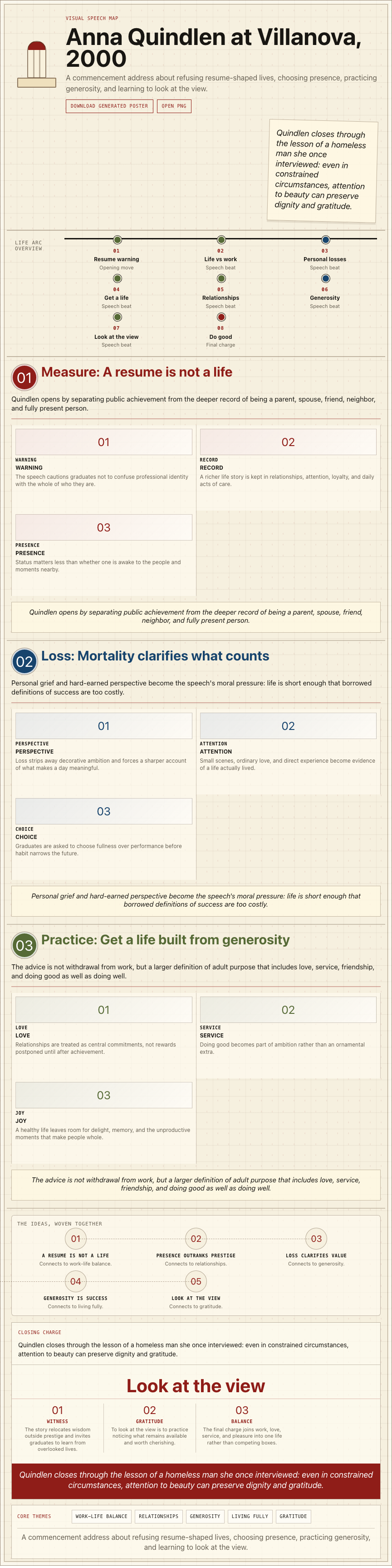
Anna Quindlen at Villanova, 2000
A commencement address about refusing resume-shaped lives, choosing presence, practicing generosity, and learning to look at the view.
Speech arc
- 01Resume warning
Opening move
- 02Life vs work
Speech beat
- 03Personal losses
Speech beat
- 04Get a life
Speech beat
- 05Relationships
Speech beat
- 06Generosity
Speech beat
- 07Look at the view
Speech beat
- 08Do good
Final charge
Measure: A resume is not a life
Quindlen opens by separating public achievement from the deeper record of being a parent, spouse, friend, neighbor, and fully present person.
Warning
The speech cautions graduates not to confuse professional identity with the whole of who they are.
Record
A richer life story is kept in relationships, attention, loyalty, and daily acts of care.
Presence
Status matters less than whether one is awake to the people and moments nearby.
Quindlen opens by separating public achievement from the deeper record of being a parent, spouse, friend, neighbor, and fully present person.
Loss: Mortality clarifies what counts
Personal grief and hard-earned perspective become the speech's moral pressure: life is short enough that borrowed definitions of success are too costly.
Perspective
Loss strips away decorative ambition and forces a sharper account of what makes a day meaningful.
Attention
Small scenes, ordinary love, and direct experience become evidence of a life actually lived.
Choice
Graduates are asked to choose fullness over performance before habit narrows the future.
Personal grief and hard-earned perspective become the speech's moral pressure: life is short enough that borrowed definitions of success are too costly.
Practice: Get a life built from generosity
The advice is not withdrawal from work, but a larger definition of adult purpose that includes love, service, friendship, and doing good as well as doing well.
Love
Relationships are treated as central commitments, not rewards postponed until after achievement.
Service
Doing good becomes part of ambition rather than an ornamental extra.
Joy
A healthy life leaves room for delight, memory, and the unproductive moments that make people whole.
The advice is not withdrawal from work, but a larger definition of adult purpose that includes love, service, friendship, and doing good as well as doing well.
• Key takeaways •
A resume is not a life
Connects to work-life balance.
Presence outranks prestige
Connects to relationships.
Loss clarifies value
Connects to generosity.
Generosity is success
Connects to living fully.
Look at the view
Connects to gratitude.
Closing charge
Quindlen closes through the lesson of a homeless man she once interviewed: even in constrained circumstances, attention to beauty can preserve dignity and gratitude.
Look at the view
Witness
The story relocates wisdom outside prestige and invites graduates to learn from overlooked lives.
Gratitude
To look at the view is to practice noticing what remains available and worth cherishing.
Balance
The final charge joins work, love, service, and pleasure into one life rather than competing boxes.
Quindlen closes through the lesson of a homeless man she once interviewed: even in constrained circumstances, attention to beauty can preserve dignity and gratitude.
Visual speech maps
Browse more visual maps from Villanova University or continue with related mapped speeches below.
Transcript
The full transcript is hosted by the original publisher. Commencement Archive links to the source rather than republishing copyrighted text.
Read the full transcript at source →Provenance
Imported from NPR commencement archive; cross-referenced with Open Commencement DB
NPR archive last updated in 2015; destination availability has not been exhaustively rechecked | Open Commencement DB transcript; not independently verified against the original recording
Explore this speech
Find the next thread through the archive
Themes in this address
Speeches like this one
Search all speeches ->