Raymond S. Stata
Chairman and co-founder, Analog Devices
Raymond S. Stata, cofounder of Analog Devices, recounts his entrepreneurial journey from MIT graduate to building a multi-billion dollar semiconductor company, sharing the principles and values that guided his success. He emphasizes innovation, calculated risk-taking, empowering talented people, learning from failure, and building trustful relationships. He urges graduates to pursue work they are passionate about, stay involved with MIT, and apply their skills to solve societal problems in a world facing crisis and transition.
“You can't play it safe and win.”
Key moments
- 01 Founding Analog Devices and pursuing 'Market Leadership through Technical Innovation'
- 02 Personally funding an integrated-circuit startup over the board's objections to avoid the S-curve
- 03 Learning from failures like Analog Devices Enterprises by reflecting on mistakes
- 04 Charging graduates not to play it safe and to be part of the solution to global challenges
Save the visual map
Download or open the generated poster as a standalone PNG.
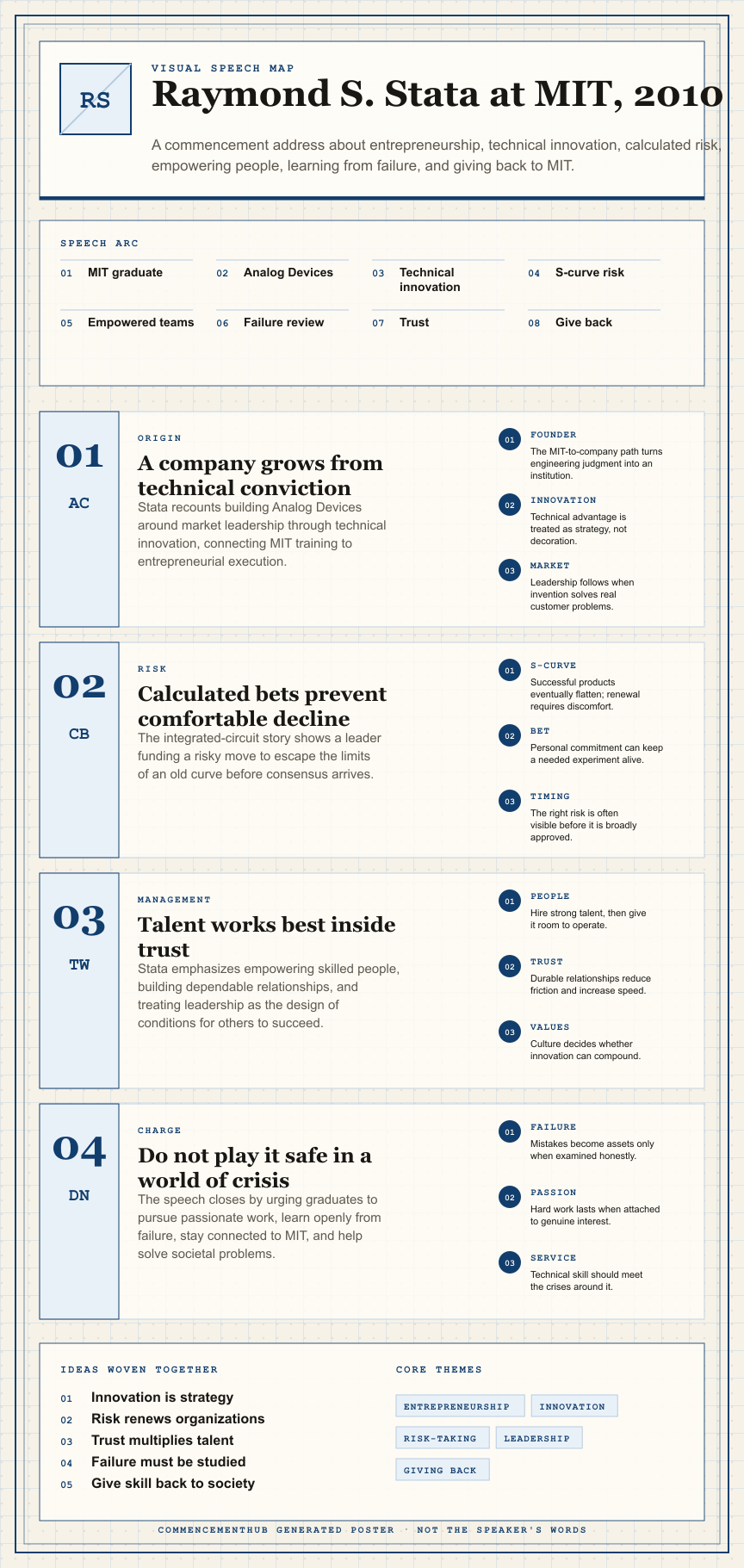
Raymond S. Stata at MIT, 2010
A commencement address about entrepreneurship, technical innovation, calculated risk, empowering people, learning from failure, and giving back to MIT.
Speech arc
- 01MIT graduate
Opening move
- 02Analog Devices
Speech beat
- 03Technical innovation
Speech beat
- 04S-curve risk
Speech beat
- 05Empowered teams
Speech beat
- 06Failure review
Speech beat
- 07Trust
Speech beat
- 08Give back
Final charge
Origin: A company grows from technical conviction
Stata recounts building Analog Devices around market leadership through technical innovation, connecting MIT training to entrepreneurial execution.
Founder
The MIT-to-company path turns engineering judgment into an institution.
Innovation
Technical advantage is treated as strategy, not decoration.
Market
Leadership follows when invention solves real customer problems.
Stata recounts building Analog Devices around market leadership through technical innovation, connecting MIT training to entrepreneurial execution.
Risk: Calculated bets prevent comfortable decline
The integrated-circuit story shows a leader funding a risky move to escape the limits of an old curve before consensus arrives.
S-curve
Successful products eventually flatten; renewal requires discomfort.
Bet
Personal commitment can keep a needed experiment alive.
Timing
The right risk is often visible before it is broadly approved.
The integrated-circuit story shows a leader funding a risky move to escape the limits of an old curve before consensus arrives.
Management: Talent works best inside trust
Stata emphasizes empowering skilled people, building dependable relationships, and treating leadership as the design of conditions for others to succeed.
People
Hire strong talent, then give it room to operate.
Trust
Durable relationships reduce friction and increase speed.
Values
Culture decides whether innovation can compound.
Stata emphasizes empowering skilled people, building dependable relationships, and treating leadership as the design of conditions for others to succeed.
• Key takeaways •
Innovation is strategy
Connects to entrepreneurship.
Risk renews organizations
Connects to innovation.
Trust multiplies talent
Connects to risk-taking.
Failure must be studied
Connects to leadership.
Give skill back to society
Connects to giving back.
Closing charge
The speech closes by urging graduates to pursue passionate work, learn openly from failure, stay connected to MIT, and help solve societal problems.
Do not play it safe in a world of crisis
Failure
Mistakes become assets only when examined honestly.
Passion
Hard work lasts when attached to genuine interest.
Service
Technical skill should meet the crises around it.
The speech closes by urging graduates to pursue passionate work, learn openly from failure, stay connected to MIT, and help solve societal problems.
Visual speech maps
Browse more visual maps from Massachusetts Institute of Technology or continue with related mapped speeches below.
Transcript
No official full transcript has been located yet. If you know of one, suggestions are welcome.
Provenance
Verified from official archive
Explore this speech
Find the next thread through the archive
Themes in this address
Speeches like this one
Search all speeches ->