Robert M. Gates
Field: politics
Defense Secretary Robert Gates congratulates the University of Georgia's Class of 2009 and devotes his address to the obligation of service and citizenship. He honors graduates entering military service, cites examples of UGA alumni who served their country and communities, and argues that public service remains an honorable calling despite its burdens. He urges able and idealistic graduates to step forward and serve the American people.
Key moments
- 01 Honoring eight classmates being commissioned as military officers and fallen UGA alumni
- 02 Citing UGA examples of service like Charlie Beckwith and agronomist D.W. Brooks
- 03 Emphasizing citizens' responsibilities, not just rights
- 04 Calling on graduates to enter public service in a time of 'great necessities'
Save the visual map
Download or open the generated poster as a standalone PNG.
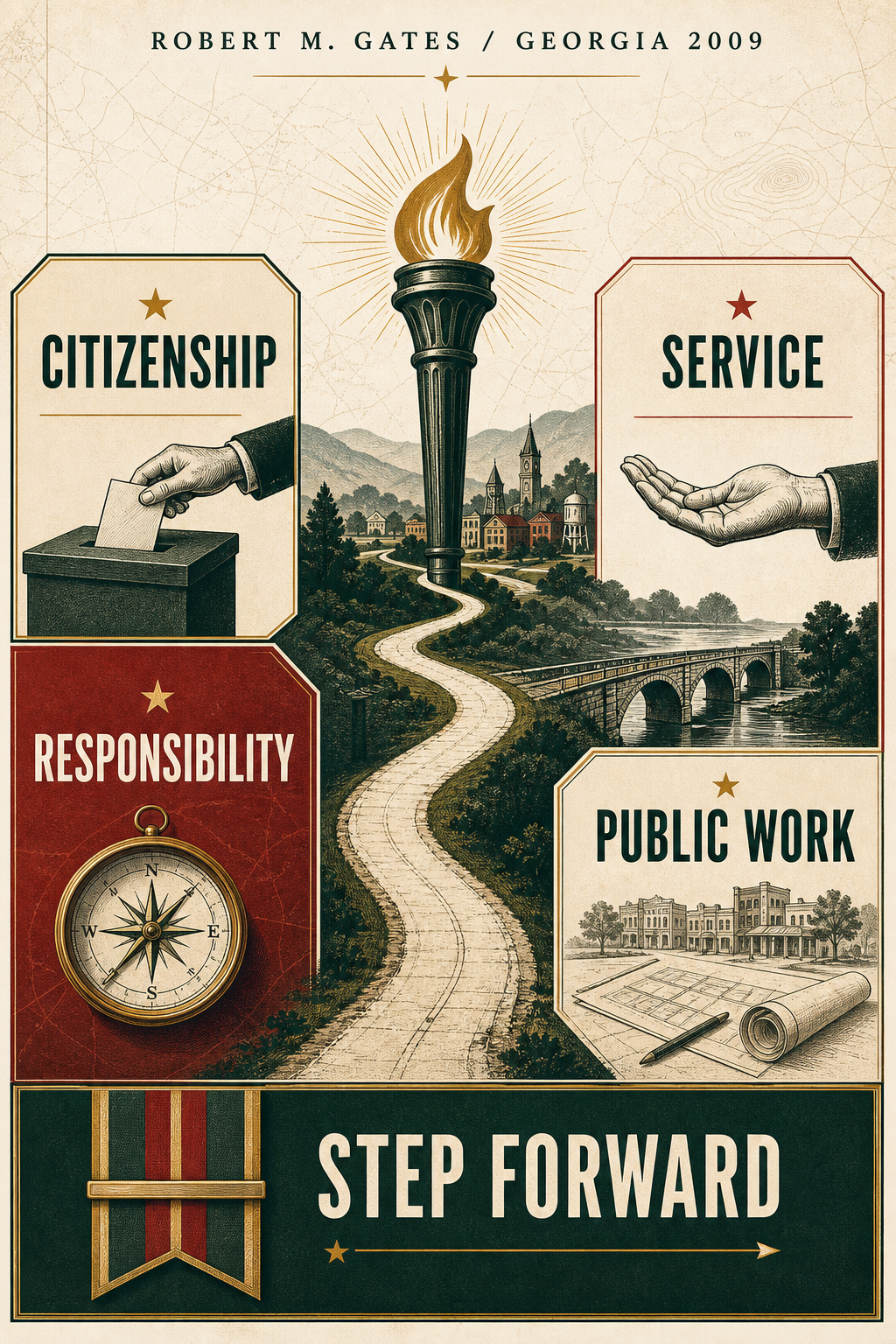
Robert M. Gates at Georgia, 2009
A University of Georgia address about service, citizenship, military sacrifice, public responsibility, and the honorable calling of public life.
Speech arc
- 01University of Georgia
Opening move
- 02Class of 2009
Speech beat
- 03Citizenship responsibilities
Speech beat
- 04Eight officers commissioned
Speech beat
- 05UGA service lineage
Speech beat
- 06Military and civilian service
Speech beat
- 07Public service as honorable
Speech beat
- 08Step forward and serve
Final charge
Frame: Rights become durable when citizens accept duties
Gates moves quickly from ceremonial congratulations to the obligation of service and citizenship, arguing that public life cannot be built only around entitlements and rights.
Occasion
He speaks to the University of Georgia Class of 2009 and uses the ceremony to ask what graduates owe their country and communities.
Contrast
The address contrasts familiar talk of rights with the less comfortable language of responsibilities as citizens.
Charge
Citizenship becomes active: vote, stay informed, strengthen institutions, and work for the common good.
Gates moves quickly from ceremonial congratulations to the obligation of service and citizenship, arguing that public life cannot be built only around entitlements and rights.
Service: Patriotism is shown by deeds, not display
The commissioning of eight classmates lets Gates ground abstract civic duty in people taking an oath to serve, protect, and defend the republic.
Oath
The graduates entering military service embody commitment rather than ease, joining forces still deployed after years of war.
Memory
Gates honors UGA service traditions, including fallen alumni and graduates who answered public needs.
Measure
The speech treats sacrifice and continued service as the test of citizenship, not ceremonial pride alone.
The commissioning of eight classmates lets Gates ground abstract civic duty in people taking an oath to serve, protect, and defend the republic.
Range: There are many paths into public work
Gates broadens service beyond uniformed duty, naming government, science, diplomacy, local communities, and everyday public institutions as places where graduates can contribute.
Fields
The address makes room for work in fields from astronomy to zoology, at home and overseas.
Temperament
Public servants must accept criticism, bureaucracy, and slow progress without surrendering integrity.
Purpose
The point is not prestige; it is joining missions and themes larger than the self.
Gates broadens service beyond uniformed duty, naming government, science, diplomacy, local communities, and everyday public institutions as places where graduates can contribute.
• Key takeaways •
Citizenship asks for responsibility
Connects to public service.
Service is measured in deeds
Connects to citizenship.
Public work has many forms
Connects to military service.
Sacrifice makes duty concrete
Connects to patriotism.
Great necessities require people to step forward
Connects to leadership.
Closing charge
After decades in government, Gates closes with a defense of public service as difficult, meaningful work that a healthy country still needs from able graduates.
Public service remains necessary and honorable
Realism
He does not romanticize the burdens: public life can be mean, risky, frustrating, and misunderstood.
Conviction
Those costs do not erase the honor of work that protects people and strengthens democratic institutions.
Invitation
The final charge is to step forward where the country has great necessities and serve with courage.
After decades in government, Gates closes with a defense of public service as difficult, meaningful work that a healthy country still needs from able graduates.
Visual speech maps
Browse more visual maps from University of Georgia or continue with related mapped speeches below.
Transcript
The full transcript is hosted by the original publisher. Commencement Archive links to the source rather than republishing copyrighted text.
Read the full transcript at source →Provenance
Imported from NPR commencement archive; cross-referenced with Open Commencement DB
NPR archive last updated in 2015; destination availability has not been exhaustively rechecked | Open Commencement DB transcript; not independently verified against the original recording
Explore this speech
Find the next thread through the archive
Themes in this address
Speeches like this one
Search all speeches ->