Jarl Mohn
Field: letters
Save the visual map
Download or open the generated poster as a standalone PNG.
Jarl Mohn at USC Annenberg, 2009
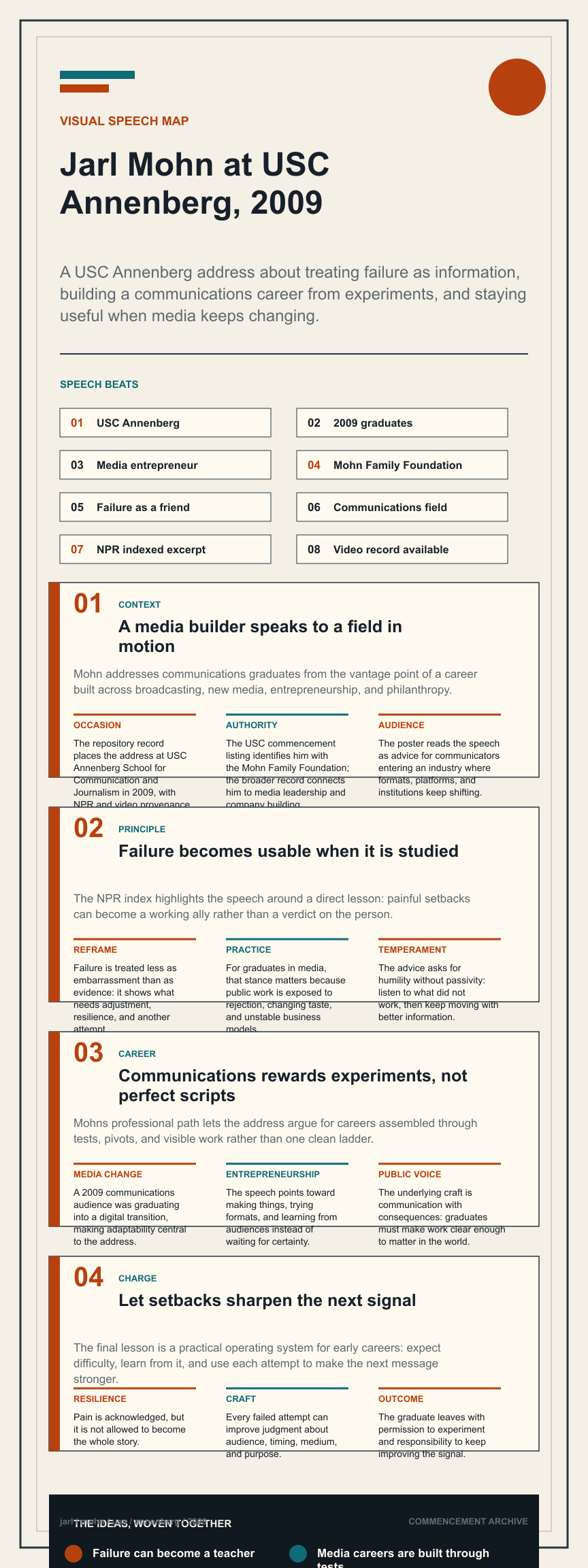
A USC Annenberg address about treating failure as information, building a communications career from experiments, and staying useful when media keeps changing.
Speech arc
- 01USC Annenberg
Opening move
- 022009 graduates
Speech beat
- 03Media entrepreneur
Speech beat
- 04Mohn Family Foundation
Speech beat
- 05Failure as a friend
Speech beat
- 06Communications field
Speech beat
- 07NPR indexed excerpt
Speech beat
- 08Video record available
Final charge
Context: A media builder speaks to a field in motion
Mohn addresses communications graduates from the vantage point of a career built across broadcasting, new media, entrepreneurship, and philanthropy.
Occasion
The repository record places the address at USC Annenberg School for Communication and Journalism in 2009, with NPR and video provenance preserved.
Authority
The USC commencement listing identifies him with the Mohn Family Foundation; the broader record connects him to media leadership and company building.
Audience
The poster reads the speech as advice for communicators entering an industry where formats, platforms, and institutions keep shifting.
Mohn addresses communications graduates from the vantage point of a career built across broadcasting, new media, entrepreneurship, and philanthropy.
Principle: Failure becomes usable when it is studied
The NPR index highlights the speech around a direct lesson: painful setbacks can become a working ally rather than a verdict on the person.
Reframe
Failure is treated less as embarrassment than as evidence: it shows what needs adjustment, resilience, and another attempt.
Practice
For graduates in media, that stance matters because public work is exposed to rejection, changing taste, and unstable business models.
Temperament
The advice asks for humility without passivity: listen to what did not work, then keep moving with better information.
The NPR index highlights the speech around a direct lesson: painful setbacks can become a working ally rather than a verdict on the person.
Career: Communications rewards experiments, not perfect scripts
Mohn's professional path lets the address argue for careers assembled through tests, pivots, and visible work rather than one clean ladder.
Media change
A 2009 communications audience was graduating into a digital transition, making adaptability central to the address.
Entrepreneurship
The speech points toward making things, trying formats, and learning from audiences instead of waiting for certainty.
Public voice
The underlying craft is communication with consequences: graduates must make work clear enough to matter in the world.
Mohn's professional path lets the address argue for careers assembled through tests, pivots, and visible work rather than one clean ladder.
• Key takeaways •
Failure can become a teacher
Connects to failure.
Media careers are built through tests
Connects to resilience.
Adaptability is professional discipline
Connects to creativity.
Public communication needs resilience
Connects to career.
A setback can clarify the signal
Connects to communication.
Closing charge
The final lesson is a practical operating system for early careers: expect difficulty, learn from it, and use each attempt to make the next message stronger.
Let setbacks sharpen the next signal
Resilience
Pain is acknowledged, but it is not allowed to become the whole story.
Craft
Every failed attempt can improve judgment about audience, timing, medium, and purpose.
Outcome
The graduate leaves with permission to experiment and responsibility to keep improving the signal.
The final lesson is a practical operating system for early careers: expect difficulty, learn from it, and use each attempt to make the next message stronger.
Visual speech maps
Browse more visual maps from USC Annenberg School for Communication and Journalism or continue with related mapped speeches below.
Transcript
The full transcript is hosted by the original publisher. Commencement Archive links to the source rather than republishing copyrighted text.
Read the full transcript at source →Provenance
Imported from NPR commencement archive; cross-referenced with Open Commencement DB
NPR archive last updated in 2015; destination availability has not been exhaustively rechecked | Open Commencement DB transcript; not independently verified against the original recording
Explore this speech
Find the next thread through the archive
Themes in this address
No canonical themes have been assigned yet.