Maria Shriver
Field: letters
Maria Shriver addresses USC Annenberg graduates, urging them to resist the pressure to constantly rush toward the next thing and instead embrace what she calls 'the power of the pause.' She encourages the communication and journalism graduates to slow down, verify facts, reflect on their values, and use their power to improve the tone of national discourse. She closes by expressing gratitude, including pride in her daughter Catherine's graduation, and calling on graduates to be courageous, authentic, and committed to fairness and truth.
Key moments
- 01 Reflects on her own graduation and the persistent 'what are you going to do next' question
- 02 Introduces the central idea of 'the power of the pause'
- 03 Urges graduates to verify facts and pause before spreading rumors or hurtful content online
- 04 Encourages self-reflection, gratitude, and courage as they enter the workforce
Save the visual map
Download or open the generated poster as a standalone PNG.
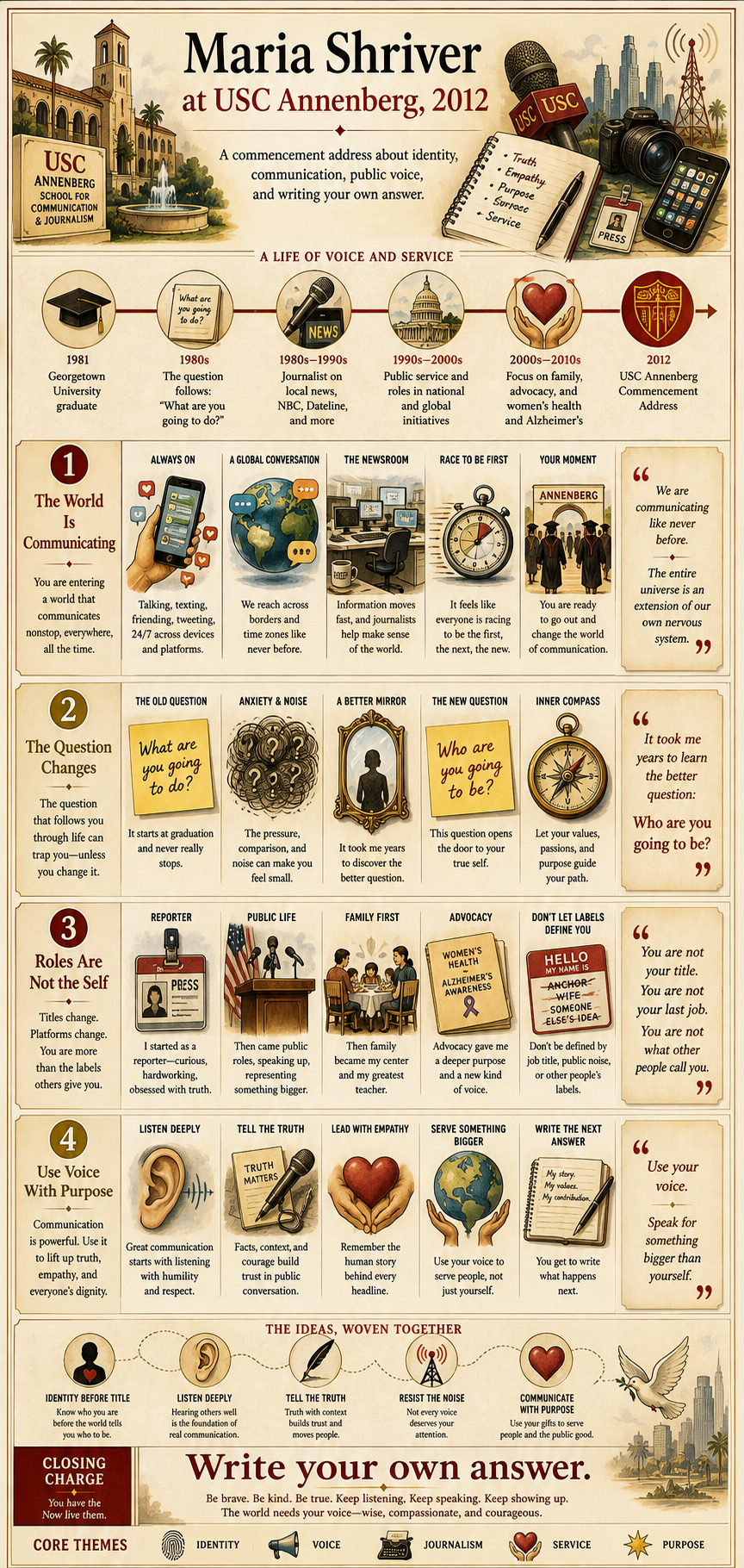
Maria Shriver at USC Annenberg, 2012
A commencement address about identity, communication, public voice, and writing your own answer.
Speech arc
- 01Always-on communication
Opening move
- 02The job question
Speech beat
- 03A better question
Speech beat
- 04Identity before title
Speech beat
- 05Public voice
Speech beat
- 06Truth and empathy
Speech beat
- 07Purposeful service
Speech beat
- 08Write your answer
Final charge
Signal: The world is communicating nonstop
Shriver addresses graduates entering a media environment of instant messages, platforms, devices, and constant pressure to be first.
Context
The speech begins by naming a world wired across borders, time zones, phones, computers, apps, games, and social platforms.
Pressure
For communication graduates, the excitement of changing the field is paired with anxiety about speed, novelty, and competition.
Opportunity
Communication is treated as a craft with civic force, not just a race to produce the next update.
Shriver addresses graduates entering a media environment of instant messages, platforms, devices, and constant pressure to be first.
Question: The old question is not enough
The recurring post-graduation question, what are you going to do, becomes a trap until it is replaced by a deeper question about being.
Anxiety
Shriver recalls graduating without a job and feeling diminished by the repeated demand for a career answer.
Reframe
The better question asks who a graduate is going to be, not only what position they will hold.
Compass
Values, purpose, and character become the guide when titles and assignments keep changing.
The recurring post-graduation question, what are you going to do, becomes a trap until it is replaced by a deeper question about being.
Identity: Roles are not the self
Her own path through journalism, public life, family, and advocacy shows how titles can shift without defining the person underneath.
Career
Reporter, anchor, public figure, family member, and advocate are roles that reveal work without exhausting identity.
Labels
The transcript repeatedly pushes against being reduced to job title, platform, public noise, or other people’s descriptions.
Purpose
Advocacy gives public voice a deeper use when it serves people and causes beyond the speaker.
Her own path through journalism, public life, family, and advocacy shows how titles can shift without defining the person underneath.
• Key takeaways •
Identity before title
Connects to identity.
Listen deeply
Connects to voice.
Tell the truth
Connects to journalism.
Resist the noise
Connects to service.
Communicate with purpose
Connects to purpose.
Closing charge
The charge turns communication outward: listen deeply, tell the truth, lead with empathy, and write the next answer with courage.
Use communication to serve purpose
Listening
Good communication begins with humility and attention rather than constant broadcast.
Truth
Facts, context, and courage build trust when speed and noise pull attention apart.
Charge
Graduates are invited to keep speaking, keep showing up, and use voice for something larger than self-promotion.
The charge turns communication outward: listen deeply, tell the truth, lead with empathy, and write the next answer with courage.
Visual speech maps
Browse more visual maps from USC Annenberg School for Communication and Journalism or continue with related mapped speeches below.
Transcript
The previously catalogued transcript link is no longer live and is queued for re-sourcing. A video of the address is available above.
Machine transcript available for archive analysis; it is unverified and may contain transcription errors. Machine transcript source ->
Provenance
BROKEN transcript link (checked 2026-06-26): gradspeeches.com is a parked/redirecting domain serving no real content. Provenance: Imported from NPR commencement archive; cross-referenced with Open Commencement DB
NPR archive last updated in 2015; destination availability has not been exhaustively rechecked | Open Commencement DB transcript; not independently verified against the original recording | Transcript URL dead (gradspeeches.com is a parked/redirecting domain serving no real content); video fallback present
Explore this speech
Find the next thread through the archive
Themes in this address
Speeches like this one
Search all speeches ->