Howard Gordon
Field: arts
Save the visual map
Download or open the generated poster as a standalone PNG.
Howard Gordon at Connecticut College, 2013
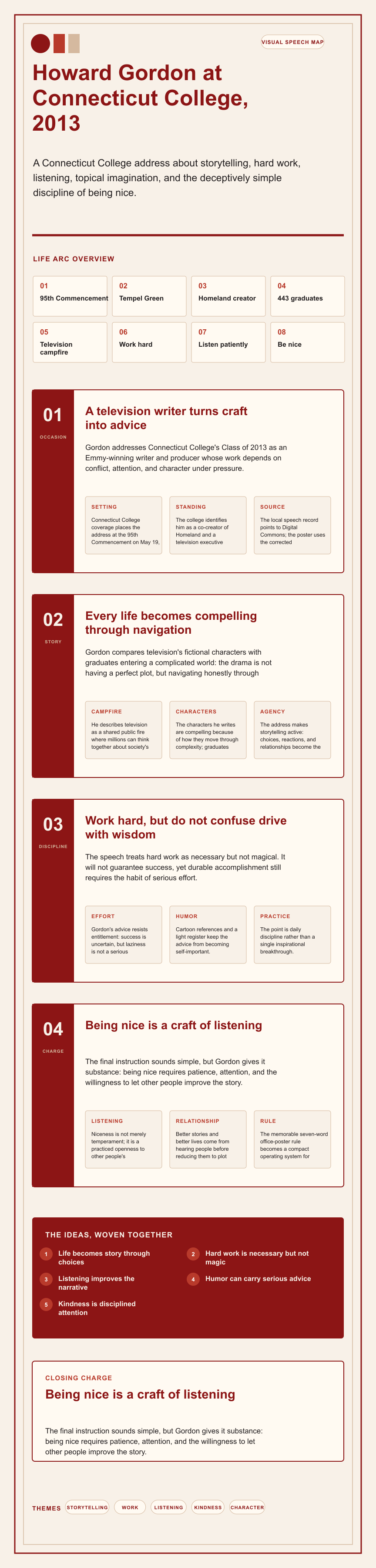
A Connecticut College address about storytelling, hard work, listening, topical imagination, and the deceptively simple discipline of being nice.
Speech arc
- 0195th Commencement
Opening move
- 02Tempel Green
Speech beat
- 03Homeland creator
Speech beat
- 04443 graduates
Speech beat
- 05Television campfire
Speech beat
- 06Work hard
Speech beat
- 07Listen patiently
Speech beat
- 08Be nice
Final charge
Occasion: A television writer turns craft into advice
Gordon addresses Connecticut College's Class of 2013 as an Emmy-winning writer and producer whose work depends on conflict, attention, and character under pressure.
Setting
Connecticut College coverage places the address at the 95th Commencement on May 19, with 443 graduates gathered on Tempel Green.
Standing
The college identifies him as a co-creator of Homeland and a television executive whose stories engage difficult public questions.
Source
The local speech record points to Digital Commons; the poster uses the corrected Connecticut College item and college news coverage for context.
Gordon addresses Connecticut College's Class of 2013 as an Emmy-winning writer and producer whose work depends on conflict, attention, and character under pressure.
Story: Every life becomes compelling through navigation
Gordon compares television's fictional characters with graduates entering a complicated world: the drama is not having a perfect plot, but navigating honestly through pressure.
Campfire
He describes television as a shared public fire where millions can think together about society's challenges.
Characters
The characters he writes are compelling because of how they move through complexity; graduates face the same test in real life.
Agency
The address makes storytelling active: choices, reactions, and relationships become the material of the graduate's next narrative.
Gordon compares television's fictional characters with graduates entering a complicated world: the drama is not having a perfect plot, but navigating honestly through pressure.
Discipline: Work hard, but do not confuse drive with wisdom
The speech treats hard work as necessary but not magical. It will not guarantee success, yet durable accomplishment still requires the habit of serious effort.
Effort
Gordon's advice resists entitlement: success is uncertain, but laziness is not a serious strategy.
Humor
Cartoon references and a light register keep the advice from becoming self-important.
Practice
The point is daily discipline rather than a single inspirational breakthrough.
The speech treats hard work as necessary but not magical.
It will not guarantee success, yet durable accomplishment still requires the habit of serious effort.
• Key takeaways •
Life becomes story through choices
Connects to storytelling.
Hard work is necessary but not magic
Connects to work.
Listening improves the narrative
Connects to listening.
Humor can carry serious advice
Connects to kindness.
Kindness is disciplined attention
Connects to character.
Closing charge
The final instruction sounds simple, but Gordon gives it substance: being nice requires patience, attention, and the willingness to let other people improve the story.
Being nice is a craft of listening
Listening
Niceness is not merely temperament; it is a practiced openness to other people's experience.
Relationship
Better stories and better lives come from hearing people before reducing them to plot devices.
Rule
The memorable seven-word office-poster rule becomes a compact operating system for graduates.
The final instruction sounds simple, but Gordon gives it substance: being nice requires patience, attention, and the willingness to let other people improve the story.
Visual speech maps
Browse more visual maps from Connecticut College or continue with related mapped speeches below.
Transcript
The full transcript is hosted by the original publisher. Commencement Archive links to the source rather than republishing copyrighted text.
Read the full transcript at source →Provenance
Imported from NPR commencement archive; cross-referenced with Open Commencement DB
NPR archive last updated in 2015; destination availability has not been exhaustively rechecked | Open Commencement DB transcript; not independently verified against the original recording
Explore this speech
Find the next thread through the archive
Themes in this address
No canonical themes have been assigned yet.
Speeches like this one
Search all speeches ->