David Foster Wallace
Field: letters
Wallace argues that the most obvious realities are the hardest to perceive, and that humans operate from a hard-wired, self-centered default-setting that makes each person experience themselves as the center of the universe. He reframes the liberal-arts cliché of 'learning how to think' as gaining conscious control over what one pays attention to and how one constructs meaning from experience. He warns that failing to exercise this choice leaves people unconscious and trapped in their own minds amid the boredom and routine of adult life.
“This is water.”
Key moments
- 01 The parable of the fish who don't notice the water
- 02 The hard-wired 'default-setting' of human self-centeredness
- 03 Reinterpreting liberal-arts education as learning to control attention and meaning
- 04 The unglamorous realities of adult life: boredom, routine, and frustration
Save the visual map
Download or open the generated poster as a standalone PNG.
David Foster Wallace at Kenyon, 2005
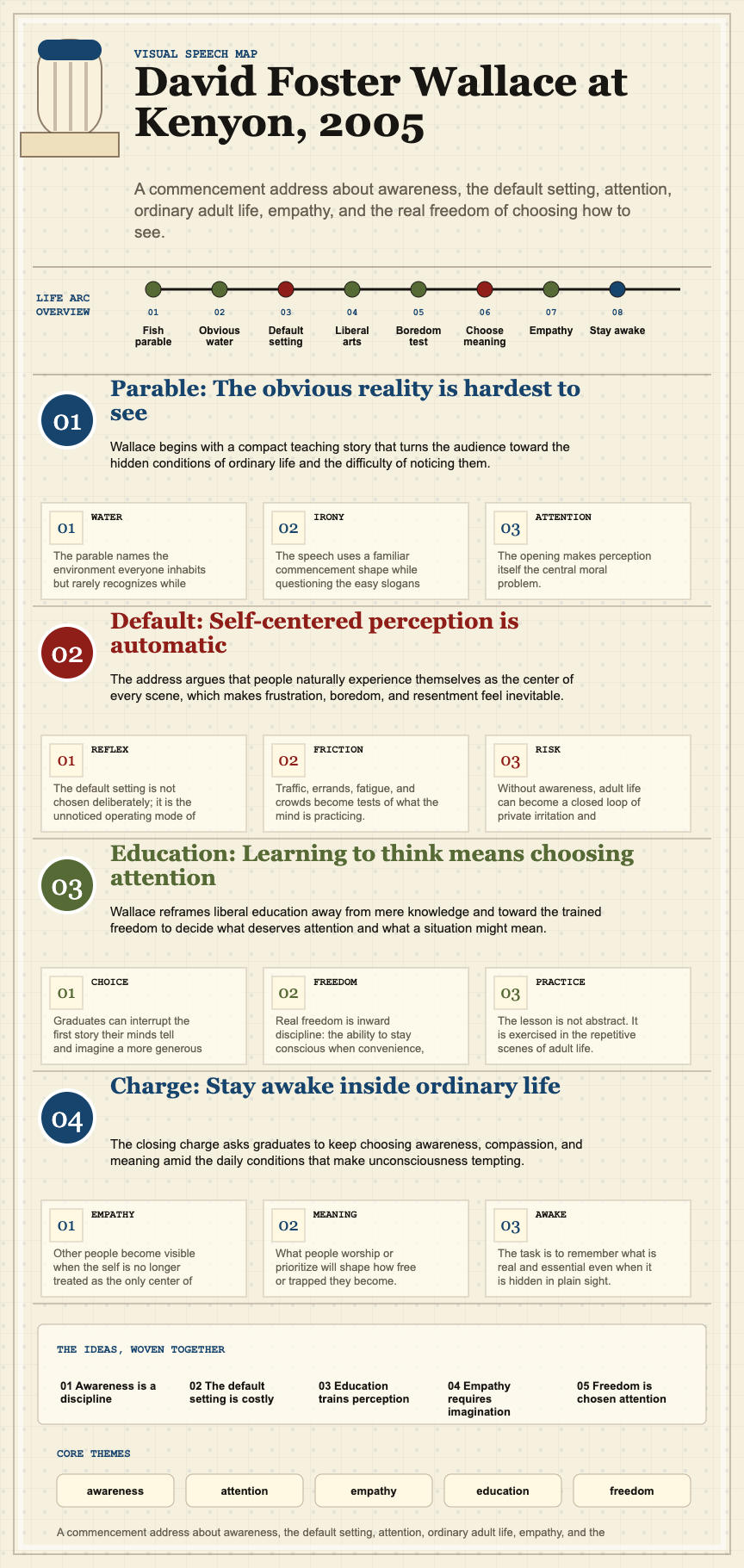
A commencement address about awareness, the default setting, attention, ordinary adult life, empathy, and the real freedom of choosing how to see.
Speech arc
- 01Fish parable
Opening move
- 02Obvious water
Speech beat
- 03Default setting
Speech beat
- 04Liberal arts
Speech beat
- 05Boredom test
Speech beat
- 06Choose meaning
Speech beat
- 07Empathy
Speech beat
- 08Stay awake
Final charge
Parable: The obvious reality is hardest to see
Wallace begins with a compact teaching story that turns the audience toward the hidden conditions of ordinary life and the difficulty of noticing them.
Water
The parable names the environment everyone inhabits but rarely recognizes while moving through daily routines.
Irony
The speech uses a familiar commencement shape while questioning the easy slogans that usually fill it.
Attention
The opening makes perception itself the central moral problem.
Wallace begins with a compact teaching story that turns the audience toward the hidden conditions of ordinary life and the difficulty of noticing them.
Default: Self-centered perception is automatic
The address argues that people naturally experience themselves as the center of every scene, which makes frustration, boredom, and resentment feel inevitable.
Reflex
The default setting is not chosen deliberately; it is the unnoticed operating mode of ordinary consciousness.
Friction
Traffic, errands, fatigue, and crowds become tests of what the mind is practicing.
Risk
Without awareness, adult life can become a closed loop of private irritation and unexamined craving.
The address argues that people naturally experience themselves as the center of every scene, which makes frustration, boredom, and resentment feel inevitable.
Education: Learning to think means choosing attention
Wallace reframes liberal education away from mere knowledge and toward the trained freedom to decide what deserves attention and what a situation might mean.
Choice
Graduates can interrupt the first story their minds tell and imagine a more generous interpretation.
Freedom
Real freedom is inward discipline: the ability to stay conscious when convenience, fear, and fatigue narrow the world.
Practice
The lesson is not abstract. It is exercised in the repetitive scenes of adult life.
Wallace reframes liberal education away from mere knowledge and toward the trained freedom to decide what deserves attention and what a situation might mean.
• Key takeaways •
Awareness is a discipline
Connects to awareness.
The default setting is costly
Connects to attention.
Education trains perception
Connects to empathy.
Empathy requires imagination
Connects to education.
Freedom is chosen attention
Connects to freedom.
Closing charge
The closing charge asks graduates to keep choosing awareness, compassion, and meaning amid the daily conditions that make unconsciousness tempting.
Stay awake inside ordinary life
Empathy
Other people become visible when the self is no longer treated as the only center of the scene.
Meaning
What people worship or prioritize will shape how free or trapped they become.
Awake
The task is to remember what is real and essential even when it is hidden in plain sight.
The closing charge asks graduates to keep choosing awareness, compassion, and meaning amid the daily conditions that make unconsciousness tempting.
Visual speech maps
Browse more visual maps from Kenyon College or continue with related mapped speeches below.
Transcript
The full transcript is hosted by the original publisher. Commencement Archive links to the source rather than republishing copyrighted text.
Read the full transcript at source →Provenance
Imported from NPR commencement archive; cross-referenced with Open Commencement DB
NPR archive last updated in 2015; destination availability has not been exhaustively rechecked | Open Commencement DB transcript; not independently verified against the original recording
Explore this speech
Find the next thread through the archive
Themes in this address
Speeches like this one
Search all speeches ->