Michael Ignatieff
Michael Ignatieff, speaking as a Canadian at a Catholic university, celebrates the friendship between Canada and the United States and salutes the tradition of Catholic higher education and service. He offers graduates advice: to make college a family tradition, give back to the university, respect themselves and others, and truly own their own lives. He closes with reflections on courage in its many forms—the courage of love, of service, and of staying true to oneself without being ruled by fear.
Key moments
- 01 Praise for Canada-U.S. friendship and Catholic educational tradition
- 02 Advice to continue the family tradition of education and support the university
- 03 Urging graduates to own their own lives and treat others with respect
- 04 Reflection on courage, including a story about a woman caring for her husband with Alzheimer's
Save the visual map
Download or open the generated poster as a standalone PNG.
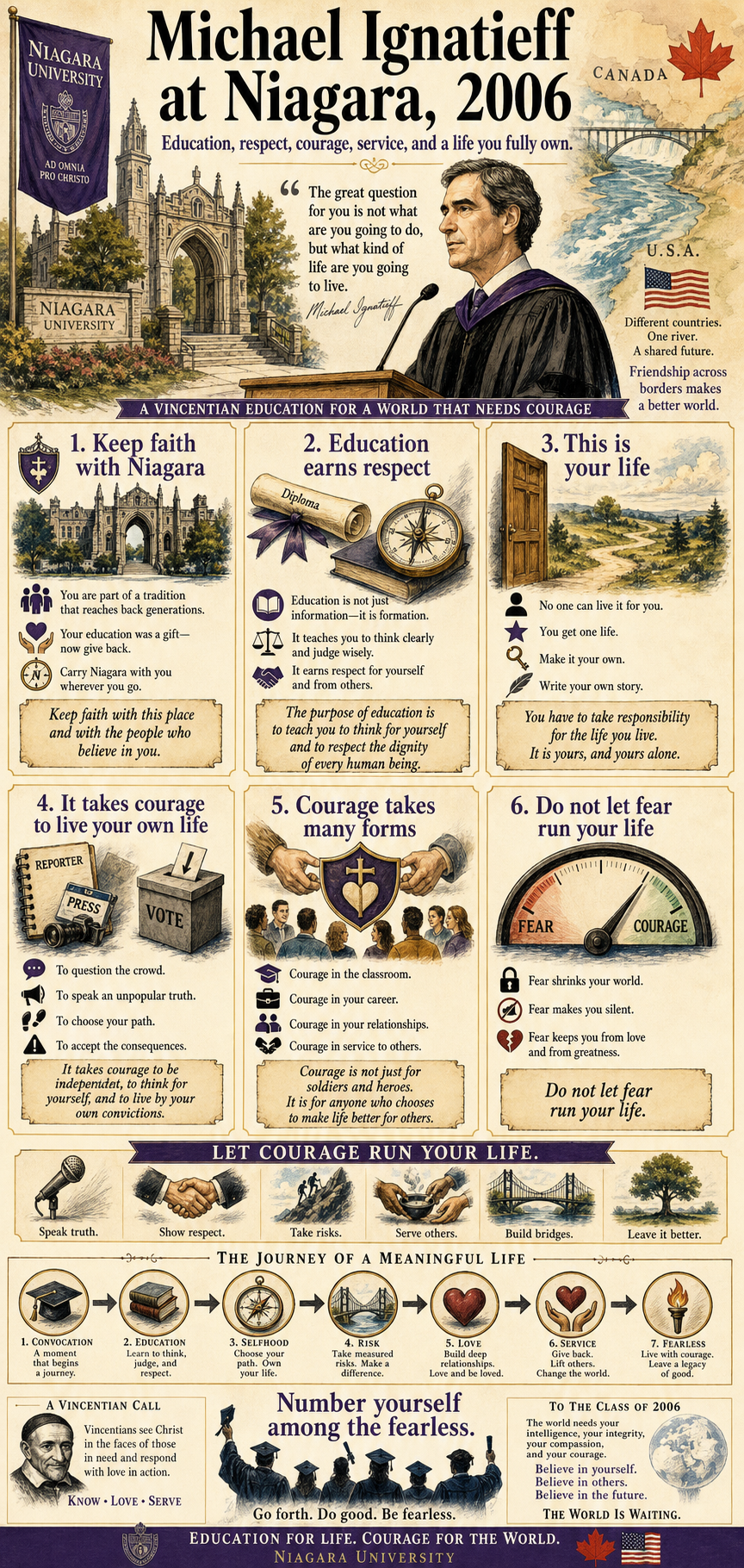
Michael Ignatieff at Niagara, 2006
A commencement address about education, respect, courage, selfhood, service, and refusing to let fear run your life.
Speech arc
- 01Niagara University
Opening move
- 02Class of 2006
Speech beat
- 03Education
Speech beat
- 04Respect
Speech beat
- 05Your own life
Speech beat
- 06Measured risk
Speech beat
- 07Service
Speech beat
- 08Fearless
Final charge
Place: Keep faith with the institution that formed you
Ignatieff opens by locating graduates inside Niagara’s tradition of faith, service, family sacrifice, and responsibility to carry the gift onward.
Memory
Commencement marks the end of one formation and the beginning of another.
Gift
Education is presented as something received through the work of many people.
Return
Graduates are asked to stay connected to the place and people who believe in them.
Ignatieff opens by locating graduates inside Niagara’s tradition of faith, service, family sacrifice, and responsibility to carry the gift onward.
Education: Learning earns respect for self and others
The speech treats education as moral formation: it teaches judgment, dignity, and the habit of treating every person with respect.
Formation
Education is more than information; it shapes how graduates see and judge.
Dignity
Respect begins with oneself and extends outward to every human being.
Perspective
Niagara’s cross-border setting becomes a lesson in shared futures.
The speech treats education as moral formation: it teaches judgment, dignity, and the habit of treating every person with respect.
Selfhood: It takes courage to live your own life
Ignatieff’s central charge is direct: no one else can live for the graduates, so they must own their choices, risks, convictions, and consequences.
Ownership
The graduate gets one life and must make it their own.
Risk
Public service, speech, love, and work all require measured courage.
Conviction
Courage is not only heroic drama; it is daily truthfulness.
Ignatieff’s central charge is direct: no one else can live for the graduates, so they must own their choices, risks, convictions, and consequences.
• Key takeaways •
Education forms judgment
Connects to courage.
Respect is a daily discipline
Connects to education.
Own the one life you get
Connects to respect.
Courage has ordinary forms
Connects to service.
Let courage, not fear, run your life
Connects to selfhood.
Closing charge
The closing broadens courage into service: speak truth, show respect, build bridges, and become one of the fearless people who leave the world better.
Do not let fear run the future
Fear
Fear narrows the world and keeps people silent.
Love
Relationships and compassion are part of courage, not separate from it.
Charge
The class is asked to number themselves among the fearless.
The closing broadens courage into service: speak truth, show respect, build bridges, and become one of the fearless people who leave the world better.
Visual speech maps
Browse more visual maps from Niagara University or continue with related mapped speeches below.
Transcript
The previously catalogued transcript link is no longer live and is queued for re-sourcing.
Machine transcript available for archive analysis; it is unverified and may contain transcription errors. Machine transcript source ->
Provenance
BROKEN transcript link (checked 2026-06-26): returns 404 Not Found. Provenance: Imported from NPR commencement archive; cross-referenced with Open Commencement DB
NPR archive last updated in 2015; destination availability has not been exhaustively rechecked | Open Commencement DB transcript; not independently verified against the original recording | Transcript URL dead (returns 404 Not Found); no video fallback — needs re-sourcing
Explore this speech
Find the next thread through the archive
Themes in this address
Speeches like this one
Search all speeches ->