Kirk Schneider
Psychologist Kirk Schneider addresses the 2010 Master's in Counseling class at San Francisco State University, drawing on personal experiences—including discouragement from an early adviser and the death of his brother—to argue for an awe-centered, present approach to counseling. He encourages graduates to be 'awe-advocacy' agents who relate to clients as whole human beings, citing research on contextual factors such as empathy, alliance, and presence as central to effective therapy. He closes by reciting Oriah Mountain Dreamer's poem 'The Invitation' and urging graduates to live and embody the work personally.
Key moments
- 01 Recounts being discouraged from psychology by an adviser and later returning as a lecturer
- 02 Tells the Taoist tale of the Chinese farmer to illustrate openness to mystery
- 03 Distinguishes 'social adjustment agents' from 'awe-advocacy' agents and cites research on contextual factors
- 04 Shares his brother's death and the analyst's 'presence' that helped him as a child
- 05 Recites Oriah Mountain Dreamer's poem 'The Invitation'
Save the visual map
Download or open the generated poster as a standalone PNG.
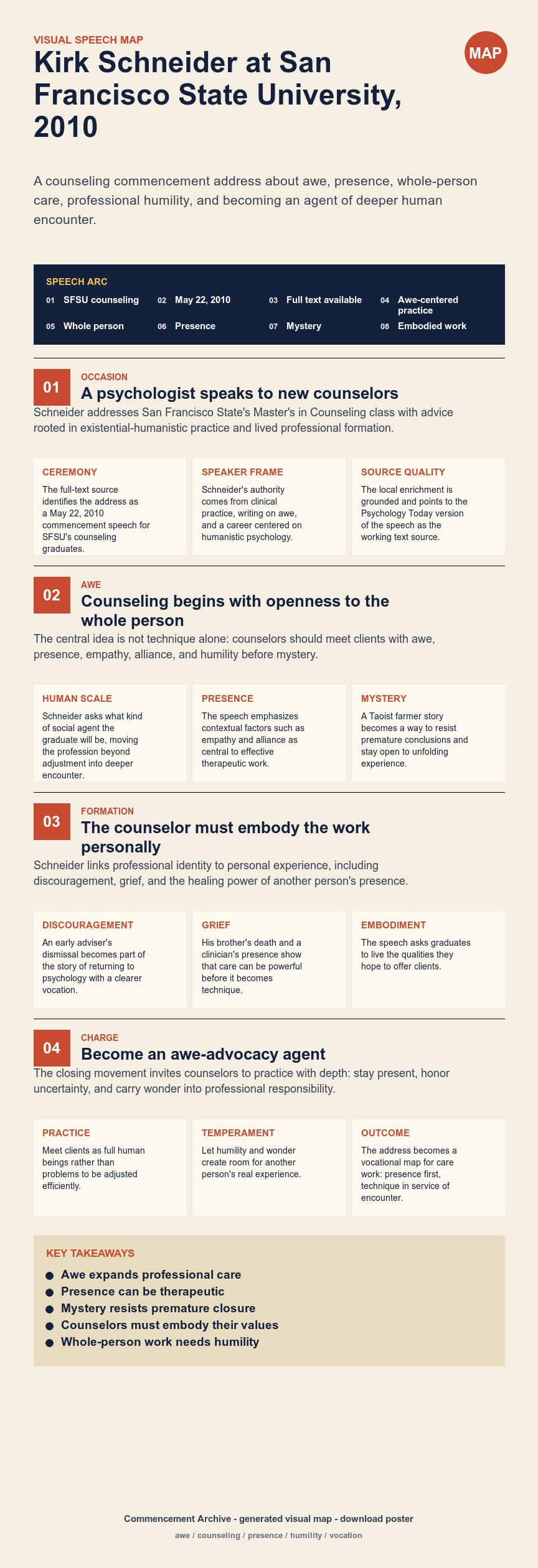
Kirk Schneider at San Francisco State University, 2010
A counseling commencement address about awe, presence, whole-person care, professional humility, and becoming an agent of deeper human encounter.
Speech arc
- 01SFSU counseling
Opening move
- 02May 22, 2010
Speech beat
- 03Full text available
Speech beat
- 04Awe-centered practice
Speech beat
- 05Whole person
Speech beat
- 06Presence
Speech beat
- 07Mystery
Speech beat
- 08Embodied work
Final charge
Occasion: A psychologist speaks to new counselors
Schneider addresses San Francisco State's Master's in Counseling class with advice rooted in existential-humanistic practice and lived professional formation.
Ceremony
The full-text source identifies the address as a May 22, 2010 commencement speech for SFSU's counseling graduates.
Speaker frame
Schneider's authority comes from clinical practice, writing on awe, and a career centered on humanistic psychology.
Source quality
The local enrichment is grounded and points to the Psychology Today version of the speech as the working text source.
Schneider addresses San Francisco State's Master's in Counseling class with advice rooted in existential-humanistic practice and lived professional formation.
Awe: Counseling begins with openness to the whole person
The central idea is not technique alone: counselors should meet clients with awe, presence, empathy, alliance, and humility before mystery.
Human scale
Schneider asks what kind of social agent the graduate will be, moving the profession beyond adjustment into deeper encounter.
Presence
The speech emphasizes contextual factors such as empathy and alliance as central to effective therapeutic work.
Mystery
A Taoist farmer story becomes a way to resist premature conclusions and stay open to unfolding experience.
The central idea is not technique alone: counselors should meet clients with awe, presence, empathy, alliance, and humility before mystery.
Formation: The counselor must embody the work personally
Schneider links professional identity to personal experience, including discouragement, grief, and the healing power of another person's presence.
Discouragement
An early adviser's dismissal becomes part of the story of returning to psychology with a clearer vocation.
Grief
His brother's death and a clinician's presence show that care can be powerful before it becomes technique.
Embodiment
The speech asks graduates to live the qualities they hope to offer clients.
Schneider links professional identity to personal experience, including discouragement, grief, and the healing power of another person's presence.
• Key takeaways •
Awe expands professional care
Connects to awe.
Presence can be therapeutic
Connects to counseling.
Mystery resists premature closure
Connects to presence.
Counselors must embody their values
Connects to humility.
Whole-person work needs humility
Connects to vocation.
Closing charge
The closing movement invites counselors to practice with depth: stay present, honor uncertainty, and carry wonder into professional responsibility.
Become an awe-advocacy agent
Practice
Meet clients as full human beings rather than problems to be adjusted efficiently.
Temperament
Let humility and wonder create room for another person's real experience.
Outcome
The address becomes a vocational map for care work: presence first, technique in service of encounter.
The closing movement invites counselors to practice with depth: stay present, honor uncertainty, and carry wonder into professional responsibility.
Visual speech maps
Browse more visual maps from San Francisco State University or continue with related mapped speeches below.
Transcript
The full transcript is hosted by the original publisher. Commencement Archive links to the source rather than republishing copyrighted text.
Read the full transcript at source →Provenance
Imported from NPR commencement archive; cross-referenced with Open Commencement DB
NPR archive last updated in 2015; destination availability has not been exhaustively rechecked | Open Commencement DB transcript; not independently verified against the original recording
Explore this speech
Find the next thread through the archive
Themes in this address
Speeches like this one
Search all speeches ->