John Walsh
Field: letters
Save the visual map
Download or open the generated poster as a standalone PNG.
John Walsh at Wheaton, 2000
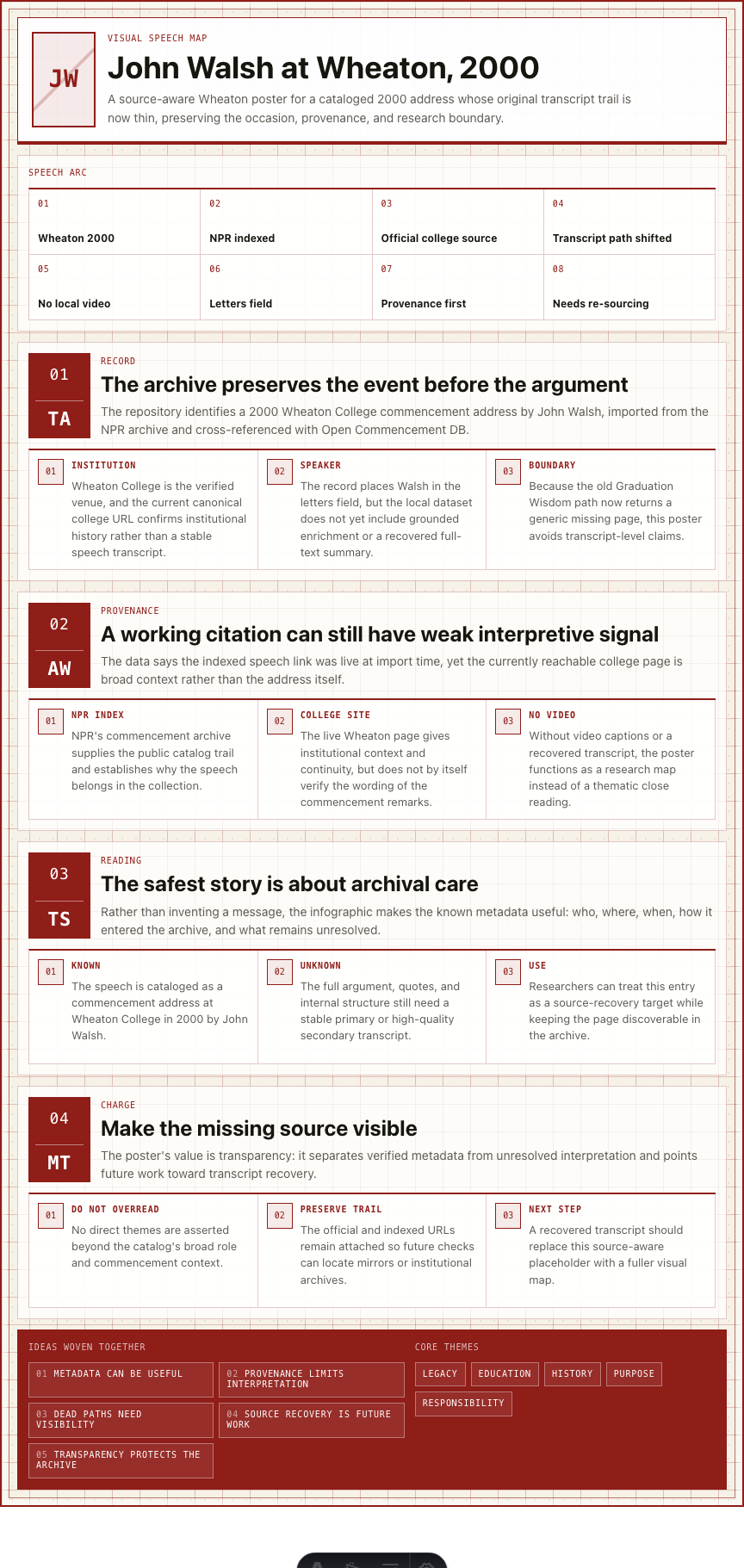
A source-aware Wheaton poster for a cataloged 2000 address whose original transcript trail is now thin, preserving the occasion, provenance, and research boundary.
Speech arc
- 01Wheaton 2000
Opening move
- 02NPR indexed
Speech beat
- 03Official college source
Speech beat
- 04Transcript path shifted
Speech beat
- 05No local video
Speech beat
- 06Letters field
Speech beat
- 07Provenance first
Speech beat
- 08Needs re-sourcing
Final charge
Record: The archive preserves the event before the argument
The repository identifies a 2000 Wheaton College commencement address by John Walsh, imported from the NPR archive and cross-referenced with Open Commencement DB.
Institution
Wheaton College is the verified venue, and the current canonical college URL confirms institutional history rather than a stable speech transcript.
Speaker
The record places Walsh in the letters field, but the local dataset does not yet include grounded enrichment or a recovered full-text summary.
Boundary
Because the old Graduation Wisdom path now returns a generic missing page, this poster avoids transcript-level claims.
The repository identifies a 2000 Wheaton College commencement address by John Walsh, imported from the NPR archive and cross-referenced with Open Commencement DB.
Provenance: A working citation can still have weak interpretive signal
The data says the indexed speech link was live at import time, yet the currently reachable college page is broad context rather than the address itself.
NPR index
NPR's commencement archive supplies the public catalog trail and establishes why the speech belongs in the collection.
College site
The live Wheaton page gives institutional context and continuity, but does not by itself verify the wording of the commencement remarks.
No video
Without video captions or a recovered transcript, the poster functions as a research map instead of a thematic close reading.
The data says the indexed speech link was live at import time, yet the currently reachable college page is broad context rather than the address itself.
Reading: The safest story is about archival care
Rather than inventing a message, the infographic makes the known metadata useful: who, where, when, how it entered the archive, and what remains unresolved.
Known
The speech is cataloged as a commencement address at Wheaton College in 2000 by John Walsh.
Unknown
The full argument, quotes, and internal structure still need a stable primary or high-quality secondary transcript.
Use
Researchers can treat this entry as a source-recovery target while keeping the page discoverable in the archive.
Rather than inventing a message, the infographic makes the known metadata useful: who, where, when, how it entered the archive, and what remains unresolved.
• Key takeaways •
Metadata can be useful
Connects to legacy.
Provenance limits interpretation
Connects to education.
Dead paths need visibility
Connects to history.
Source recovery is future work
Connects to purpose.
Transparency protects the archive
Connects to responsibility.
Closing charge
The poster's value is transparency: it separates verified metadata from unresolved interpretation and points future work toward transcript recovery.
Make the missing source visible
Do not overread
No direct themes are asserted beyond the catalog's broad role and commencement context.
Preserve trail
The official and indexed URLs remain attached so future checks can locate mirrors or institutional archives.
Next step
A recovered transcript should replace this source-aware placeholder with a fuller visual map.
The poster's value is transparency: it separates verified metadata from unresolved interpretation and points future work toward transcript recovery.
Visual speech maps
Browse more visual maps from Wheaton College .
Transcript
The full transcript is hosted by the original publisher. Commencement Archive links to the source rather than republishing copyrighted text.
Read the full transcript at source →Provenance
Imported from NPR commencement archive; cross-referenced with Open Commencement DB
NPR archive last updated in 2015; destination availability has not been exhaustively rechecked | Open Commencement DB transcript; not independently verified against the original recording
Explore this speech
Find the next thread through the archive
Themes in this address
No canonical themes have been assigned yet.