Atul Gawande
Surgeon and writer Atul Gawande uses the story of an 87-year-old patient who survived a rare surgical complication to argue that success in any field depends less on avoiding risk than on the ability to recover when things go wrong. He cites research showing the best hospitals don't have fewer complications but are better at rescuing patients, a concept called 'failure to rescue.' Drawing on the BP oil disaster and his own early career missteps, he tells graduates that the difference between triumph and defeat lies in the willingness to acknowledge failure and act to set things right.
Key moments
- 01 The story of Mrs. C's surgery and unexpected gastric complication
- 02 Research finding that top hospitals rescue more rather than fail less
- 03 Three pitfalls when things go wrong: wrong plan, inadequate plan, or no plan
- 04 BP oil disaster as an example of failing to acknowledge trouble in time
- 05 Gawande's own failures before finding his path in medicine
Save the visual map
Download or open the generated poster as a standalone PNG.
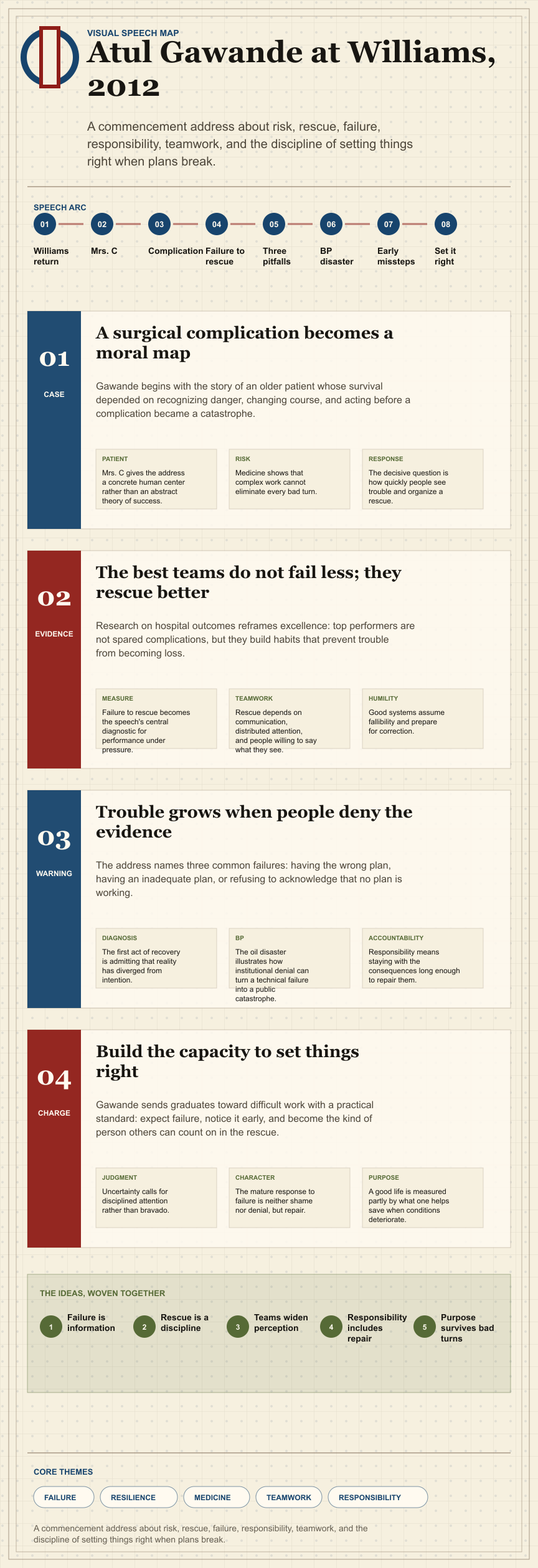
Atul Gawande at Williams, 2012
A commencement address about risk, rescue, failure, responsibility, teamwork, and the discipline of setting things right when plans break.
Speech arc
- 01Williams return
Opening move
- 02Mrs. C
Speech beat
- 03Complication
Speech beat
- 04Failure to rescue
Speech beat
- 05Three pitfalls
Speech beat
- 06BP disaster
Speech beat
- 07Early missteps
Speech beat
- 08Set it right
Final charge
Case: A surgical complication becomes a moral map
Gawande begins with the story of an older patient whose survival depended on recognizing danger, changing course, and acting before a complication became a catastrophe.
Patient
Mrs. C gives the address a concrete human center rather than an abstract theory of success.
Risk
Medicine shows that complex work cannot eliminate every bad turn.
Response
The decisive question is how quickly people see trouble and organize a rescue.
Gawande begins with the story of an older patient whose survival depended on recognizing danger, changing course, and acting before a complication became a catastrophe.
Evidence: The best teams do not fail less; they rescue better
Research on hospital outcomes reframes excellence: top performers are not spared complications, but they build habits that prevent trouble from becoming loss.
Measure
Failure to rescue becomes the speech's central diagnostic for performance under pressure.
Teamwork
Rescue depends on communication, distributed attention, and people willing to say what they see.
Humility
Good systems assume fallibility and prepare for correction.
Research on hospital outcomes reframes excellence: top performers are not spared complications, but they build habits that prevent trouble from becoming loss.
Warning: Trouble grows when people deny the evidence
The address names three common failures: having the wrong plan, having an inadequate plan, or refusing to acknowledge that no plan is working.
Diagnosis
The first act of recovery is admitting that reality has diverged from intention.
BP
The oil disaster illustrates how institutional denial can turn a technical failure into a public catastrophe.
Accountability
Responsibility means staying with the consequences long enough to repair them.
The address names three common failures: having the wrong plan, having an inadequate plan, or refusing to acknowledge that no plan is working.
• Key takeaways •
Failure is information
Connects to failure.
Rescue is a discipline
Connects to resilience.
Teams widen perception
Connects to medicine.
Responsibility includes repair
Connects to teamwork.
Purpose survives bad turns
Connects to responsibility.
Closing charge
Gawande sends graduates toward difficult work with a practical standard: expect failure, notice it early, and become the kind of person others can count on in the rescue.
Build the capacity to set things right
Judgment
Uncertainty calls for disciplined attention rather than bravado.
Character
The mature response to failure is neither shame nor denial, but repair.
Purpose
A good life is measured partly by what one helps save when conditions deteriorate.
Gawande sends graduates toward difficult work with a practical standard: expect failure, notice it early, and become the kind of person others can count on in the rescue.
Visual speech maps
Browse more visual maps from Williams College or continue with related mapped speeches below.
Transcript
The full transcript is hosted by the original publisher. Commencement Archive links to the source rather than republishing copyrighted text.
Read the full transcript at source →Provenance
Imported from NPR commencement archive; cross-referenced with Open Commencement DB
NPR archive last updated in 2015; destination availability has not been exhaustively rechecked | Open Commencement DB transcript; not independently verified against the original recording
Explore this speech
Find the next thread through the archive
Themes in this address
Speeches like this one
Search all speeches ->