George Pataki
Governor of New York; Yale College Class of 1967
Save the visual map
Download or open the generated poster as a standalone PNG.
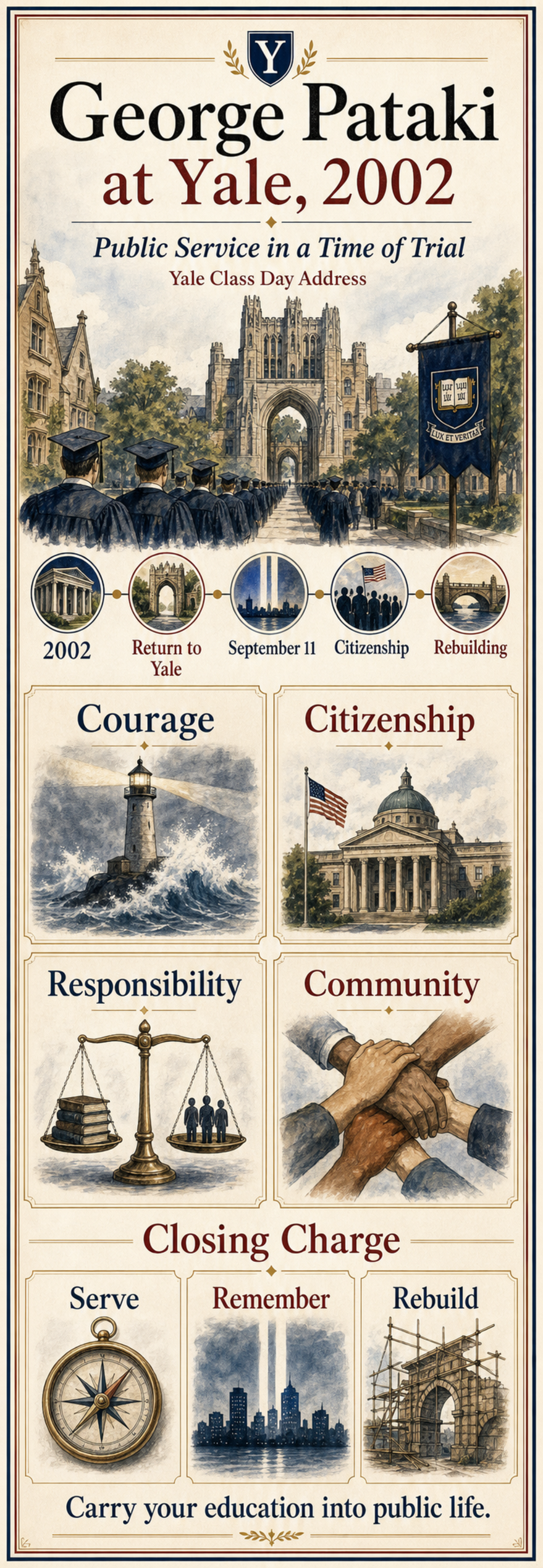
George Pataki at Yale, 2002
A Yale Class Day address by New York's governor and Yale alumnus, framed by public duty, campus return, post-9/11 leadership, civic service, and institutional memory.
Speech arc
- 01Old Campus
Opening move
- 02Yale alumnus
Speech beat
- 03Governor
Speech beat
- 04New York
Speech beat
- 05Post-9/11
Speech beat
- 06Public duty
Speech beat
- 07Service
Speech beat
- 08Civic repair
Final charge
Return: An alumnus returns as governor
The verified record places Pataki at Yale's 301st Commencement as New York's governor and a Yale College graduate addressing seniors on Class Day.
Alumnus
The address carries the particular weight of a graduate returning to speak from public office.
Office
A governor's platform turns Class Day toward civic obligation and institutional responsibility.
Ceremony
The speech sits inside Yale's long commencement ritual, linking memory to departure.
The verified record places Pataki at Yale's 301st Commencement as New York's governor and a Yale College graduate addressing seniors on Class Day.
Context: New York leadership shapes the frame
Because the located source is a preview rather than a transcript, the poster stays grounded in public context: Pataki led New York in the first commencement season after September 11.
New York
The speaker's role inevitably brings the city and state into the moral background of the address.
Aftermath
Class Day 2002 comes less than a year after attacks that transformed public service language.
Restraint
Without a full transcript, the infographic avoids invented quotations and reads the verified context closely.
Because the located source is a preview rather than a transcript, the poster stays grounded in public context: Pataki led New York in the first commencement season after September 11.
Service: Prestige becomes a public instrument
The address can be mapped through the civic expectation attached to Yale training: education is not only advancement, but preparation for responsibility beyond campus.
Duty
Public office makes leadership visible as decisions, institutions, budgets, and accountability.
Scale
Graduates leave a protected campus for systems where consequences are uneven and public.
Repair
Civic work asks for patience in damaged institutions, not only ambition in successful ones.
The address can be mapped through the civic expectation attached to Yale training: education is not only advancement, but preparation for responsibility beyond campus.
• Key takeaways •
Alumni memory can become duty
Connects to public service.
Leadership is public work
Connects to leadership.
Context matters when transcripts are absent
Connects to New York.
Service outlasts ceremony
Connects to post-9/11.
Civic repair needs steady hands
Connects to Yale.
Closing charge
The closing reading turns the available record into a civic charge: use education, memory, and position to serve communities under stress.
Carry Yale into public responsibility
Serve
Let credentials become practical help, not merely private advantage.
Remember
Honor the historical moment by refusing civic indifference.
Lead
Leadership is measured by steadiness when institutions are tested.
The closing reading turns the available record into a civic charge: use education, memory, and position to serve communities under stress.
Visual speech maps
Browse more visual maps from Yale University or continue with related mapped speeches below.
Transcript
No official full transcript has been located yet. If you know of one, suggestions are welcome.
Provenance
Yale Daily News preview verified live (2026-06-26); full transcript not located
Class Day, 301st Commencement, May 26 2002. Full transcript not located. Category: Politics
Explore this speech
Find the next thread through the archive
Themes in this address
No canonical themes have been assigned yet.
Speeches like this one
Search all speeches ->