Tom Friedman
Foreign-affairs columnist, The New York Times; three-time Pulitzer Prize winner
Thomas Friedman tells Yale's Class of 2003 that in the post-9/11 "Age of Terrorism" they should choose to be "thrivers" rather than "survivors," living fully despite uncertainty rather than retreating in fear. Drawing on his career covering the Middle East, he offers five lessons: thrive, follow your heart and do what you love, listen well to others, remain a naive optimist, and call your parents regularly.
Key moments
- 01 Distinguishing "survivors" from "thrivers" using examples from war-torn Lebanon
- 02 Urging graduates to follow their hearts and do what they love rather than rigid planning
- 03 Calling on Americans to be better listeners given their global power
- 04 Advocating naive optimism as a survival strategy, including hope for change in the Arab world
- 05 Reminding students to call their parents, reflecting on his own father's death
Save the visual map
Download or open the generated poster as a standalone PNG.
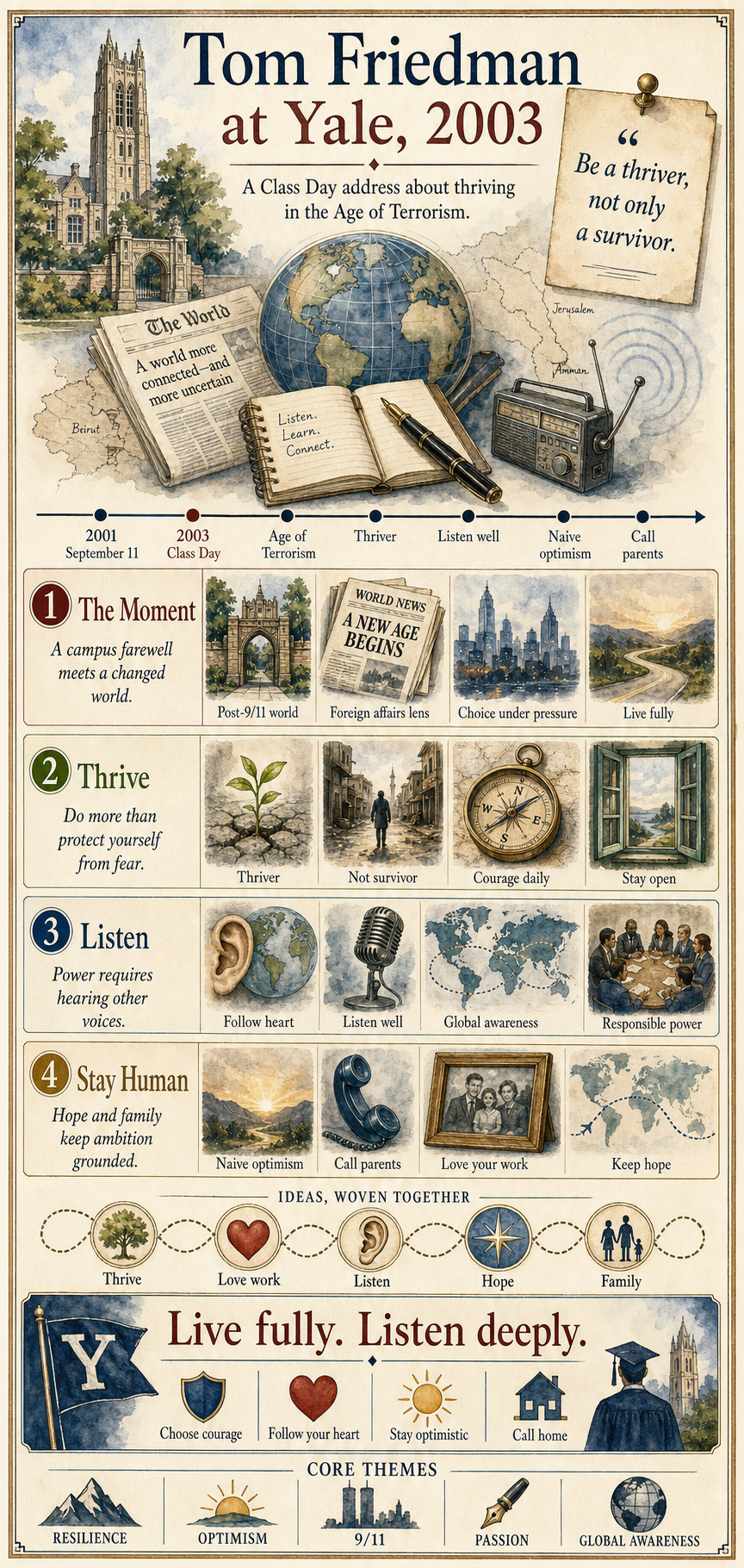
Tom Friedman at Yale, 2003
A Class Day address about becoming a thriver after 9/11, following your heart, listening across borders, naive optimism, and staying connected to family.
Speech arc
- 01Old Campus
Opening move
- 02Age of Terrorism
Speech beat
- 03Thriver
Speech beat
- 04Follow heart
Speech beat
- 05Listen well
Speech beat
- 06Naive optimism
Speech beat
- 07Parents
Speech beat
- 08Live fully
Final charge
Moment: Class Day meets the post-9/11 world
Friedman speaks to Yale seniors in 2003 with the Age of Terrorism close at hand, turning global uncertainty into a test of how graduates choose to live.
Context
The official Yale coverage frames the address around life after September 11 and the dangers of retreating into fear.
Witness
His foreign-affairs reporting gives the advice a world-facing scale, not just a campus farewell.
Choice
The question is whether graduates let danger narrow their lives or sharpen their commitments.
Friedman speaks to Yale seniors in 2003 with the Age of Terrorism close at hand, turning global uncertainty into a test of how graduates choose to live.
Frame: Be a thriver, not only a survivor
The speech's central contrast asks graduates to live with force and openness instead of merely protecting themselves from an anxious era.
Thrive
Thriving means keeping ambition, imagination, and generosity active when the public mood is defensive.
Courage
The address treats courage as daily orientation: remain porous to the world without being consumed by it.
Lebanon
Examples from conflict zones make resilience concrete rather than ceremonial.
The speech's central contrast asks graduates to live with force and openness instead of merely protecting themselves from an anxious era.
Practice: Listen before leading
Friedman links personal direction to public responsibility: follow work you love, but pair American power with better listening and wider global awareness.
Heart
Careers become sturdier when they start from genuine appetite rather than overmanaged plans.
Listening
Power increases the obligation to hear how others experience American decisions and culture.
Optimism
Naive optimism becomes a disciplined refusal to let cynicism own the future.
Friedman links personal direction to public responsibility: follow work you love, but pair American power with better listening and wider global awareness.
• Key takeaways •
Thriving resists fear
Connects to resilience.
Global power requires listening
Connects to optimism.
Love gives work direction
Connects to 9/11.
Optimism is strategic
Connects to listening.
Family keeps ambition grounded
Connects to global awareness.
Closing charge
The closing advice draws the global and intimate together: keep hope alive, choose meaningful work, and remember the parents and people who made the moment possible.
Stay human while living globally
Hope
Practice optimism as an operating system, especially when events reward despair.
Family
Call your parents; connection is part of a life that is fully lived.
World
Let global awareness enlarge, not paralyze, the next chapter.
The closing advice draws the global and intimate together: keep hope alive, choose meaningful work, and remember the parents and people who made the moment possible.
Visual speech maps
Browse more visual maps from Yale University or continue with related mapped speeches below.
Transcript
No official full transcript has been located yet. If you know of one, suggestions are welcome.
Provenance
Verified from official Yale Bulletin & Calendar archive (2026-06-26)
Class Day, May 25 2003. Theme: 'thriver, not survivor' in the Age of Terrorism. Official Yale Bulletin coverage (excerpts), not full transcript. Category: Journalism
Explore this speech
Find the next thread through the archive
Themes in this address
Speeches like this one
Search all speeches ->