John Kerry
U.S. secretary of state
In his remarks at Yale's 2014 commencement, Secretary of State John Kerry reflects on returning to his alma mater 48 years after his own graduation. The provided excerpt opens with humorous acknowledgments before, according to the framing, addressing the unique role of the United States in the world and arguing against isolationism.
Key moments
- 01 Opening with self-deprecating humor and acknowledgments
- 02 Reflecting on returning to Yale 48 years after his own graduation
- 03 Discussing the unique role of the U.S. in the world
- 04 Arguing against isolationism
Save the visual map
Download or open the generated poster as a standalone PNG.
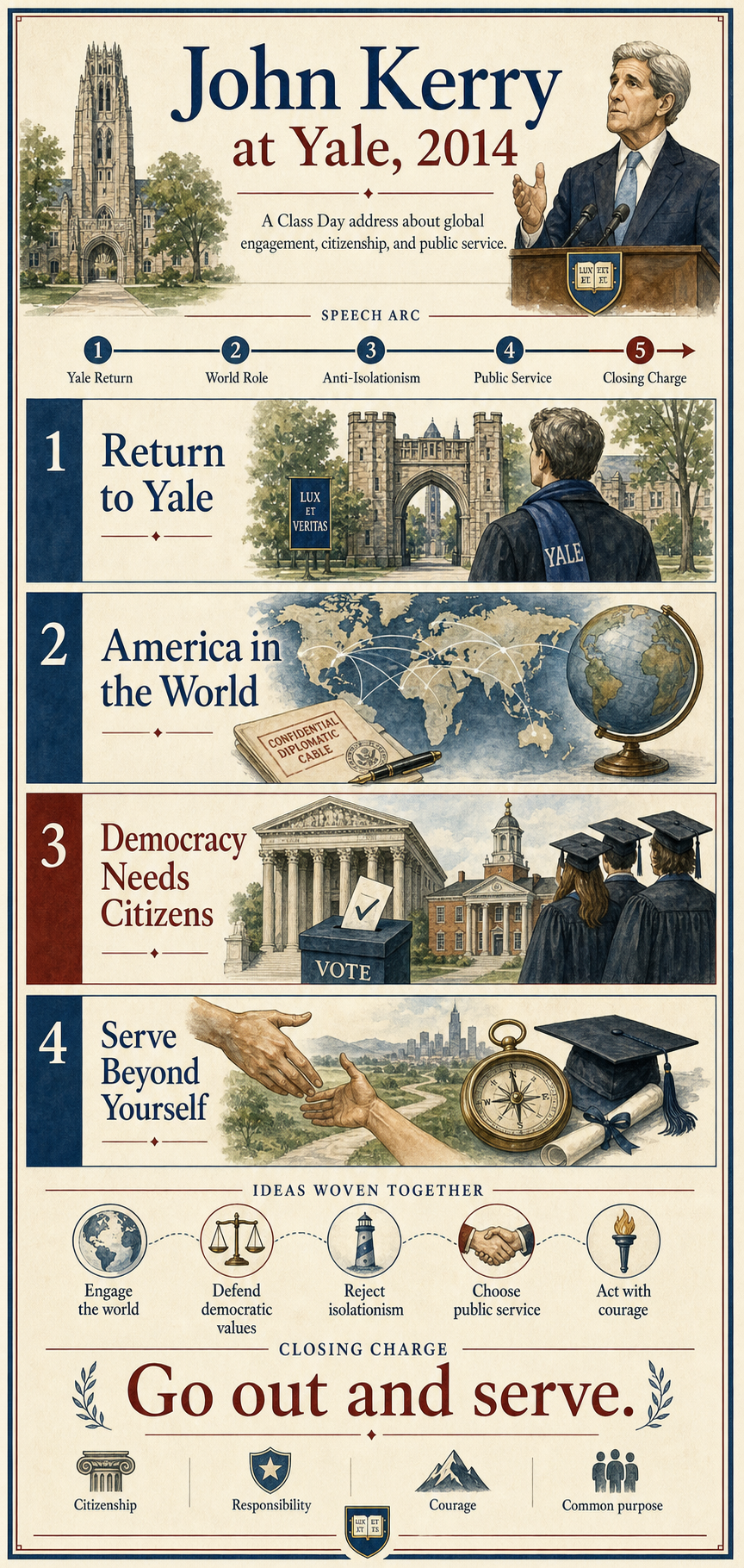
John Kerry at Yale, 2014
A Class Day address about returning to Yale, American responsibility, global engagement, public service, and rejecting isolationism.
Speech arc
- 01Return
Opening move
- 02Yale 1966
Speech beat
- 03Humor
Speech beat
- 04Public duty
Speech beat
- 05World role
Speech beat
- 06Engagement
Speech beat
- 07Anti-isolation
Speech beat
- 08Service
Final charge
Return: An alumnus measures the distance back
Kerry frames the day through the long arc from his own Yale graduation to a return as secretary of state during a more connected world.
Alma mater
The speaker stands before Yale as both insider and public servant, connecting personal memory to national obligation.
Time
Forty-eight years become a measure of how quickly expectations, threats, and responsibilities can change.
Humor
Self-deprecating acknowledgments keep the ceremonial setting conversational before the foreign-policy argument sharpens.
Kerry frames the day through the long arc from his own Yale graduation to a return as secretary of state during a more connected world.
World: America cannot opt out of consequence
The address argues that U.S. choices still shape global stability, and that withdrawal leaves problems to grow without democratic influence.
Role
American power is described less as entitlement than as responsibility under pressure.
Interdependence
Graduates inherit a world where distant conflict, markets, climate, and rights concerns arrive quickly at home.
Choice
Engagement is presented as a hard discipline rather than an automatic confidence in national virtue.
The address argues that U.S.
choices still shape global stability, and that withdrawal leaves problems to grow without democratic influence.
Warning: Isolationism is a false shelter
Kerry's central warning is that turning inward may feel safe, but it weakens the ability to defend values and solve shared problems.
Costs
Avoidance does not remove danger; it often lets crises define the terms later.
Values
Human rights, alliances, and democratic norms require active defense across borders.
Debate
The speech invites graduates into public argument about how engagement should be practiced, not whether the world matters.
Kerry's central warning is that turning inward may feel safe, but it weakens the ability to defend values and solve shared problems.
• Key takeaways •
Engagement beats withdrawal
Connects to foreign policy.
Power carries responsibility
Connects to isolationism.
Public service requires patience
Connects to american role.
Global problems arrive locally
Connects to public service.
Citizenship is active work
Connects to citizenship.
Closing charge
The close turns foreign policy into a graduate-level call: use education, skill, and citizenship to stay involved when problems resist simple answers.
Public service asks for durable engagement
Service
Yale privilege is translated into obligation to institutions, neighbors, country, and global common goods.
Patience
Diplomacy and civic work require persistence through ambiguity and partial wins.
Agency
Graduates are treated as future participants in shaping whether power serves responsibility.
The close turns foreign policy into a graduate-level call: use education, skill, and citizenship to stay involved when problems resist simple answers.
Visual speech maps
Browse more visual maps from Yale University or continue with related mapped speeches below.
Transcript
The full transcript is hosted by the original publisher. Commencement Archive links to the source rather than republishing copyrighted text.
Read the full transcript at source →Provenance
Verified from official archive; cross-referenced with NPR commencement archive; cross-referenced with Open Commencement DB
Category: Politics | NPR archive last updated in 2015; destination availability has not been exhaustively rechecked | Open Commencement DB transcript; not independently verified against the original recording
Explore this speech
Find the next thread through the archive
Themes in this address
No canonical themes have been assigned yet.
Speeches like this one
Search all speeches ->