Barbara Walters
Television journalist
At Yale's 2012 Class Day, Barbara Walters reassured graduates that most people, including herself, don't discover their passion early in life, and that their "bliss" will eventually find them. She shared lessons drawn from interviews with figures including Barack Obama, Hillary Clinton, the Dalai Lama, Margaret Thatcher, and Christopher Reeve, emphasizing choices, resilience after failure, and active participation in life. She closed with a personal family anecdote urging graduates to fully participate in their lives.
“If you have a failure, you will rise; you will be fine; you will work your way back.”
Key moments
- 01 Telling graduates not to fear if they haven't found their passion, as most people discover it later
- 02 Sharing Obama's reflection on unexpected career paths and Clinton's account of personal choices
- 03 Recounting the Dalai Lama's view that the purpose of life is happiness through compassion
- 04 Drawing on Thatcher's and her own experiences with failure, urging students to rise back
- 05 Sharing Christopher Reeve's perspective on facing hardship and her grandmother story to 'participate'
Save the visual map
Download or open the generated poster as a standalone PNG.
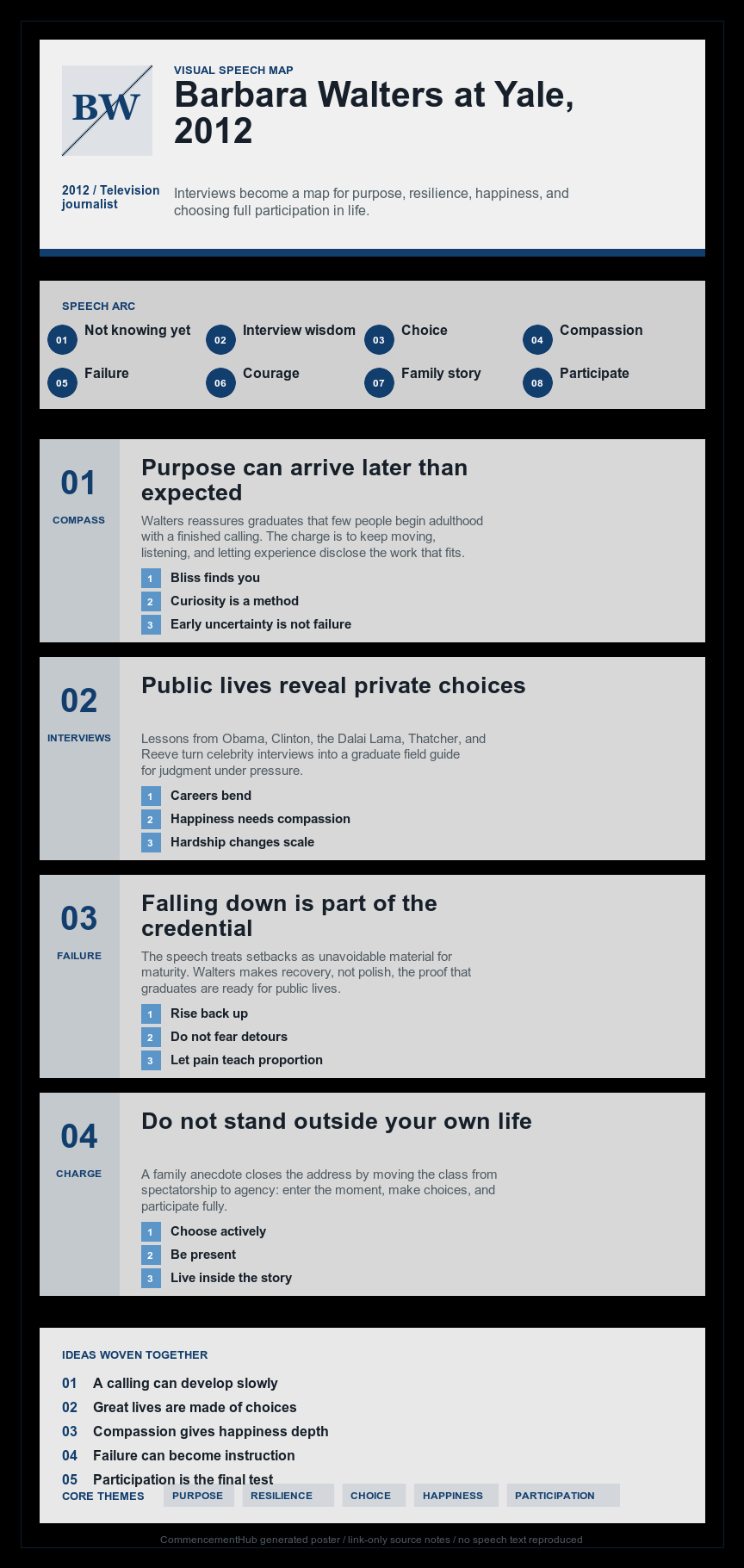
Barbara Walters at Yale, 2012
A Class Day address about purpose arriving in time, interview-tested wisdom, resilience after failure, compassion, and choosing to participate fully.
Speech arc
- 01Not knowing yet
Opening move
- 02Interview wisdom
Speech beat
- 03Choice
Speech beat
- 04Compassion
Speech beat
- 05Failure
Speech beat
- 06Courage
Speech beat
- 07Family story
Speech beat
- 08Participate
Final charge
Compass: Purpose can arrive later than expected
Walters reassures graduates that few people begin adulthood with a finished calling. The charge is to keep moving, listening, and letting experience disclose the work that fits.
Bliss
The address lowers the pressure to have a complete plan and treats purpose as something discovered through attention.
Curiosity
A journalist's life becomes evidence that questions, detours, and encounters can form a vocation over time.
Timing
Uncertainty after graduation is framed as normal, not as proof that the class is already behind.
Walters reassures graduates that few people begin adulthood with a finished calling.
The charge is to keep moving, listening, and letting experience disclose the work that fits.
Interviews: Public lives reveal private choices
Lessons from Barack Obama, Hillary Clinton, the Dalai Lama, Margaret Thatcher, and Christopher Reeve turn celebrity interviews into a graduate field guide for judgment under pressure.
Obama
Unexpected paths show that ambition often develops through choices made before the destination is clear.
Dalai Lama
Happiness is tied to compassion, moving the speech from achievement toward how graduates treat other people.
Reeve
Hardship becomes a lesson in scale, courage, and the capacity to keep living with purpose.
Lessons from Barack Obama, Hillary Clinton, the Dalai Lama, Margaret Thatcher, and Christopher Reeve turn celebrity interviews into a graduate field guide for judgment under pressure.
Failure: Falling down is part of the credential
The speech treats setbacks as unavoidable material for maturity. Walters makes recovery, not polish, the proof that graduates are ready for public lives.
Thatcher
Public reversals and personal disappointments become examples of how to rise back without being defined by the fall.
Resilience
Failure is not romanticized; it is made useful when it teaches proportion, persistence, and renewed choice.
Perspective
Graduates are asked to measure pain against the larger work of becoming active, generous adults.
The speech treats setbacks as unavoidable material for maturity.
Walters makes recovery, not polish, the proof that graduates are ready for public lives.
• Key takeaways •
A calling can develop slowly
Connects to purpose.
Great lives are made of choices
Connects to resilience.
Compassion gives happiness depth
Connects to choice.
Failure can become instruction
Connects to happiness.
Participation is the final test
Connects to participation.
Closing charge
A family anecdote closes the address by moving the class from spectatorship to agency: enter the moment, make choices, and participate fully.
Do not stand outside your own life
Presence
The final lesson is not to watch life from a careful distance when participation is possible.
Choice
Graduates are sent out with responsibility for the lives they build, not simply the opportunities they receive.
Action
The closing charge turns wisdom into a habit: show up, choose, and live inside the story.
A family anecdote closes the address by moving the class from spectatorship to agency: enter the moment, make choices, and participate fully.
Visual speech maps
Browse more visual maps from Yale University or continue with related mapped speeches below.
Transcript
No official full transcript has been located yet. If you know of one, suggestions are welcome.
Provenance
Verified from official archive; targeted event-level link verified
Category: Journalism
Explore this speech
Find the next thread through the archive
Themes in this address
Speeches like this one
Search all speeches ->