George W. Bush
Field: politics
President George W. Bush addresses Calvin College's Class of 2005, urging graduates to contribute to American freedom by serving their communities. Drawing on Alexis de Tocqueville and Dutch figure Abraham Kuyper, he argues that individual freedom is anchored in community institutions like family, faith, and civic organizations. He calls on graduates to choose citizenship over spectatorship and to embrace service through faith-based and community efforts.
Key moments
- 01 Opens with humor about his own college experience and English skills
- 02 Cites Tocqueville's Democracy in America on Americans banding together for the common good
- 03 Argues private character, local power, and community involvement sustain a free society
- 04 References Abraham Kuyper's call for Dutch immigrants to serve as Christian citizens
- 05 Challenges graduates to choose to be citizens, not spectators, through service
Save the visual map
Download or open the generated poster as a standalone PNG.
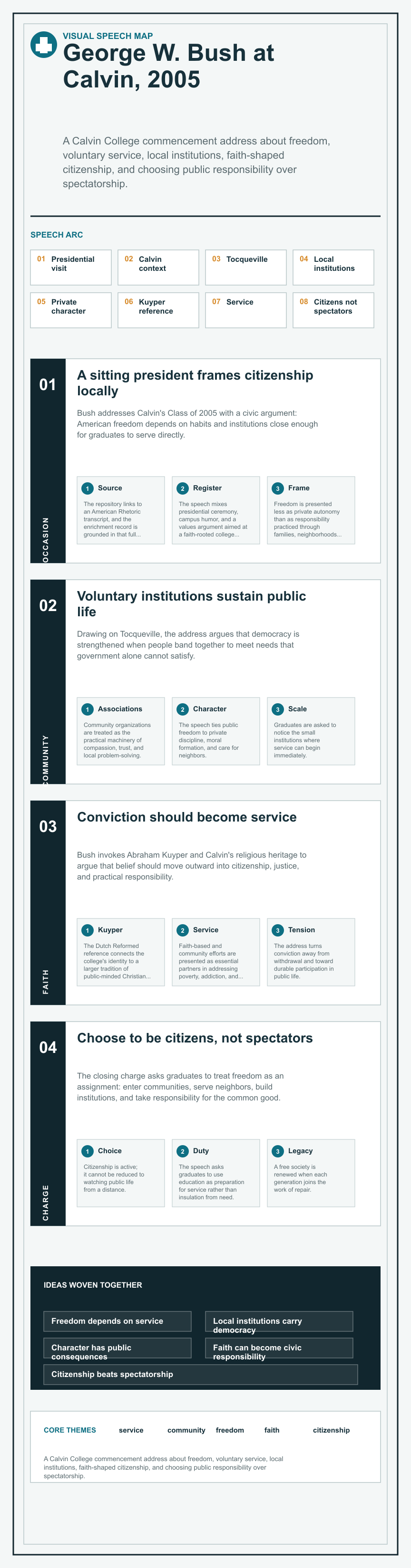
George W. Bush at Calvin, 2005
A Calvin College commencement address about freedom, voluntary service, local institutions, faith-shaped citizenship, and choosing public responsibility over spectatorship.
Speech arc
- 01Presidential visit
Opening move
- 02Calvin context
Speech beat
- 03Tocqueville
Speech beat
- 04Local institutions
Speech beat
- 05Private character
Speech beat
- 06Kuyper reference
Speech beat
- 07Service
Speech beat
- 08Citizens not spectators
Final charge
Occasion: A sitting president frames citizenship locally
Bush addresses Calvin's Class of 2005 with a civic argument: American freedom depends on habits and institutions close enough for graduates to serve directly.
Source
The repository links to an American Rhetoric transcript, and the enrichment record is grounded in that full text.
Register
The speech mixes presidential ceremony, campus humor, and a values argument aimed at a faith-rooted college audience.
Frame
Freedom is presented less as private autonomy than as responsibility practiced through families, neighborhoods, churches, and civic groups.
Bush addresses Calvin's Class of 2005 with a civic argument: American freedom depends on habits and institutions close enough for graduates to serve directly.
Community: Voluntary institutions sustain public life
Drawing on Tocqueville, the address argues that democracy is strengthened when people band together to meet needs that government alone cannot satisfy.
Associations
Community organizations are treated as the practical machinery of compassion, trust, and local problem-solving.
Character
The speech ties public freedom to private discipline, moral formation, and care for neighbors.
Scale
Graduates are asked to notice the small institutions where service can begin immediately.
Drawing on Tocqueville, the address argues that democracy is strengthened when people band together to meet needs that government alone cannot satisfy.
Faith: Conviction should become service
Bush invokes Abraham Kuyper and Calvin's religious heritage to argue that belief should move outward into citizenship, justice, and practical responsibility.
Kuyper
The Dutch Reformed reference connects the college's identity to a larger tradition of public-minded Christian citizenship.
Service
Faith-based and community efforts are presented as essential partners in addressing poverty, addiction, and social need.
Tension
The address turns conviction away from withdrawal and toward durable participation in public life.
Bush invokes Abraham Kuyper and Calvin's religious heritage to argue that belief should move outward into citizenship, justice, and practical responsibility.
• Key takeaways •
Freedom depends on service
Connects to service.
Local institutions carry democracy
Connects to community.
Character has public consequences
Connects to freedom.
Faith can become civic responsibility
Connects to faith.
Citizenship beats spectatorship
Connects to citizenship.
Closing charge
The closing charge asks graduates to treat freedom as an assignment: enter communities, serve neighbors, build institutions, and take responsibility for the common good.
Choose to be citizens, not spectators
Choice
Citizenship is active; it cannot be reduced to watching public life from a distance.
Duty
The speech asks graduates to use education as preparation for service rather than insulation from need.
Legacy
A free society is renewed when each generation joins the work of repair.
The closing charge asks graduates to treat freedom as an assignment: enter communities, serve neighbors, build institutions, and take responsibility for the common good.
Visual speech maps
Browse more visual maps from Calvin College or continue with related mapped speeches below.
Transcript
The full transcript is hosted by the original publisher. Commencement Archive links to the source rather than republishing copyrighted text.
Read the full transcript at source →Provenance
Imported from NPR commencement archive; cross-referenced with Open Commencement DB
NPR archive last updated in 2015; destination availability has not been exhaustively rechecked | Open Commencement DB transcript; not independently verified against the original recording
Explore this speech
Find the next thread through the archive
Themes in this address
Speeches like this one
Search all speeches ->