Jon Lovett
Field: arts
Jon Lovett, a former presidential and Hillary Clinton speechwriter, warns graduates about the pervasive 'culture of bullshit' in public and private life and urges them to commit to honesty. He offers three practical lessons: don't cover for your inexperience, speak up when you believe something is wrong, and recognize that authenticity can be rewarded. He argues society may have reached 'peak bullshit' and that earnest, sincere graduates are well positioned to lead a turn toward greater authenticity.
Key moments
- 01 Diagnosing the pervasive 'culture of bullshit' in politics, media, and personal life
- 02 Lesson one: balance confidence with awareness of your inexperience
- 03 Lesson two: speak up when you're inexperienced but right, illustrated by the Clinton campaign's slogans
- 04 Lesson three: honesty pays off and society may have reached 'peak bullshit'
Save the visual map
Download or open the generated poster as a standalone PNG.
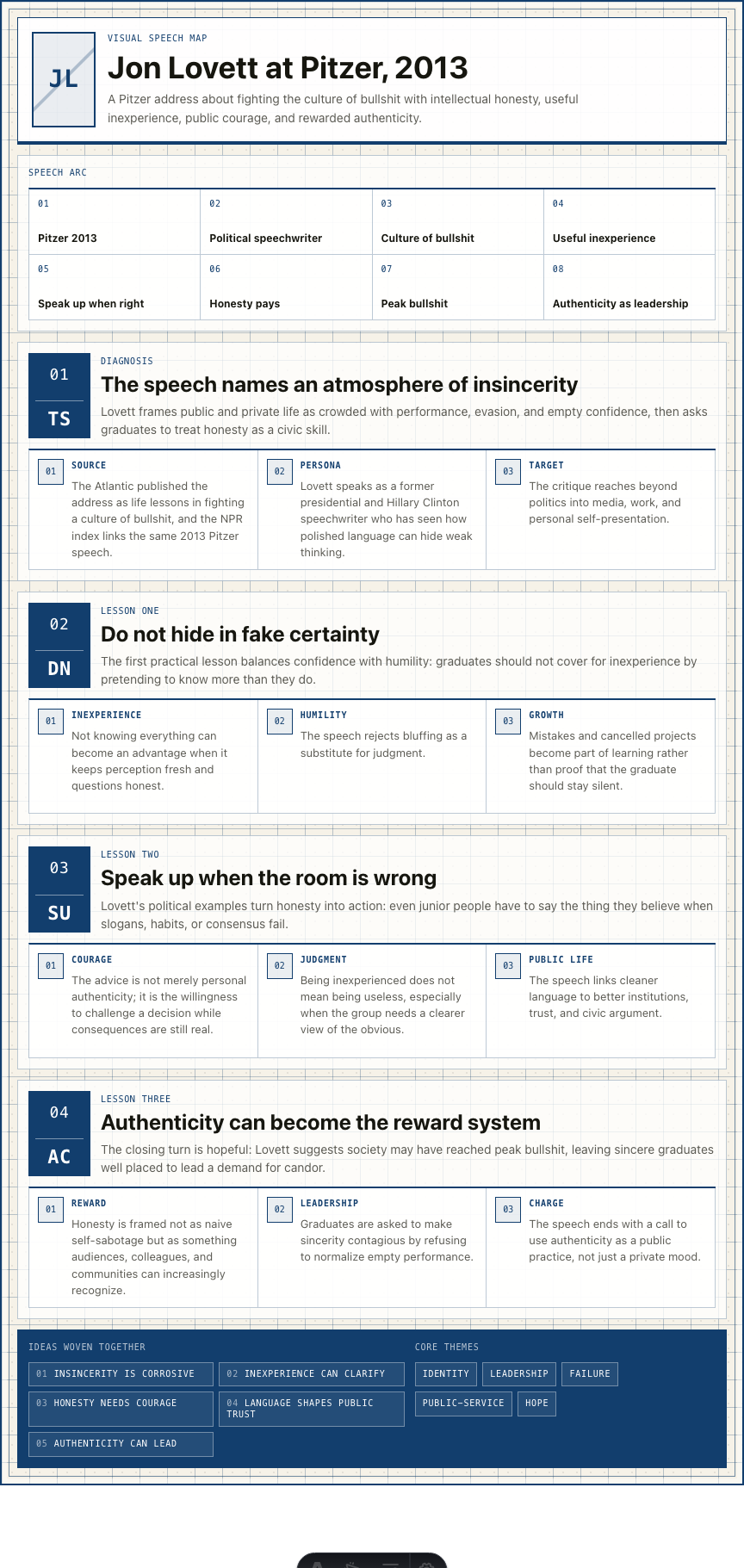
Jon Lovett at Pitzer, 2013
A Pitzer address about fighting the culture of bullshit with intellectual honesty, useful inexperience, public courage, and rewarded authenticity.
Speech arc
- 01Pitzer 2013
Opening move
- 02Political speechwriter
Speech beat
- 03Culture of bullshit
Speech beat
- 04Useful inexperience
Speech beat
- 05Speak up when right
Speech beat
- 06Honesty pays
Speech beat
- 07Peak bullshit
Speech beat
- 08Authenticity as leadership
Final charge
Diagnosis: The speech names an atmosphere of insincerity
Lovett frames public and private life as crowded with performance, evasion, and empty confidence, then asks graduates to treat honesty as a civic skill.
Source
The Atlantic published the address as life lessons in fighting a culture of bullshit, and the NPR index links the same 2013 Pitzer speech.
Persona
Lovett speaks as a former presidential and Hillary Clinton speechwriter who has seen how polished language can hide weak thinking.
Target
The critique reaches beyond politics into media, work, and personal self-presentation.
Lovett frames public and private life as crowded with performance, evasion, and empty confidence, then asks graduates to treat honesty as a civic skill.
Lesson one: Do not hide in fake certainty
The first practical lesson balances confidence with humility: graduates should not cover for inexperience by pretending to know more than they do.
Inexperience
Not knowing everything can become an advantage when it keeps perception fresh and questions honest.
Humility
The speech rejects bluffing as a substitute for judgment.
Growth
Mistakes and cancelled projects become part of learning rather than proof that the graduate should stay silent.
The first practical lesson balances confidence with humility: graduates should not cover for inexperience by pretending to know more than they do.
Lesson two: Speak up when the room is wrong
Lovett's political examples turn honesty into action: even junior people have to say the thing they believe when slogans, habits, or consensus fail.
Courage
The advice is not merely personal authenticity; it is the willingness to challenge a decision while consequences are still real.
Judgment
Being inexperienced does not mean being useless, especially when the group needs a clearer view of the obvious.
Public life
The speech links cleaner language to better institutions, trust, and civic argument.
Lovett's political examples turn honesty into action: even junior people have to say the thing they believe when slogans, habits, or consensus fail.
• Key takeaways •
Insincerity is corrosive
Connects to identity.
Inexperience can clarify
Connects to leadership.
Honesty needs courage
Connects to failure.
Language shapes public trust
Connects to public-service.
Authenticity can lead
Connects to hope.
Closing charge
The closing turn is hopeful: Lovett suggests society may have reached peak bullshit, leaving sincere graduates well placed to lead a demand for candor.
Authenticity can become the reward system
Reward
Honesty is framed not as naive self-sabotage but as something audiences, colleagues, and communities can increasingly recognize.
Leadership
Graduates are asked to make sincerity contagious by refusing to normalize empty performance.
Charge
The speech ends with a call to use authenticity as a public practice, not just a private mood.
The closing turn is hopeful: Lovett suggests society may have reached peak bullshit, leaving sincere graduates well placed to lead a demand for candor.
Visual speech maps
Browse more visual maps from Pitzer College or continue with related mapped speeches below.
Transcript
The full transcript is hosted by the original publisher. Commencement Archive links to the source rather than republishing copyrighted text.
Read the full transcript at source →Provenance
Imported from NPR commencement archive; cross-referenced with Open Commencement DB
NPR archive last updated in 2015; destination availability has not been exhaustively rechecked | Open Commencement DB transcript; not independently verified against the original recording
Explore this speech
Find the next thread through the archive
Themes in this address
Speeches like this one
Search all speeches ->