Neil Howe
Neil Howe distinguishes a 'generation' (a group shaped by common age location in history) from 'youth' (a mere age bracket), arguing that Millennial graduates are fundamentally different from their Boomer and Gen-X parents. He describes how Millennials were raised with more protection, a sense of being special, and team-oriented, technology-connected habits, contrasting this with their parents' more rebellious, competitive, individualistic upbringing. He contends no generation is better or worse, and predicts Millennials will correct the excesses of older generations and could become a great generation.
Key moments
- 01 Defining the difference between a generation and 'youth' as an age bracket
- 02 Contrasting Millennials' protected, team-oriented upbringing with parents' rebellious individualism
- 03 Noting the near disappearance of the values gap between youth and parents
- 04 Arguing Millennials reprise the traits of the G.I. 'greatest generation' and may rescue the country
Save the visual map
Download or open the generated poster as a standalone PNG.
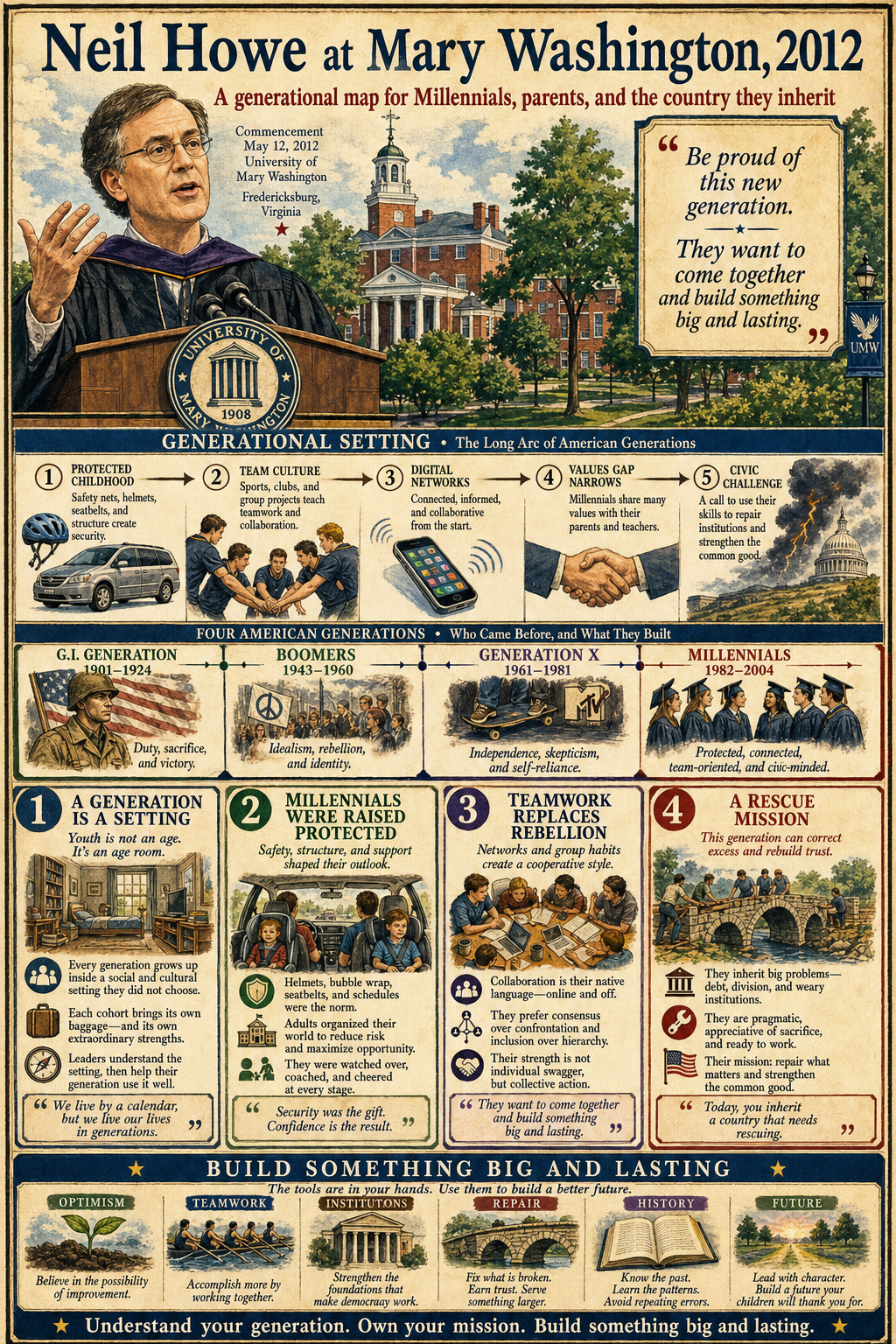
Neil Howe at Mary Washington, 2012
A University of Mary Washington address about generational setting, Millennial habits, civic repair, and building something big and lasting.
Speech arc
- 01University of Mary Washington
Opening move
- 02Class of 2012
Speech beat
- 03Generational setting
Speech beat
- 04Protected childhood
Speech beat
- 05Team culture
Speech beat
- 06Digital networks
Speech beat
- 07Older-generation excesses
Speech beat
- 08Build something lasting
Final charge
Frame: A generation is a setting, not simply an age bracket
Howe distinguishes youth from generation, arguing that each cohort enters history with a shared setting that shapes its outlook and role.
Definition
Youth is a temporary room; a generation brings its own baggage, habits, and strengths into that room.
History
The speech uses historical pattern rather than nostalgia to explain why parents and graduates differ.
Use
Understanding the setting helps graduates see their traits as tools for the moment ahead.
Howe distinguishes youth from generation, arguing that each cohort enters history with a shared setting that shapes its outlook and role.
Formation: Millennials were raised inside protection and structure
The address names helmets, seatbelts, counseling, orientations, and parental support as signs of a cohort formed around safety and encouragement.
Protection
Howe contrasts Millennial childhood safeguards with the looser childhoods of many parents.
Support
The speech treats structure as formative, shaping confidence, risk habits, and expectations.
Reading
Protection is neither mocked nor romanticized; it becomes one source of the generation's civic style.
The address names helmets, seatbelts, counseling, orientations, and parental support as signs of a cohort formed around safety and encouragement.
Style: Teamwork replaces rebellion as the generational habit
Howe argues Millennials are more cooperative, networked, conventional, and values-aligned with parents than youth cohorts famous for rebellion.
Networks
Digital tools make collaboration and constant connection feel native.
Culture
Group projects, clubs, community service, and shared media point toward team-oriented habits.
Contrast
The speech contrasts this with older ideals of individualism, rebellion, and distrust.
Howe argues Millennials are more cooperative, networked, conventional, and values-aligned with parents than youth cohorts famous for rebellion.
• Key takeaways •
Generations are shaped by history
Connects to generations.
Protection can become confidence
Connects to millennials.
Networks teach cooperation
Connects to teamwork.
Civic trust must be rebuilt
Connects to history.
Build something big and lasting
Connects to civic repair.
Closing charge
The final charge is civic: correct older excesses, rebuild institutions, restore trust, and create something durable from a difficult inheritance.
The generation may inherit a rescue mission
Problem
Howe names gridlock, distrust, individualism, and culture-war exhaustion as older-generation excesses.
Hope
Millennial optimism and cooperation become a possible answer to those problems.
Destiny
The speech imagines graduates building something big enough to earn future praise.
The final charge is civic: correct older excesses, rebuild institutions, restore trust, and create something durable from a difficult inheritance.
Visual speech maps
Browse more visual maps from University of Mary Washington or continue with related mapped speeches below.
Transcript
The previously catalogued transcript link is no longer live and is queued for re-sourcing.
Machine transcript available for archive analysis; it is unverified and may contain transcription errors. Machine transcript source ->
Provenance
BROKEN transcript link (checked 2026-06-26): gradspeeches.com is a parked/redirecting domain serving no real content. Provenance: Imported from NPR commencement archive; cross-referenced with Open Commencement DB
NPR archive last updated in 2015; destination availability has not been exhaustively rechecked | Open Commencement DB transcript; not independently verified against the original recording | Transcript URL dead (gradspeeches.com is a parked/redirecting domain serving no real content); no video fallback — needs re-sourcing
Explore this speech
Find the next thread through the archive
Themes in this address
Speeches like this one
Search all speeches ->