Bill Clinton
Field: politics
Bill Clinton congratulates NYU graduates and offers personal advice to pursue happiness through what they do well and to persist through failure. He then analyzes the challenges of an interdependent world—inequality, instability, and unsustainability—and argues for a stakeholder-oriented society and public-private partnerships. He closes by urging graduates to build a world of shared opportunity and to recognize the common humanity that outweighs human differences.
Key moments
- 01 Recounts his own rainy graduation and gives advice to find happiness and not quit through hardship
- 02 Describes living in the most interdependent age in history
- 03 Identifies inequality, instability, and unsustainability as negative forces, citing student debt and climate change in the Arctic
- 04 Critiques shareholder-only thinking and anti-government ideology, praising public-private partnerships and Kyoto success stories
- 05 Cites the human genome to emphasize shared common humanity
Save the visual map
Download or open the generated poster as a standalone PNG.
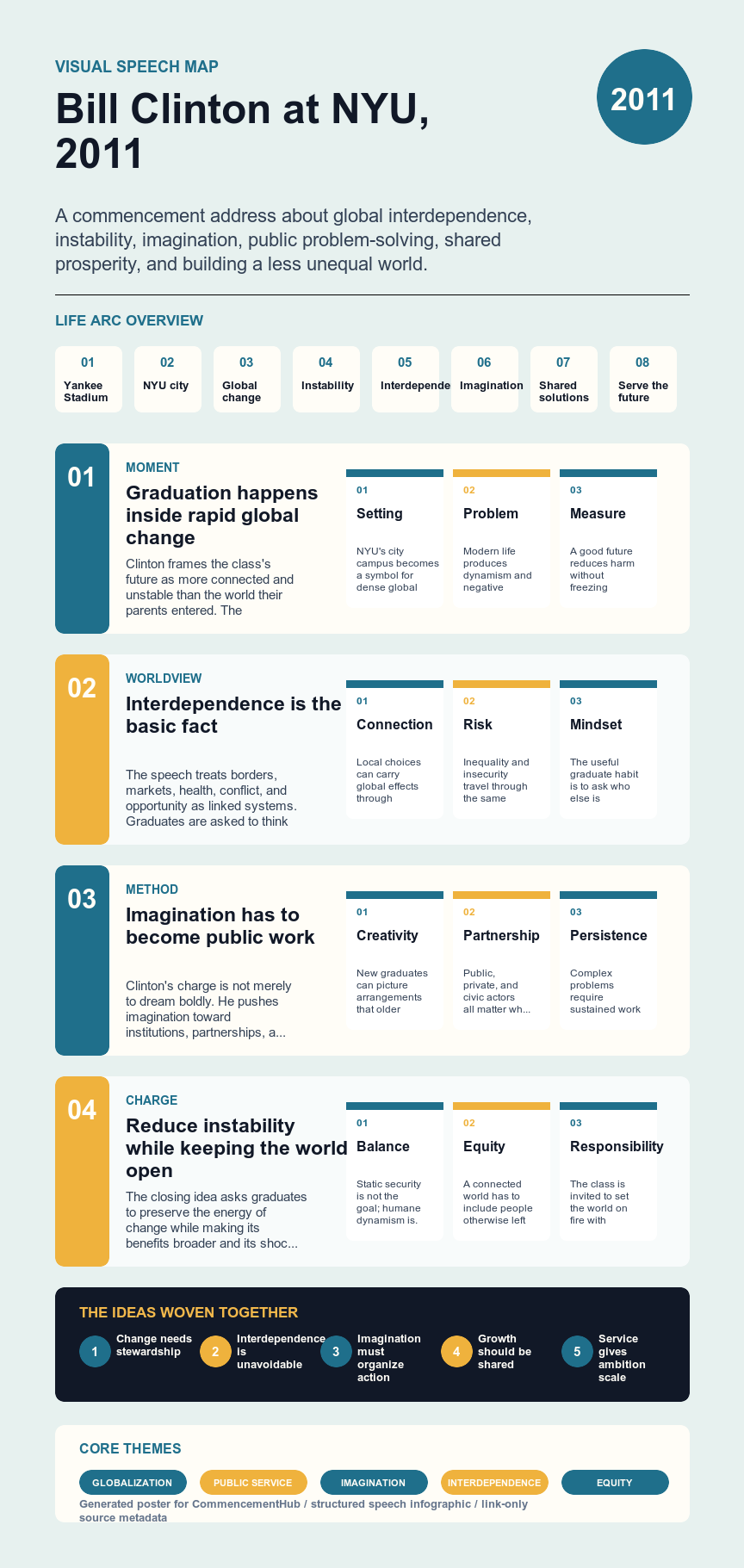
Bill Clinton at NYU, 2011
A commencement address about global interdependence, instability, imagination, public problem-solving, shared prosperity, and building a less unequal world.
Speech arc
- 01Yankee Stadium
Opening move
- 02NYU city
Speech beat
- 03Global change
Speech beat
- 04Instability
Speech beat
- 05Interdependence
Speech beat
- 06Imagination
Speech beat
- 07Shared solutions
Speech beat
- 08Serve the future
Final charge
Moment: Graduation happens inside rapid global change
Clinton frames the class's future as more connected and unstable than the world their parents entered. The opportunity is real, but so is the obligation to manage change humanely.
Setting
NYU's city campus becomes a symbol for dense global contact and constant motion.
Problem
Modern life produces dynamism and negative instability at the same time.
Measure
A good future reduces harm without freezing growth, invention, or openness.
Clinton frames the class's future as more connected and unstable than the world their parents entered.
The opportunity is real, but so is the obligation to manage change humanely.
Worldview: Interdependence is the basic fact
The speech treats borders, markets, health, conflict, and opportunity as linked systems. Graduates are asked to think beyond narrow personal success.
Connection
Local choices can carry global effects through finance, technology, migration, and climate.
Risk
Inequality and insecurity travel through the same networks as opportunity.
Mindset
The useful graduate habit is to ask who else is affected by a decision.
The speech treats borders, markets, health, conflict, and opportunity as linked systems.
Graduates are asked to think beyond narrow personal success.
Method: Imagination has to become public work
Clinton's charge is not merely to dream boldly. He pushes imagination toward institutions, partnerships, and practical efforts that improve people's lives.
Creativity
New graduates can picture arrangements that older systems have stopped seeing.
Partnership
Public, private, and civic actors all matter when problems cross boundaries.
Persistence
Complex problems require sustained work after the ceremonial inspiration fades.
Clinton's charge is not merely to dream boldly.
He pushes imagination toward institutions, partnerships, and practical efforts that improve people's lives.
• Key takeaways •
Change needs stewardship
Connects to globalization.
Interdependence is unavoidable
Connects to public service.
Imagination must organize action
Connects to imagination.
Growth should be shared
Connects to interdependence.
Service gives ambition scale
Connects to equity.
Closing charge
The closing idea asks graduates to preserve the energy of change while making its benefits broader and its shocks less destructive.
Reduce instability while keeping the world open
Balance
Static security is not the goal; humane dynamism is.
Equity
A connected world has to include people otherwise left outside its gains.
Responsibility
The class is invited to set the world on fire with imagination and service.
The closing idea asks graduates to preserve the energy of change while making its benefits broader and its shocks less destructive.
Visual speech maps
Browse more visual maps from New York University or continue with related mapped speeches below.
Transcript
The previously catalogued transcript link is no longer live and is queued for re-sourcing. A video of the address is available above.
Machine transcript available for archive analysis; it is unverified and may contain transcription errors. Machine transcript source ->
Provenance
BROKEN transcript link (checked 2026-06-26): gradspeeches.com is a parked/redirecting domain serving no real content. Provenance: Imported from NPR commencement archive
NPR archive last updated in 2015; destination availability has not been exhaustively rechecked | Transcript URL dead (gradspeeches.com is a parked/redirecting domain serving no real content); video fallback present
Explore this speech
Find the next thread through the archive
Themes in this address
Speeches like this one
Search all speeches ->