Tim Russert
Field: letters
Save the visual map
Download or open the generated poster as a standalone PNG.
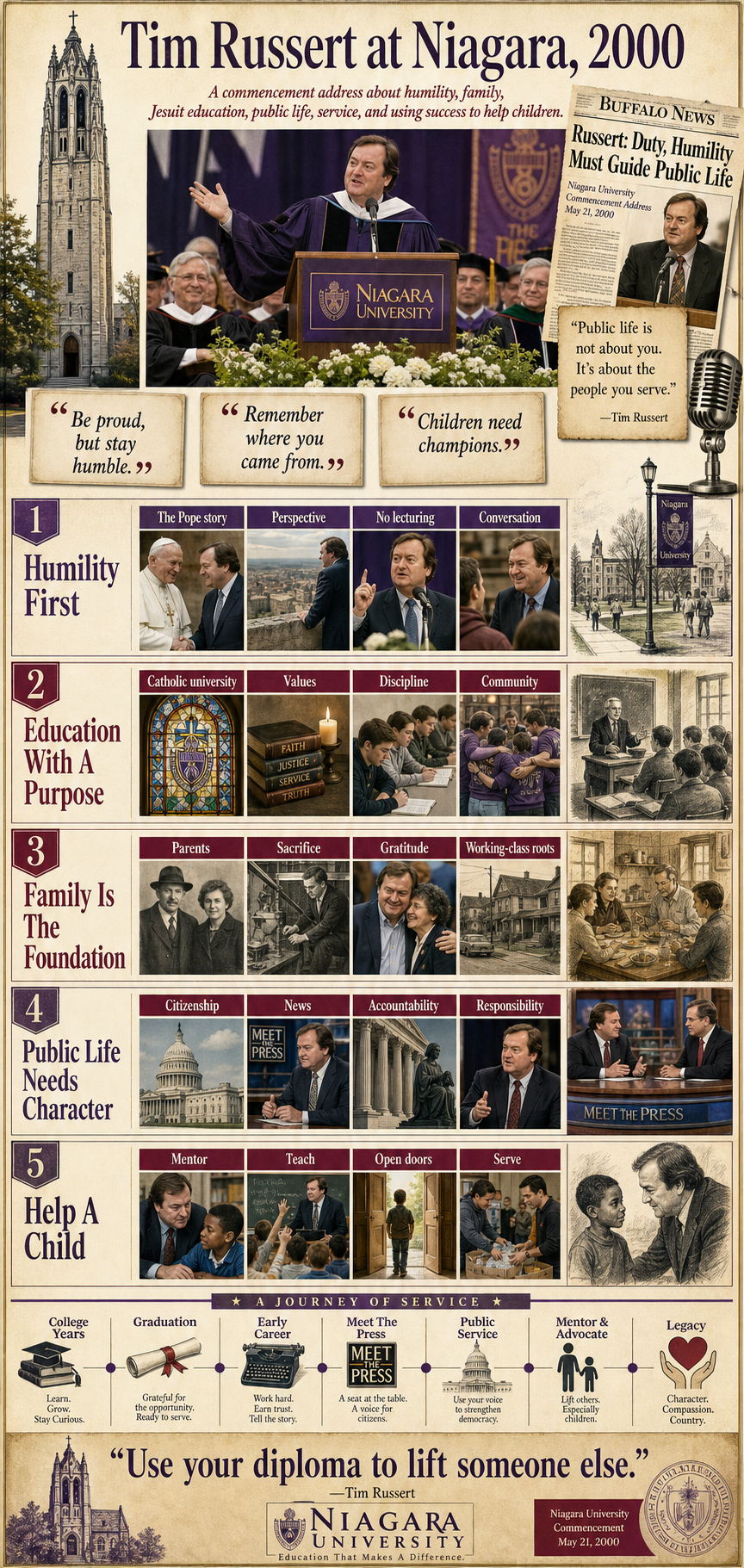
Tim Russert at Niagara, 2000
A commencement address about humility, family, Jesuit education, public life, service, and using success to help children.
Speech arc
- 01Niagara University
Opening move
- 02Class of 2000
Speech beat
- 03Humility first
Speech beat
- 04Jesuit values
Speech beat
- 05Family sacrifice
Speech beat
- 06Public responsibility
Speech beat
- 07Children need help
Speech beat
- 08Lift someone else
Final charge
Opening: Humility makes achievement usable
Russert begins with jokes about commencement speeches and a self-deprecating papal-audience story, turning celebrity into perspective rather than status.
Tone
The address avoids grand lecturing and presents itself as a conversation with graduates who share a values-based education.
Pope story
The comic memory of meeting John Paul II becomes a lesson about knowing one’s place in a room and in the world.
Purpose
Humor lowers the distance between speaker and audience so the moral charge can land plainly.
Russert begins with jokes about commencement speeches and a self-deprecating papal-audience story, turning celebrity into perspective rather than status.
Education: A Niagara education is meant to form character
Russert frames the Catholic university choice as deliberate, emphasizing discipline, values, and community as parts of education that should outlast graduation.
Choice
Graduates chose a school different from many alternatives, one that carries a religious and ethical mission.
Formation
The diploma is not presented as a private credential alone; it is training for responsibility.
Standard
Values become a practical measure for career, citizenship, and how graduates treat people with less power.
Russert frames the Catholic university choice as deliberate, emphasizing discipline, values, and community as parts of education that should outlast graduation.
Family: Success rests on sacrifice that must be remembered
The speech returns to parents, working roots, and gratitude, insisting that ambition should not erase the people who made opportunity possible.
Roots
Russert identifies with first-generation opportunity and the sacrifices families make for education.
Memory
Graduates are asked to remember where they came from as they enter professions and public life.
Gratitude
Family is not background sentiment; it is the ethical foundation for how success should be used.
The speech returns to parents, working roots, and gratitude, insisting that ambition should not erase the people who made opportunity possible.
Public life: Citizenship needs accountability and responsibility
Drawing on his public career, Russert connects news, politics, and civic trust to character, not performance or access alone.
News
Public communication matters because citizens need truthful accountability from those with power.
Character
The address treats ambition as incomplete unless it is joined to honesty, service, and responsibility.
Citizenship
Graduates are invited to carry their values into the public square, not leave them at the campus gate.
Drawing on his public career, Russert connects news, politics, and civic trust to character, not performance or access alone.
• Key takeaways •
Stay humble
Connects to humility.
Remember family sacrifice
Connects to family.
Carry values into public life
Connects to service.
Use success for service
Connects to education.
Children need champions
Connects to citizenship.
Closing charge
Russert’s most concrete charge is to use education and influence to mentor, teach, open doors, and improve the lives of children who need champions.
The final test is whether graduates help a child
Focus
The speech narrows service to a vivid audience: children whose futures can be changed by adult attention.
Action
Mentoring, teaching, advocacy, and personal presence are treated as accessible forms of service.
Charge
The diploma becomes a tool for lifting someone else rather than a trophy marking individual arrival.
Russert’s most concrete charge is to use education and influence to mentor, teach, open doors, and improve the lives of children who need champions.
Visual speech maps
Browse more visual maps from Niagara University or continue with related mapped speeches below.
Transcript
The previously catalogued transcript link is no longer live and is queued for re-sourcing.
Machine transcript available for archive analysis; it is unverified and may contain transcription errors. Machine transcript source ->
Provenance
BROKEN transcript link (checked 2026-06-26): returns 404 Not Found. Provenance: Imported from NPR commencement archive; cross-referenced with Open Commencement DB
NPR archive last updated in 2015; destination availability has not been exhaustively rechecked | Open Commencement DB transcript; not independently verified against the original recording | Transcript URL dead (returns 404 Not Found); no video fallback — needs re-sourcing
Explore this speech
Find the next thread through the archive
Themes in this address
No canonical themes have been assigned yet.
Speeches like this one
Search all speeches ->