Lewis Lapham
Field: letters
Lapham argues that the humanities are necessities rather than luxuries, essential to giving direction to technological power and cultivating self-reliant, curious minds. He illustrates the meaning of humanism through a portrait of his editor and mentor Otto Friedrich, whose lifelong love of learning and storytelling endured through personal hardship. He urges graduates to align themselves with the possibility of change against the defenders of the status quo, and to trust their own thought and voice.
Key moments
- 01 Reframing the humanities as necessities that can 'clean up' the mess made by technology
- 02 Defining humanism through Renaissance ideals and figures like Ulysses, Darwin, and Condorcet
- 03 Extended tribute to mentor Otto Friedrich as an embodiment of the humanist spirit
- 04 Contrasting the party of 'things as they are' with the party of 'things as they might become'
- 05 Debunking the claims that the future is too dangerous and that nothing remains to be discovered
Save the visual map
Download or open the generated poster as a standalone PNG.
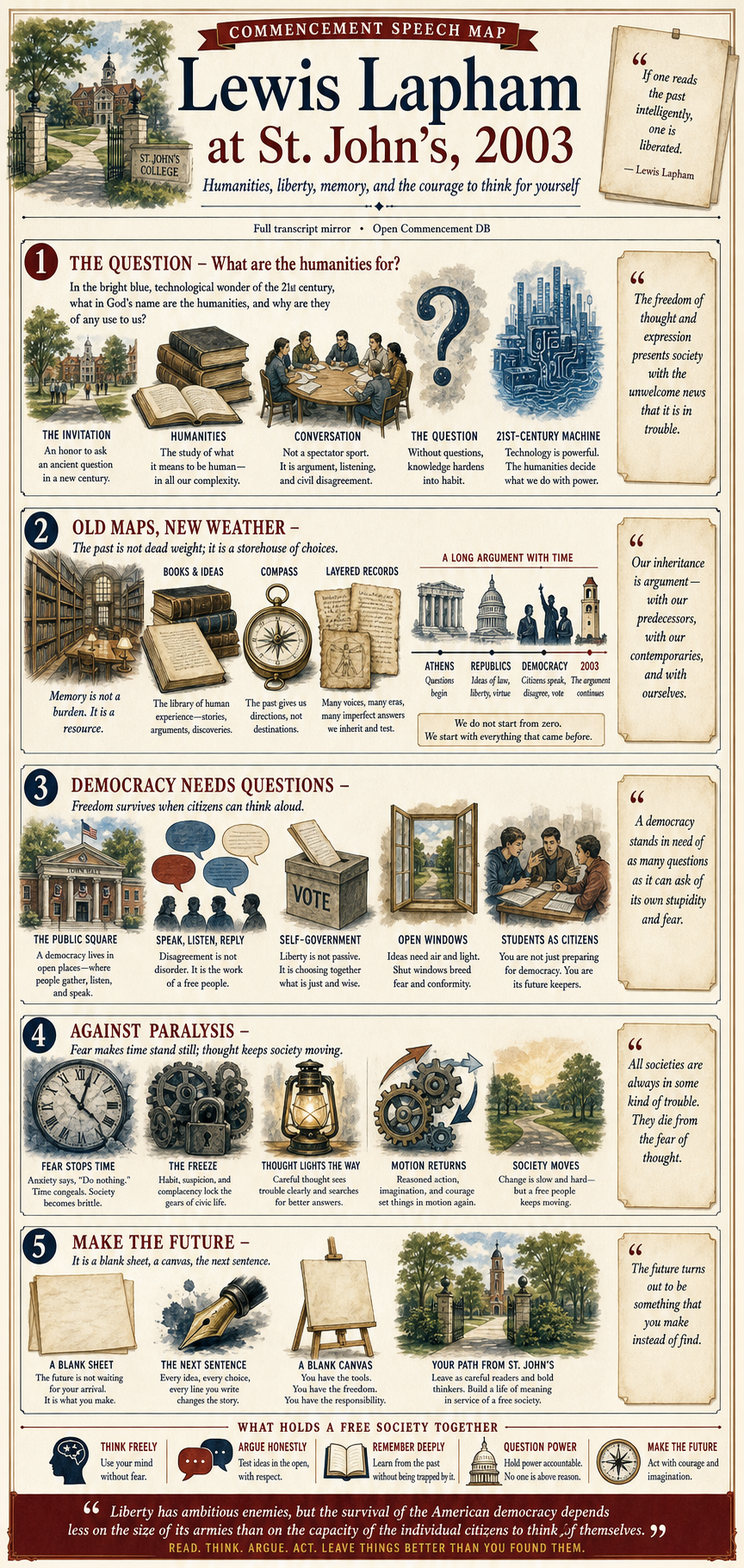
Lewis Lapham at St. John’s College, 2003
A St. John’s address about the humanities, democratic questioning, memory, liberty, and the future as something citizens make rather than find.
Speech arc
- 01St. John’s College
Opening move
- 02Full transcript mirror
Speech beat
- 03Humanities question
Speech beat
- 04Old books and new century
Speech beat
- 05Democratic argument
Speech beat
- 06Fear versus thought
Speech beat
- 07Blank canvas future
Speech beat
- 08Liberty and self-rule
Final charge
Question: The humanities become a civic instrument
Lapham treats the humanities not as cultural ornament, but as a way to ask what human beings are for inside a technological century.
Occasion
The address speaks to a St. John’s class formed by sustained engagement with old books, shared inquiry, and demanding conversation.
Problem
The core question asks why inherited texts and humanistic study matter when speed, utility, and technical power dominate public imagination.
Answer
The humanities keep complexity visible: they teach attention to language, motive, power, memory, and human consequence.
Lapham treats the humanities not as cultural ornament, but as a way to ask what human beings are for inside a technological century.
Memory: The past supplies arguments, not cages
The speech frames tradition as a living storehouse of examples and disagreements that helps graduates judge the present more freely.
Inheritance
Old maps are useful because they expose recurring human questions rather than dictating a single route.
Method
Reading across time becomes a discipline of comparison: test inherited claims against current experience.
Freedom
Memory gives citizens more than nostalgia; it gives them the material to resist fashionable certainty.
The speech frames tradition as a living storehouse of examples and disagreements that helps graduates judge the present more freely.
Democracy: A free society needs more questions
Lapham links freedom of thought and expression to the health of democracy: self-government requires citizens able to disagree, doubt, and speak.
Civic habit
Democracy is presented as argument in public, not passive agreement with authority or the comfort of the status quo.
Risk
The speech warns that fear and conformity narrow the range of thought a society can tolerate.
Charge
Graduates are asked to use education as active citizenship: observe clearly, question power, and keep public life intellectually awake.
Lapham links freedom of thought and expression to the health of democracy: self-government requires citizens able to disagree, doubt, and speak.
• Key takeaways •
The humanities sharpen civic judgment
Connects to humanities.
Memory expands freedom
Connects to democracy.
Democracy depends on questioning
Connects to liberty.
Fear paralyzes thought
Connects to memory.
The future is made, not found
Connects to courage.
Closing charge
The closing movement turns away from fatalism: the future is not waiting fully formed, but made through thought, courage, and the next deliberate act.
The future is made sentence by sentence
Agency
A blank sheet or canvas becomes the speech’s central image for possibility.
Temperament
Courage of thought matters because imaginative citizens can move where fear tries to freeze the present.
Synthesis
Humanistic education becomes preparation to make a life and a polity with intelligence, skepticism, and hope.
The closing movement turns away from fatalism: the future is not waiting fully formed, but made through thought, courage, and the next deliberate act.
Visual speech maps
Browse more visual maps from St. John’s College or continue with related mapped speeches below.
Transcript
The previously catalogued transcript link is no longer live and is queued for re-sourcing.
Machine transcript available for archive analysis; it is unverified and may contain transcription errors. Machine transcript source ->
Provenance
BROKEN transcript link (checked 2026-06-26): humanity.org removed its /voices/commencements section. Provenance: Imported from NPR commencement archive
NPR archive last updated in 2015; destination availability has not been exhaustively rechecked | Transcript URL dead (humanity.org removed its /voices/commencements section); no video fallback — needs re-sourcing
Explore this speech
Find the next thread through the archive
Themes in this address
Speeches like this one
Search all speeches ->