Lewis Lapham
Lapham argues that the humanities are necessities rather than luxuries, essential for guiding a technological society and for sustaining democracy. He devotes much of the address to a tribute to his late editor and mentor Otto Friedrich, holding him up as the embodiment of true humanism—curiosity, learning, and intellectual courage in the face of hardship. He urges graduates to distrust the guardians of the status quo and to make the future through independent thought.
Key moments
- 01 Defense of the humanities as necessities, not ornaments
- 02 Extended tribute to mentor Otto Friedrich as a model humanist
- 03 Critique of the media and authorities who exaggerate fear of the future
- 04 Call to join the 'party of things-as-they-might-become' and think for oneself
Save the visual map
Download or open the generated poster as a standalone PNG.
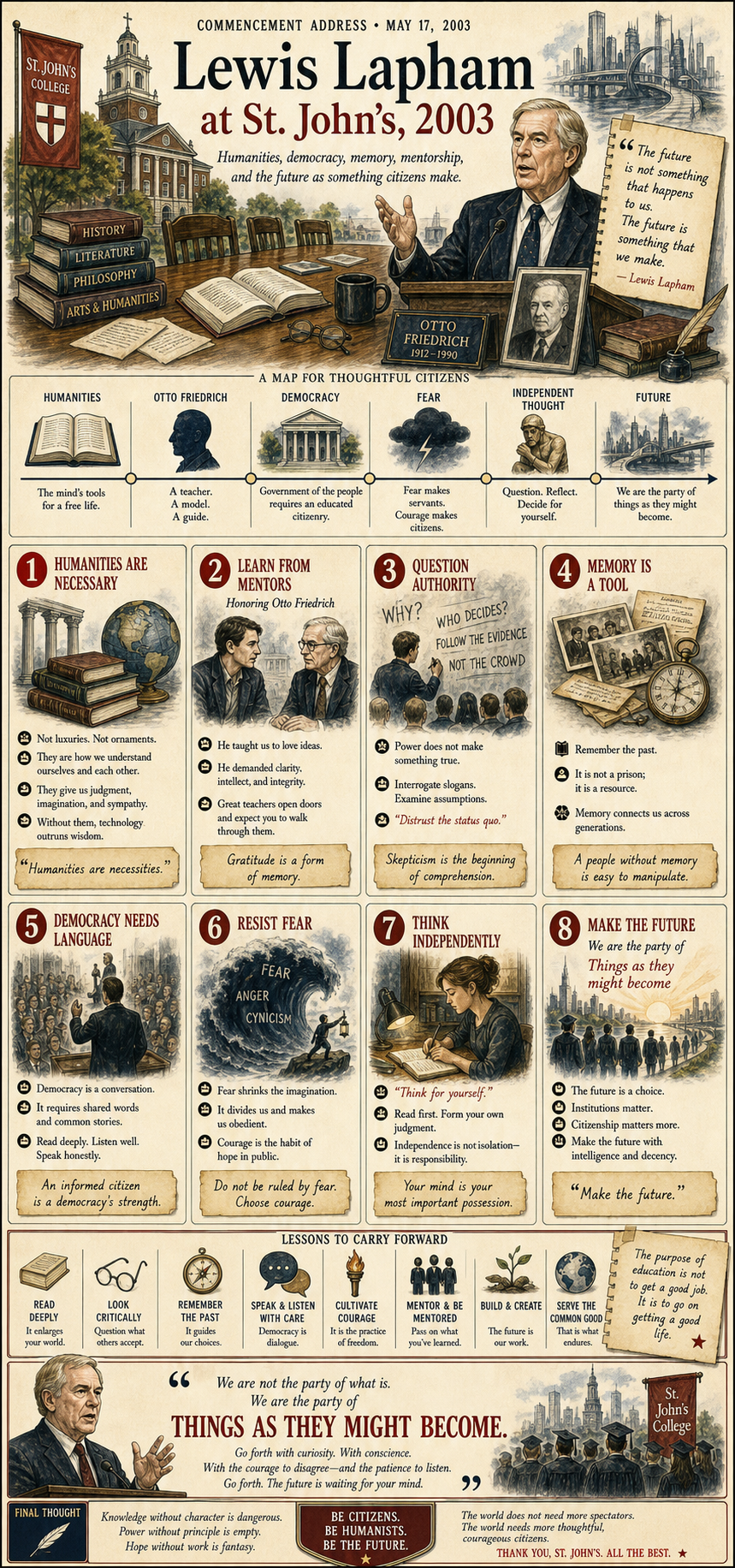
Lewis Lapham at St. John's, 2003
A St. John's address about humanities, democracy, mentorship, memory, and making the future.
Speech arc
- 01St. John's College
Opening move
- 02Humanities
Speech beat
- 03Otto Friedrich
Speech beat
- 04Democracy
Speech beat
- 05Memory
Speech beat
- 06Independent thought
Speech beat
- 07Status quo
Speech beat
- 08Make the future
Final charge
Humanities: The humanities are necessities
Lapham argues that humanistic learning is civic equipment for a technological age.
Source
Grounded in a substantive transcript.
Pattern
The poster maps the speech into visual claims.
Charge
The closing lesson turns advice into action.
Lapham argues that humanistic learning is civic equipment for a technological age.
Mentor: A humanist model
The tribute to Otto Friedrich turns mentorship into an example of curiosity and courage.
Source
Grounded in a substantive transcript.
Pattern
The poster maps the speech into visual claims.
Charge
The closing lesson turns advice into action.
The tribute to Otto Friedrich turns mentorship into an example of curiosity and courage.
Democracy: Question the guardians
The address warns against fear, media certainty, and status quo thinking.
Source
Grounded in a substantive transcript.
Pattern
The poster maps the speech into visual claims.
Charge
The closing lesson turns advice into action.
The address warns against fear, media certainty, and status quo thinking.
• Key takeaways •
Democracy
Connects to humanities.
Memory
Connects to democracy.
Independent thought
Connects to independent thought.
Status quo
Connects to mentorship.
Make the future
Connects to future.
Closing charge
Graduates are called to make the future through independent judgment.
Join what might become
Source
Grounded in a substantive transcript.
Pattern
The poster maps the speech into visual claims.
Charge
The closing lesson turns advice into action.
Graduates are called to make the future through independent judgment.
Visual speech maps
Browse more visual maps from St. John’s College or continue with related mapped speeches below.
Transcript
The full transcript is hosted by the original publisher. Commencement Archive links to the source rather than republishing copyrighted text.
Read the full transcript at source →Provenance
Imported from Open Commencement DB
Open Commencement DB transcript; not independently verified against the original recording
Explore this speech
Find the next thread through the archive
Themes in this address
Speeches like this one
Search all speeches ->