Chimamanda Ngozi Adichie
Field: letters
Chimamanda Ngozi Adichie addresses Wellesley's class of 2015, drawing on personal anecdotes about makeup, her mother's career, and her own decision to leave medical school to pursue writing. She urges graduates to recognize their privilege, to try to create the world they want, and to make feminism an inclusive movement. She shares the recent kidnapping of her father to reflect on what truly matters, and closes with advice about authenticity, refusing gendered expectations, and loving by both giving and taking.
Key moments
- 01 Anecdote about wearing makeup after being dismissed as a 'small girl'
- 02 Her mother insisting on being called 'chairman' to illustrate that ideologies don't always fit life
- 03 Leaving medical school to pursue writing as an act of trying
- 04 Call to make feminism a big, inclusive party
- 05 Disclosing her father's recent kidnapping and reflecting on what matters
- 06 Advice to not twist oneself to please and to love by giving and taking
Save the visual map
Download or open the generated poster as a standalone PNG.
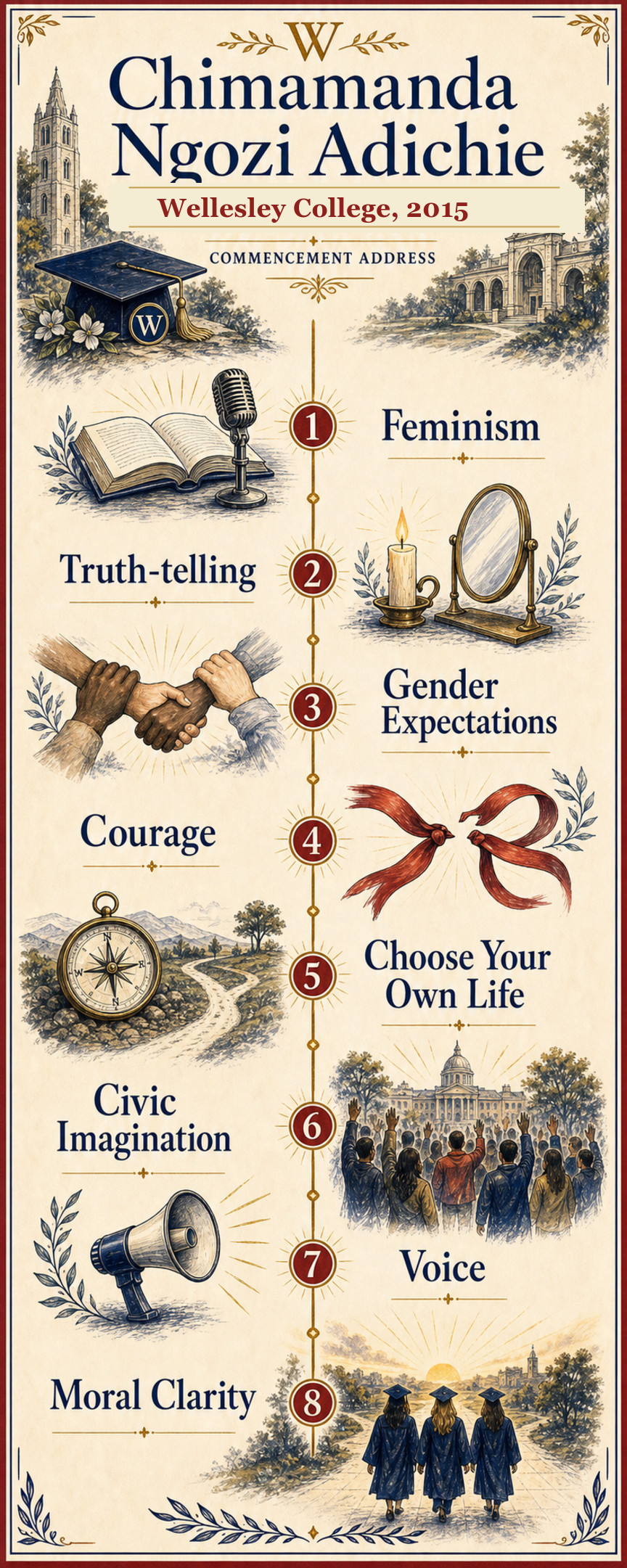
Chimamanda Ngozi Adichie at Wellesley, 2015
A commencement address about feminism as inclusion, privilege, authenticity, gendered expectations, trying anyway, and loving without self-erasure.
Speech arc
- 01Wellesley class
Opening move
- 02Makeup anecdote
Speech beat
- 03Mother's title
Speech beat
- 04Privilege
Speech beat
- 05Leaving medicine
Speech beat
- 06Inclusive feminism
Speech beat
- 07Father kidnapped
Speech beat
- 08Authentic love
Final charge
Persona: Personal stories expose social scripts
Adichie uses stories about appearance, respectability, and family to show how gender expectations enter ordinary life before they become ideology.
Makeup
A small encounter becomes evidence of how quickly authority is read through gender.
Mother
Her mother's title complicates tidy slogans and keeps feminism attached to lived reality.
Voice
The address builds authority through candor rather than distance.
Adichie uses stories about appearance, respectability, and family to show how gender expectations enter ordinary life before they become ideology.
Privilege: Use advantage to imagine a different world
The speech asks graduates to recognize their privilege without guilt paralysis, then convert it into attempts to create the world they want.
Recognize
Privilege is treated as responsibility, not a reason for denial or self-congratulation.
Try
Leaving medical school for writing becomes a model of honest risk.
Create
Graduates are urged to make social change practical through choices and work.
The speech asks graduates to recognize their privilege without guilt paralysis, then convert it into attempts to create the world they want.
Feminism: Make the movement large enough for everyone
Adichie frames feminism as expansive, joyful, and inclusive: a collective project that rejects narrow prescriptions about who belongs.
Party
The movement is imagined as open, crowded, and alive rather than austere or exclusive.
Gender
Freedom requires challenging expectations imposed on women and men.
World
Feminism becomes a way to redesign ordinary institutions and relationships.
Adichie frames feminism as expansive, joyful, and inclusive: a collective project that rejects narrow prescriptions about who belongs.
• Key takeaways •
Privilege carries obligation
Connects to feminism.
Feminism should be expansive
Connects to privilege.
Trying is a moral act
Connects to authenticity.
Authenticity resists scripts
Connects to gender.
Love gives and receives
Connects to perseverance.
Closing charge
The closing advice links grief, love, and selfhood: know what matters, refuse self-erasure, and love by both giving and receiving.
Do not twist yourself to please
Loss
Her father's kidnapping sharpens the speech's sense of what is precious and urgent.
Authenticity
Graduates are told not to contort their lives around other people's comfort.
Love
Love is mutual; it asks graduates to receive care as well as offer it.
The closing advice links grief, love, and selfhood: know what matters, refuse self-erasure, and love by both giving and receiving.
Visual speech maps
Browse more visual maps from Wellesley College or continue with related mapped speeches below.
Transcript
The full transcript is hosted by the original publisher. Commencement Archive links to the source rather than republishing copyrighted text.
Read the full transcript at source →Provenance
Imported from NPR commencement archive; cross-referenced with Open Commencement DB
NPR archive last updated in 2015; destination availability has not been exhaustively rechecked | Open Commencement DB transcript; not independently verified against the original recording
Explore this speech
Find the next thread through the archive
Themes in this address
Speeches like this one
Search all speeches ->