Anne Lamott
Field: letters
Anne Lamott recounts her own meandering path as a college dropout turned writer, arguing that the success and fame the culture promises do not fulfill the spirit. She urges graduates to ignore parental and societal expectations, slow down, resist the endless chase for money and status, and instead seek the truth of their spiritual identity. She advises caring for the poor, defending civil liberties, and finding joy, rest, and humor in life.
Key moments
- 01 Shares her story of dropping out of college and taking odd jobs while writing
- 02 Describes achieving literary success but finding it hollow, like a greyhound catching a fake rabbit
- 03 Names three spiritual truths: live in the now, reap what you sow, and care for the poor
- 04 Encourages rest, laughter, and resisting pressure to constantly prove oneself
Save the visual map
Download or open the generated poster as a standalone PNG.
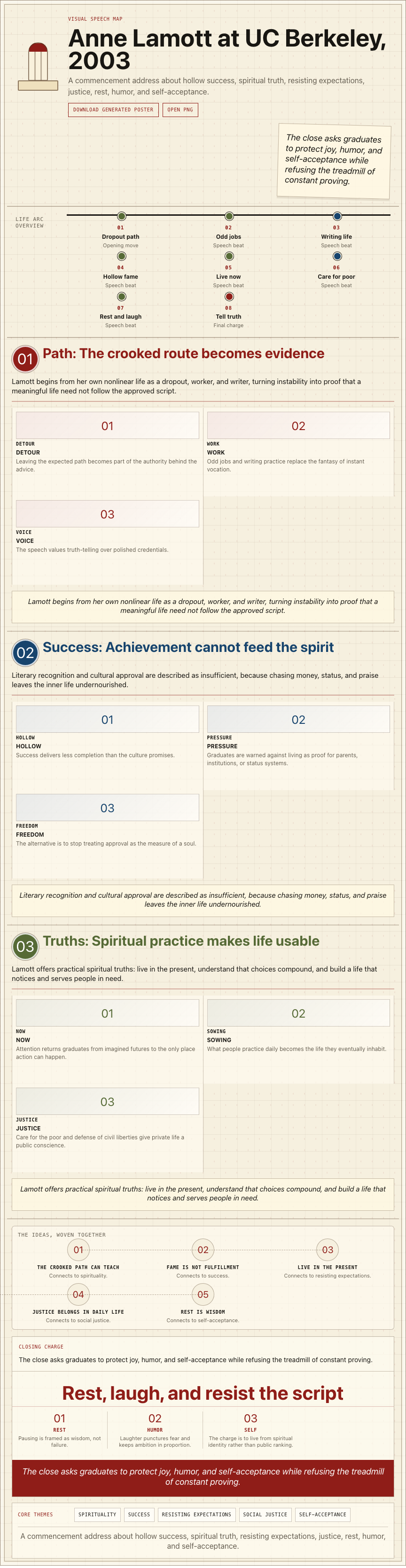
Anne Lamott at UC Berkeley, 2003
A commencement address about hollow success, spiritual truth, resisting expectations, justice, rest, humor, and self-acceptance.
Speech arc
- 01Dropout path
Opening move
- 02Odd jobs
Speech beat
- 03Writing life
Speech beat
- 04Hollow fame
Speech beat
- 05Live now
Speech beat
- 06Care for poor
Speech beat
- 07Rest and laugh
Speech beat
- 08Tell truth
Final charge
Path: The crooked route becomes evidence
Lamott begins from her own nonlinear life as a dropout, worker, and writer, turning instability into proof that a meaningful life need not follow the approved script.
Detour
Leaving the expected path becomes part of the authority behind the advice.
Work
Odd jobs and writing practice replace the fantasy of instant vocation.
Voice
The speech values truth-telling over polished credentials.
Lamott begins from her own nonlinear life as a dropout, worker, and writer, turning instability into proof that a meaningful life need not follow the approved script.
Success: Achievement cannot feed the spirit
Literary recognition and cultural approval are described as insufficient, because chasing money, status, and praise leaves the inner life undernourished.
Hollow
Success delivers less completion than the culture promises.
Pressure
Graduates are warned against living as proof for parents, institutions, or status systems.
Freedom
The alternative is to stop treating approval as the measure of a soul.
Literary recognition and cultural approval are described as insufficient, because chasing money, status, and praise leaves the inner life undernourished.
Truths: Spiritual practice makes life usable
Lamott offers practical spiritual truths: live in the present, understand that choices compound, and build a life that notices and serves people in need.
Now
Attention returns graduates from imagined futures to the only place action can happen.
Sowing
What people practice daily becomes the life they eventually inhabit.
Justice
Care for the poor and defense of civil liberties give private life a public conscience.
Lamott offers practical spiritual truths: live in the present, understand that choices compound, and build a life that notices and serves people in need.
• Key takeaways •
The crooked path can teach
Connects to spirituality.
Fame is not fulfillment
Connects to success.
Live in the present
Connects to resisting expectations.
Justice belongs in daily life
Connects to social justice.
Rest is wisdom
Connects to self-acceptance.
Closing charge
The close asks graduates to protect joy, humor, and self-acceptance while refusing the treadmill of constant proving.
Rest, laugh, and resist the script
Rest
Pausing is framed as wisdom, not failure.
Humor
Laughter punctures fear and keeps ambition in proportion.
Self
The charge is to live from spiritual identity rather than public ranking.
The close asks graduates to protect joy, humor, and self-acceptance while refusing the treadmill of constant proving.
Visual speech maps
Browse more visual maps from University of California, Berkeley or continue with related mapped speeches below.
Transcript
The full transcript is hosted by the original publisher. Commencement Archive links to the source rather than republishing copyrighted text.
Read the full transcript at source →Provenance
Imported from NPR commencement archive; cross-referenced with Open Commencement DB
NPR archive last updated in 2015; destination availability has not been exhaustively rechecked | Open Commencement DB transcript; not independently verified against the original recording
Explore this speech
Find the next thread through the archive
Themes in this address
Speeches like this one
Search all speeches ->