Arianna Huffington
Field: letters
Arianna Huffington urges Vassar's Class of 2015 to cultivate three relationships: with technology, with themselves, and with the world. She warns against addiction to devices and multitasking, advocating digital detoxes and self-reflection rooted in the ideas of 'Know Thyself' and the examined life. She also calls graduates to address growing inequality and to pursue solutions-oriented journalism and meaningful priorities over external markers of success.
Key moments
- 01 Calling for digital boundaries and detoxes from constant connectivity
- 02 Stressing the relationship with oneself as the most important relationship
- 03 Citing studies on smartphone addiction and inability to be alone with one's thoughts
- 04 Highlighting growing inequality and the need for wisdom and solutions-focused journalism
- 05 Using the acorn symbol and 'Memento Mori' to put life and success in perspective
Save the visual map
Download or open the generated poster as a standalone PNG.
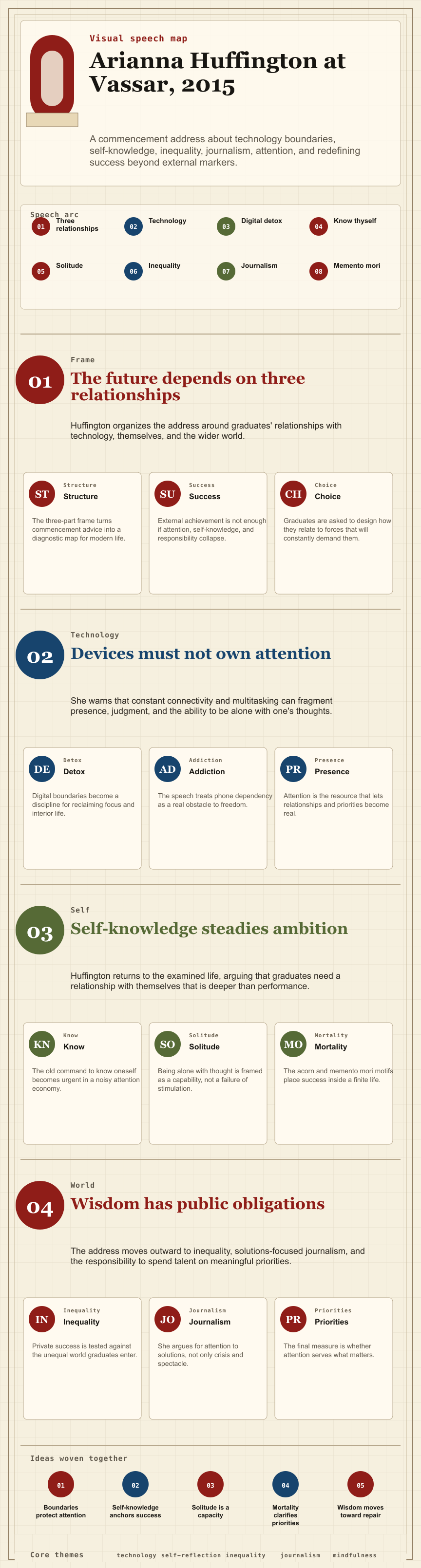
Arianna Huffington at Vassar, 2015
A commencement address about technology boundaries, self-knowledge, inequality, journalism, attention, and redefining success beyond external markers.
Speech arc
- 01Three relationships
Opening move
- 02Technology
Speech beat
- 03Digital detox
Speech beat
- 04Know thyself
Speech beat
- 05Solitude
Speech beat
- 06Inequality
Speech beat
- 07Journalism
Speech beat
- 08Memento mori
Final charge
Frame: The future depends on three relationships
Huffington organizes the address around graduates' relationships with technology, themselves, and the wider world.
Structure
The three-part frame turns commencement advice into a diagnostic map for modern life.
Success
External achievement is not enough if attention, self-knowledge, and responsibility collapse.
Choice
Graduates are asked to design how they relate to forces that will constantly demand them.
Huffington organizes the address around graduates' relationships with technology, themselves, and the wider world.
Technology: Devices must not own attention
She warns that constant connectivity and multitasking can fragment presence, judgment, and the ability to be alone with one's thoughts.
Detox
Digital boundaries become a discipline for reclaiming focus and interior life.
Addiction
The speech treats phone dependency as a real obstacle to freedom.
Presence
Attention is the resource that lets relationships and priorities become real.
She warns that constant connectivity and multitasking can fragment presence, judgment, and the ability to be alone with one's thoughts.
Self: Self-knowledge steadies ambition
Huffington returns to the examined life, arguing that graduates need a relationship with themselves that is deeper than performance.
Know
The old command to know oneself becomes urgent in a noisy attention economy.
Solitude
Being alone with thought is framed as a capability, not a failure of stimulation.
Mortality
The acorn and memento mori motifs place success inside a finite life.
Huffington returns to the examined life, arguing that graduates need a relationship with themselves that is deeper than performance.
• Key takeaways •
Boundaries protect attention
Connects to technology.
Self-knowledge anchors success
Connects to self-reflection.
Solitude is a capacity
Connects to inequality.
Mortality clarifies priorities
Connects to journalism.
Wisdom moves toward repair
Connects to mindfulness.
Closing charge
The address moves outward to inequality, solutions-focused journalism, and the responsibility to spend talent on meaningful priorities.
Wisdom has public obligations
Inequality
Private success is tested against the unequal world graduates enter.
Journalism
She argues for attention to solutions, not only crisis and spectacle.
Priorities
The final measure is whether attention serves what matters.
The address moves outward to inequality, solutions-focused journalism, and the responsibility to spend talent on meaningful priorities.
Visual speech maps
Browse more visual maps from Vassar College or continue with related mapped speeches below.
Transcript
The full transcript is hosted by the original publisher. Commencement Archive links to the source rather than republishing copyrighted text.
Read the full transcript at source →Provenance
Imported from NPR commencement archive; cross-referenced with Open Commencement DB
NPR archive last updated in 2015; destination availability has not been exhaustively rechecked | Open Commencement DB transcript; not independently verified against the original recording
Explore this speech
Find the next thread through the archive
Themes in this address
Speeches like this one
Search all speeches ->