Bernard Harris
Field: science
Bernard Harris, a physician-astronaut and WPI trustee, recounts his journey from a poor, broken home in Houston to growing up on the Navajo Nation, discovering his talents in science and space, and eventually becoming a NASA astronaut. He describes the lessons he learned along the way—raising expectations, pursuing personal passion rather than others' expectations, and treating failure as a chance to grow—and vividly narrates what it feels like to launch into space and perform a spacewalk.
Key moments
- 01 Reflecting on growing up poor and moving to the Navajo Nation, where he discovered his talents and love of exploring
- 02 Learning to raise his expectations after a childhood conversation with his friend about money
- 03 Being rejected by NASA in 1987, then reapplying and being selected first in his class in 1990
- 04 Describing the physical experience of shuttle launch, zero gravity, and a 350-pound-suit spacewalk viewing Earth
Save the visual map
Download or open the generated poster as a standalone PNG.
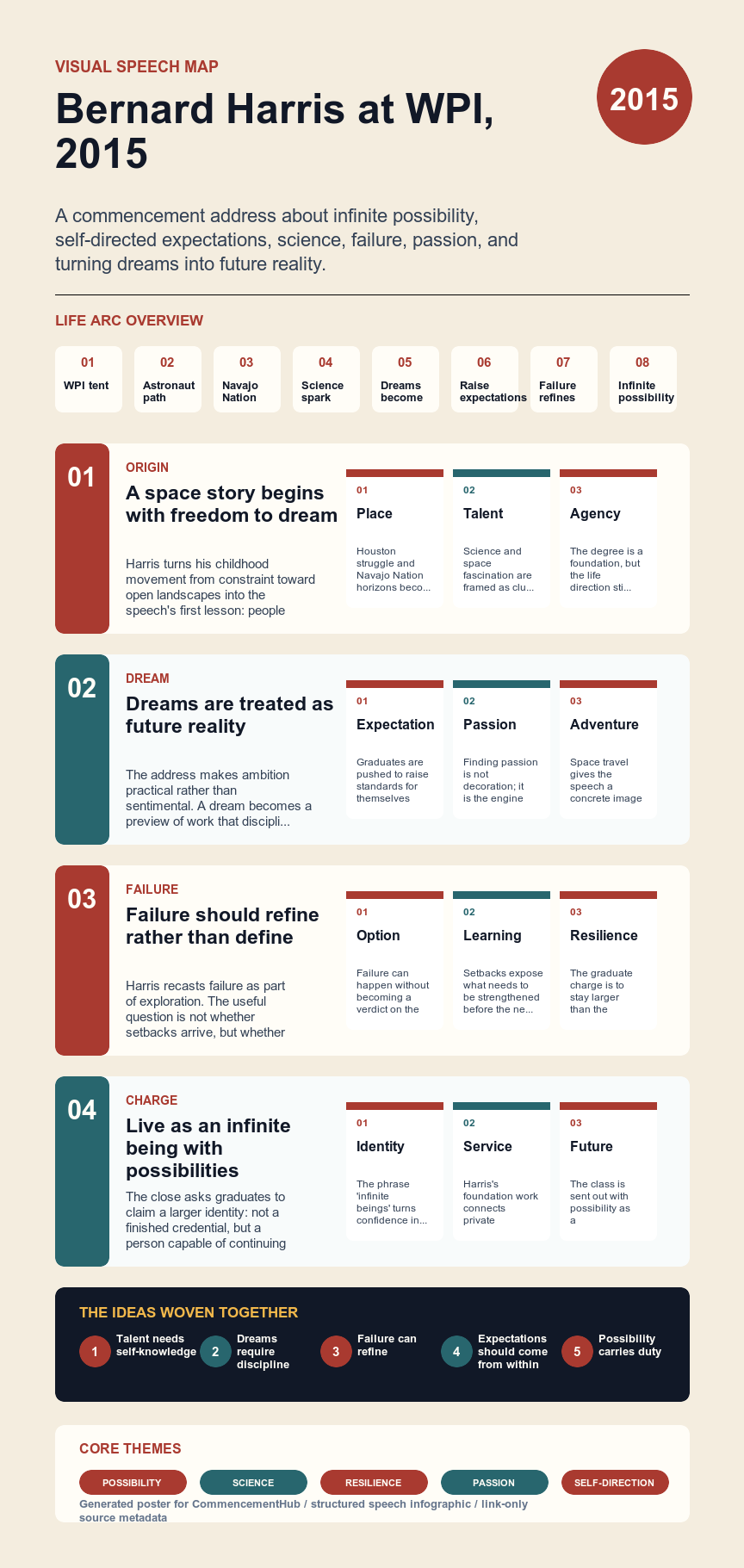
Bernard Harris at WPI, 2015
A commencement address about infinite possibility, self-directed expectations, science, failure, passion, and turning dreams into future reality.
Speech arc
- 01WPI tent
Opening move
- 02Astronaut path
Speech beat
- 03Navajo Nation
Speech beat
- 04Science spark
Speech beat
- 05Dreams become real
Speech beat
- 06Raise expectations
Speech beat
- 07Failure refines
Speech beat
- 08Infinite possibility
Final charge
Origin: A space story begins with freedom to dream
Harris turns his childhood movement from constraint toward open landscapes into the speech's first lesson: people need room to discover their own talents and ambitions.
Place
Houston struggle and Navajo Nation horizons become a contrast between limitation and possibility.
Talent
Science and space fascination are framed as clues graduates should learn to notice in themselves.
Agency
The degree is a foundation, but the life direction still has to be chosen from within.
Harris turns his childhood movement from constraint toward open landscapes into the speech's first lesson: people need room to discover their own talents and ambitions.
Dream: Dreams are treated as future reality
The address makes ambition practical rather than sentimental. A dream becomes a preview of work that discipline can eventually make visible.
Expectation
Graduates are pushed to raise standards for themselves instead of borrowing someone else's script.
Passion
Finding passion is not decoration; it is the engine that keeps hard work coherent.
Adventure
Space travel gives the speech a concrete image for impossible things becoming operational tasks.
The address makes ambition practical rather than sentimental.
A dream becomes a preview of work that discipline can eventually make visible.
Failure: Failure should refine rather than define
Harris recasts failure as part of exploration. The useful question is not whether setbacks arrive, but whether they become evidence for quitting or material for growth.
Option
Failure can happen without becoming a verdict on the whole person.
Learning
Setbacks expose what needs to be strengthened before the next attempt.
Resilience
The graduate charge is to stay larger than the temporary result.
Harris recasts failure as part of exploration.
The useful question is not whether setbacks arrive, but whether they become evidence for quitting or material for growth.
• Key takeaways •
Talent needs self-knowledge
Connects to possibility.
Dreams require discipline
Connects to science.
Failure can refine
Connects to resilience.
Expectations should come from within
Connects to passion.
Possibility carries duty
Connects to self-direction.
Closing charge
The close asks graduates to claim a larger identity: not a finished credential, but a person capable of continuing discovery, service, and reinvention.
Live as an infinite being with possibilities
Identity
The phrase 'infinite beings' turns confidence into a repeated public commitment.
Service
Harris's foundation work connects private achievement to widening opportunity for others.
Future
The class is sent out with possibility as a responsibility, not only a feeling.
The close asks graduates to claim a larger identity: not a finished credential, but a person capable of continuing discovery, service, and reinvention.
Visual speech maps
Browse more visual maps from Worcester Polytechnic Institute or continue with related mapped speeches below.
Transcript
The previously catalogued transcript link is no longer live and is queued for re-sourcing. A video of the address is available above.
Machine transcript available for archive analysis; it is unverified and may contain transcription errors. Machine transcript source ->
Provenance
BROKEN transcript link (checked 2026-06-26): returns 404 Not Found. Provenance: Imported from NPR commencement archive; cross-referenced with Open Commencement DB
NPR archive last updated in 2015; destination availability has not been exhaustively rechecked | Open Commencement DB transcript; not independently verified against the original recording | Transcript URL dead (returns 404 Not Found); video fallback present
Explore this speech
Find the next thread through the archive
Themes in this address
Speeches like this one
Search all speeches ->