Ronan Farrow
Field: letters
Ronan Farrow argues that the qualities often criticized in young people—impatience, risk-taking, disobedience, and a resistance to arbitrary rules—are in fact strengths suited to periods of change. Drawing on neuroscience about the developing young brain and on his experiences with young people in Sudan, Tunisia, and the broader Arab Spring, he contends that youth have driven major political and economic change. He urges graduates facing a difficult economy to embrace risk, impatience, and diverse pursuits, and to keep challenging broken norms to solve inherited global problems.
Key moments
- 01 Anecdote about arguing over cell phone rules with a fellow passenger named Judith
- 02 Neuroscience of the young brain rewiring itself and favoring recklessness for adaptation
- 03 Stories of a Sudanese child soldier and a young Tunisian musician's protest song
- 04 Argument that youthful risk-taking and impatience fuel entrepreneurship amid economic crisis
- 05 Call to keep trailblazing and confront inherited global challenges
Save the visual map
Download or open the generated poster as a standalone PNG.
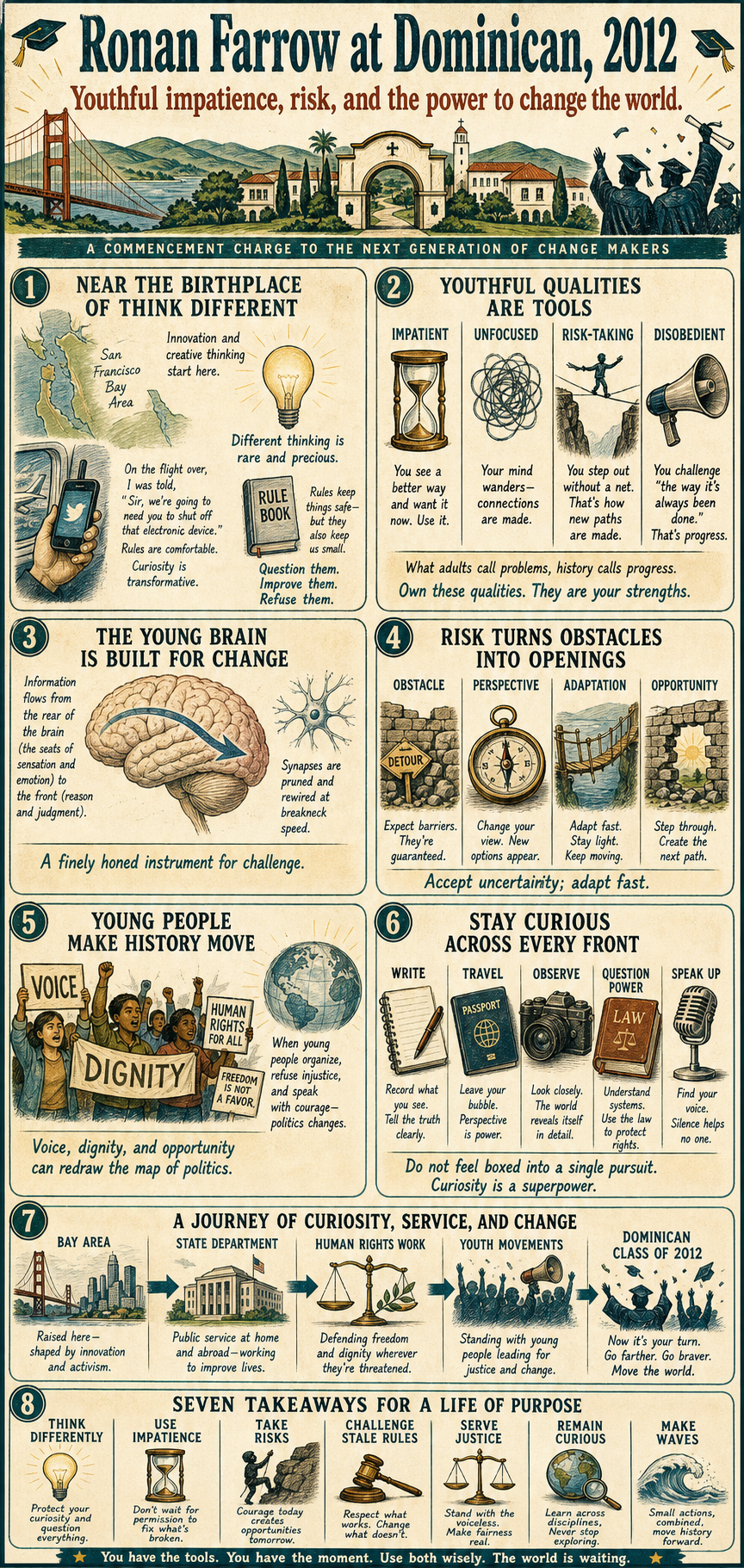
Ronan Farrow at Dominican, 2012
A Dominican University address about youth, impatience, risk, curiosity, justice, and using difference as a force for change.
Speech arc
- 01Dominican University
Opening move
- 02Class of 2012
Speech beat
- 03Think different
Speech beat
- 04Youthful impatience
Speech beat
- 05Risk
Speech beat
- 06Curiosity
Speech beat
- 07Human rights
Speech beat
- 08Change makers
Final charge
Difference: Different thinking is a civic resource
Farrow places the speech near the Bay Area’s culture of invention and treats unconventional thinking as the engine of social progress.
Setting
The Bay Area becomes a symbol for questioning stale assumptions.
Rules
Rules can protect people, but they can also preserve small thinking.
Curiosity
Questioning is framed as a public good, not a personality quirk.
Farrow places the speech near the Bay Area’s culture of invention and treats unconventional thinking as the engine of social progress.
Youth: Youthful traits can become tools
The address reframes impatience, scattered energy, risk-taking, and disobedience as strengths when they are aimed at meaningful problems.
Impatience
Urgency can break through complacency.
Restlessness
A wandering mind can connect fields that institutions keep apart.
Disobedience
Progress often begins when someone refuses an unjust normal.
The address reframes impatience, scattered energy, risk-taking, and disobedience as strengths when they are aimed at meaningful problems.
Risk: Risk creates openings where certainty cannot
Farrow urges graduates to accept uncertainty, adapt quickly, and let obstacles become routes toward new work.
Obstacle
The barrier is not always the end of the path.
Adaptation
The young brain is cast as a tool for rapid change.
Opportunity
Risk is valuable when it serves larger goals than ego.
Farrow urges graduates to accept uncertainty, adapt quickly, and let obstacles become routes toward new work.
• Key takeaways •
Think differently
Connects to youth.
Use impatience well
Connects to risk.
Take risks for purpose
Connects to curiosity.
Question stale rules
Connects to human-rights.
Aim curiosity at justice
Connects to change.
Closing charge
The speech links personal courage to public change, arguing that young people’s voice, organizing, and moral energy can redraw politics.
Young people can make history move
Voice
Silence protects broken systems; speech makes claims visible.
Rights
Human dignity is the recurring measure behind the address.
Service
Curiosity and courage are pointed toward justice, not only self-expression.
The speech links personal courage to public change, arguing that young people’s voice, organizing, and moral energy can redraw politics.
Visual speech maps
Browse more visual maps from Dominican University of California or continue with related mapped speeches below.
Transcript
The previously catalogued transcript link is no longer live and is queued for re-sourcing. A video of the address is available above.
Machine transcript available for archive analysis; it is unverified and may contain transcription errors. Machine transcript source ->
Provenance
BROKEN transcript link (checked 2026-06-26): gradspeeches.com is a parked/redirecting domain serving no real content. Provenance: Imported from NPR commencement archive; cross-referenced with Open Commencement DB
NPR archive last updated in 2015; destination availability has not been exhaustively rechecked | Open Commencement DB transcript; not independently verified against the original recording | Transcript URL dead (gradspeeches.com is a parked/redirecting domain serving no real content); video fallback present
Explore this speech
Find the next thread through the archive
Themes in this address
Speeches like this one
Search all speeches ->